Online store terms of sale: what is mandatory, how they differ from terms of use, and a template (Benin)
G. CHRIST
Published on November 2, 2026

A customer orders a dress from your online store, pays with Mobile Money, receives it three days later… and messages you on WhatsApp saying she wants to send it back. Can you refuse? Do you have to refund the delivery fee? Within how many days? If you are not sure, the problem is not your customer service. Your website is missing a page: your terms and conditions of sale.
Terms of sale are often the last thing people think about when they launch an online shop. Someone copies a French or American template, swaps in the company name and never looks at it again. That is a mistake. A copied template talks about euros, consumer mediators and a 14-calendar-day return window, while Benin's Digital Code says something different. And on the day of a dispute, that text is what counts.
At Guelichweb we build websites and online stores for SMEs, NGOs and public institutions in Benin and French-speaking Africa. This guide explains what terms of sale are, how they differ from terms of use, what Beninese law actually requires (with article numbers), how to adapt them to Mobile Money and WhatsApp sales, and gives you a template outline to fill in. It is not a substitute for a lawyer, but it will help you avoid the most common mistakes.
In short: if you sell online to consumers, your terms of sale must be available before the order is placed, or the contract can be declared void in Benin. It is not a page you add "to look professional". It is part of the contract.
Terms of sale, terms of use, legal notice: who does what?
Three documents keep coming up, and many websites lump them into one catch-all page.
- Terms and conditions of sale (in French, CGV) govern the sale itself: prices, payment, delivery, returns, warranties, complaints. Every business that sells a product or a service online needs them.
- Terms of use (CGU) govern how people use the site: accounts, user-generated content, forbidden behaviour, the publisher's liability. They are usually not mandatory, but they become very useful once you have accounts, a members' area or reviews (France Num explains the difference well, in French).
- The legal notice says who is behind the website (publisher, contact details, company registration, hosting provider). We covered it in our guide to the website legal notice and privacy policy.
A brochure website that sells nothing does not need terms of sale. It needs a legal notice, a privacy policy if it collects any data (a simple contact form is enough to trigger that), and possibly terms of use. As soon as you take payment online or accept firm orders on the site, terms of sale become essential. If you sell both products and services (training courses, for example), one document with clearly separated sections is fine, as long as it stays readable.
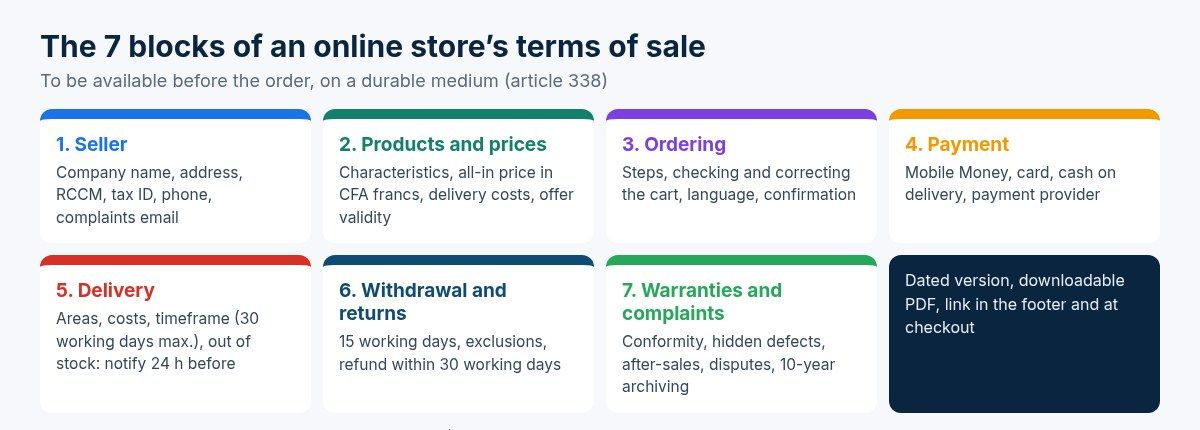
Guelichweb diagram: the blocks to include in an online store's terms of sale.
Are terms of sale mandatory in Benin?
Yes, as soon as you sell online. Law No. 2017-20 on the Digital Code, in Book IV on electronic commerce, is very clear. Article 338 requires every online seller of goods or services, "on pain of nullity", to provide before the contract is concluded "easy, direct and permanent access on a durable medium" to the contractual terms, in a way that lets the customer reproduce and keep them.
In practice, a line saying "terms available on request" is not enough. Customers must be able to read, download or save your terms before they pay. A web page linked from the footer and the cart, with a downloadable PDF version, meets that requirement.
Two more articles complete the picture. Article 339 covers product information (essential and technical characteristics, instructions for use, safety and health warnings, compatibility for digital content). Article 340 covers price: the all-taxes-included price, whether delivery is included, how long the offer is valid, payment methods, the billing currency and any other cost the customer will have to pay.
Finally, article 341 puts the burden of proof on you, the seller. You must be able to show that the customer was informed and agreed. An "I have read and accept the terms of sale" checkbox, a time-stamped confirmation email and a copy of the version of the terms in force on the day of the order are therefore not details. They are your evidence.
A fair warning: we are quoting the text published by APDP, Benin's data protection authority, in its 2018 version. The Code was amended by Law No. 2020-35, which mainly affects other books. For a high-stakes project, have a lawyer check the consolidated version.
What your terms of sale must contain (the Digital Code list)
Article 338 lists twenty-four items. Rather than copying them out, here is how we group them when we build an online store for a client. The numbers in brackets refer to the items of article 338, or to another article when stated.
1. Who is selling
Name or company name, postal address, phone number and email address for complaints (item 15), company registration (RCCM) and tax number (IFU). This information is already in your legal notice: repeat it at the top of the terms or link to it clearly.
2. How ordering works
The steps to follow (item 1), the language of the contract (item 2), how to correct an input error before confirming (item 4), how the order is confirmed (item 5) and what happens if it is not (item 6). If you require parental consent for minors, say so (item 7).
3. Price and payment
All-taxes-included prices in CFA francs, delivery costs, how long promotions last, accepted payment methods (MTN MoMo, Moov Money, Celtiis Cash, card, cash on delivery) and any instalment options (article 340). If you use a payment gateway such as FedaPay or KKiaPay, say so: the gateway processes the payment. Our article on Mobile Money payment gateways compares them.
4. Delivery
Areas served, costs, the delivery date you commit to (items 11 and 12), and what happens if you are late or deliver the wrong thing (item 13). Note that unless otherwise agreed, article 356 gives you a maximum of thirty working days after the order to fulfil it. Beyond that, the customer can cancel the contract outright. If an item is out of stock, you must tell the buyer at least twenty-four hours before the planned delivery date and refund them in full where applicable (article 345).
5. Withdrawal, returns, exchanges
Whether a right of withdrawal exists and how it works (item 17), and how returns, exchanges and refunds are handled (item 18). This is the part copied templates get wrong most often; more on that below.
6. Warranties and after-sales service
Statutory warranties of conformity, against hidden defects and against eviction (item 21), any commercial warranty you offer (item 20), and after-sales service (item 19).
7. Complaints, data, archiving
How complaints are handled (item 14), any out-of-court dispute options (item 16), a link to your privacy policy (item 3), and how the customer can access the archived contract (item 22). Article 346 requires you to keep every electronic contract for ten years from delivery. Your platform must therefore keep the full order history, not just the last six months.
Right of withdrawal: 15 working days, not 14 days
This is the mistake we see most often. French templates say 14 days. In Benin, article 348 of the Digital Code gives consumers fifteen working days to withdraw, with no reason needed and no cost other than the direct cost of sending the item back. The period starts the day after the goods are received, or the day after the order for a service.
The painful part: if you did not provide the prior information required by articles 338 to 340, that period becomes ninety days. Missing or incomplete terms do not protect you. They extend the time during which a customer can return an order.
Other rules your terms should reflect:
- The customer returns the item at their own cost within fourteen working days (article 350). You may refuse the return if the item lost value through handling beyond simple trying out.
- You refund everything you received within thirty working days at most, counted from receipt of the returned item (article 351). If you are late, the amount bears interest at the legal rate.
- Delivery costs are refunded only if the withdrawal is caused by your delay or failure (article 352).
- The refund uses the same payment method as the purchase unless the customer expressly agrees otherwise (article 353). A Mobile Money payment is refunded by Mobile Money, at no cost to the customer.
Some products are excluded from the right of withdrawal (article 355): made-to-measure or personalised items, food and perishable goods, items that cannot be sent back without deteriorating, hygiene products that have been unsealed, downloaded audio or video content, newspapers and magazines, and purchases at public auctions. For services, the right ends once the service has been fully provided; if the customer wants the service to start before the period ends, get their express agreement in writing (article 354).
These rules apply to sales to consumers (article 347). If you only sell to businesses, your terms can say something different, but state clearly that the site is for professional buyers only.
The ordering process itself must comply
Good terms are not enough if the checkout contradicts them. Article 343 requires buyers to be able to check the details of their order, correct it and stop before confirming. Article 344 requires you to acknowledge the order without undue delay, with the invoice or proof of payment, a detailed summary, and the date and time.
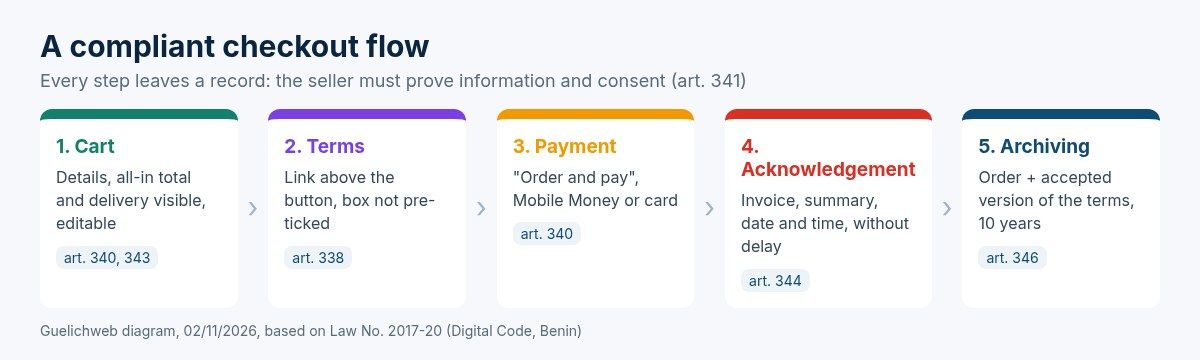
Guelichweb diagram: a checkout flow that follows articles 338 to 346 of the Digital Code.
On a well-built store, this means:
- an editable cart summary showing the all-taxes-included total and delivery costs before payment;
- a link to the terms just above the payment button, and an "I accept the terms of sale" checkbox that is not ticked by default;
- a button whose label makes it clear that clicking means paying ("Order and pay" rather than "Continue");
- an automatic confirmation by email or WhatsApp with the order number, details, amount, date, time and payment reference;
- the accepted version of the terms stored with the order.
That last point is often forgotten. If you change your terms in March, an order placed in January is still governed by the January version. Date every version and keep the old ones.
Selling on WhatsApp, Facebook or Instagram: terms still matter
A large share of online commerce in Benin still runs through WhatsApp and social media, with no cart and no checkbox. The Digital Code applies to every "online supplier of goods or services", and nothing suggests that a sale concluded by messaging is exempt. Our advice:
- publish your terms on a simple web page (even a one-page site is enough) and put the link in your WhatsApp Business profile, your catalogue and your quick replies;
- send the link before asking for payment, together with a written summary: item, price, delivery cost, delivery time;
- confirm the order in writing once payment is received, with the date and time. A screenshot of the chat is weak evidence;
- when volume grows, automate those steps. A WhatsApp chatbot can send the summary, the link to the terms and the confirmation without forgetting anything.
What if you sell in Senegal, Côte d'Ivoire or France?
The principle is the same everywhere: inform before the order, let the buyer check and correct, confirm afterwards. The details change.
- Senegal: Law No. 2008-08 on electronic transactions requires contractual terms to be made available in a way that allows them to be stored and reproduced. Its implementing decree No. 2008-718 sets a list of mandatory information and a withdrawal period of seven working days.
- Côte d'Ivoire: Law No. 2013-546 on electronic transactions sets the same obligation for accessible, storable and reproducible contractual terms, with order verification before confirmation.
- France: the withdrawal period is 14 days, failing to provide terms of sale to consumers can lead to a fine of up to €15,000, and since 19 June 2026 websites must offer an online withdrawal function (Service Public Entreprendre on terms of sale and on e-commerce rules, in French).
If you deliver to several countries, do not pick the shortest period for convenience. Apply at least the rule of your customer's country, or offer the longest period to everyone: it is easier to manage and it is a selling point.
Template outline for an online store's terms of sale in Benin
Here is the structure we use as a starting point. Replace the brackets with your real details. This is not a ready-made legal text: adapt it to your products and have it reviewed.
- Purpose and scope: "These terms govern sales concluded on [website address] between [company name] and any person making a purchase. Version dated [date]."
- Seller identification: [company name, legal form, address, RCCM, IFU, phone, complaints email].
- Products: "The essential characteristics of each product are shown on its product page. Photos are not contractual within the limits of [detail]."
- Prices: "Prices are shown in CFA francs, all taxes included, excluding delivery, unless stated otherwise. Promotions are valid until the date shown."
- Ordering: steps, cart check, acceptance of the terms, confirmation by email or WhatsApp, language of the contract (French, with an English translation if you offer one).
- Payment: [accepted methods], payment provider, when the account is debited, cash on delivery if applicable.
- Delivery: areas, costs, timeframes, in-store pickup, what to do if a parcel arrives damaged.
- Unavailability: notice at least 24 hours before the planned delivery and a full refund.
- Right of withdrawal: 15 working days, starting point, notification address, return within 14 working days at the customer's cost, refund within 30 working days by the same payment method, list of exclusions.
- Warranties: conformity (report within 15 working days, article 359), hidden defects, any commercial warranty.
- Complaints and disputes: channel, response time, attempt at an amicable solution, governing law (Beninese) and competent court.
- Personal data: link to the privacy policy.
- Archiving and evidence: orders kept for ten years, customer access to their order.
If many of your customers are English speakers (from Nigeria or Ghana, for example), offer an English translation and state which version prevails in case of disagreement.
The 8 mistakes we see most often
- A French template copied as is, with euros, a consumer mediator and 14 calendar days.
- Terms only available after payment, in the confirmation email.
- A pre-ticked "I accept" box, which proves no consent at all.
- "No returns, no exchanges" applied to every product, when the law grants a right of withdrawal outside the listed exceptions.
- Delivery costs revealed only at the last step.
- No version date, so nobody knows which terms applied to an order.
- Terms that contradict product pages (delivery times, returns, warranties).
- A store that deletes its order history after a few months, when the retention period is ten years.
Free terms of sale generators: good idea or not?
Free generators are handy for getting a first structure. The problem is that almost all of them are built for French, UK or US law. Use them as a checklist of headings, never as the final text. The same goes for the default terms offered by Shopify, WooCommerce or Wix: they are examples to rewrite.
Artificial intelligence can help rewrite a text in plain language. It does not always know Benin's Digital Code and may invent articles. Check every figure and every reference against the official text.
Where should your terms of sale appear on the site?
- in the footer of every page, next to the legal notice and privacy policy;
- in the cart and at the payment step, just above the confirm button;
- as a downloadable PDF (the durable medium required by article 338);
- as a link in the order confirmation email or message;
- in your WhatsApp Business profile and catalogue if you also sell by messaging.
If you are launching your store, our guide on how to create an online store in Benin covers the other steps, and our website requirements document template helps you include the legal pages and the checkout flow in your quote request.
FAQ
Are terms of sale mandatory for a brochure website?
No. Without sales or online payment, you need a legal notice and a privacy policy if you collect data. Terms of sale become necessary as soon as you sell on the site.
What is the difference between terms of use and terms of sale?
Terms of use set the rules for using the site (accounts, content, behaviour). Terms of sale set the rules of the sale (price, payment, delivery, returns, warranties). An online store with customer accounts usually needs both.
What is the withdrawal period for online purchases in Benin?
Fifteen working days under article 348 of the Digital Code, extended to ninety days if the seller did not provide the mandatory prior information.
Can I write "no returns, no exchanges" in my terms?
For consumer sales, only for the products excluded by article 355 (made-to-measure, perishable, unsealed hygiene products and so on). For everything else, the right of withdrawal applies.
Do my terms have to be in French?
The Code requires you to state the languages offered for concluding the contract. For customers in Benin, French is the obvious choice; an English version is a plus if you sell abroad.
How long must I keep orders?
Ten years from delivery of the goods or provision of the service (article 346).
Want an online store that complies from day one?
At Guelichweb we build the legal pages, the checkout flow, automatic confirmations and archiving into the design from the start, instead of bolting them on later. Pricing depends on your catalogue, your payment methods and your automations, so we set it after a diagnostic, as explained on our offers page. You can also browse our services.
Running an online store whose terms came from a copied template? Contact us: we will review your checkout and tell you what needs fixing.
Sources: Digital Code, Law No. 2017-20 (text published by APDP); ACED guide to the texts on online commerce in Benin (2024, in French); Service Public Entreprendre on terms of sale; Conso.gouv on mandatory online information.