Website legal notice and privacy policy: what is mandatory (Benin, French-speaking Africa, France) + template
G. CHRIST
Published on November 1, 2026

At the very bottom of almost every website there is a small row of links nobody reads: "Legal notice", "Privacy", "Terms", "Cookies". On many of the business and NGO websites we audit, those links lead to an empty page, to a text copied from a French site that talks about the CNIL to a small business in Cotonou, or to a template that still says "[YOUR COMPANY NAME]".
You could call that a detail. We don't. These pages are often the first ones a serious partner reads before signing, a donor before funding, or a cautious customer before paying online. And depending on your country and your activity, some of them are simply required by law.
At Guelichweb, we build websites and automations for SMEs, NGOs and institutions in Benin and across French-speaking Africa. This guide explains, without jargon, what a legal notice and a privacy policy are, what is mandatory in Benin, in France and in a few neighbouring countries, what each page must contain, and the mistakes we fix most often. It ends with a checklist and sample paragraphs you can adapt.
Important: this article is a practical guide, not legal advice. For a regulated activity (health, finance, education, security…) or sensitive data processing, have your texts reviewed by a lawyer or check directly with the data protection authority of your country.
Legal notice, privacy policy, terms, cookies: four pages, four jobs
The confusion comes from filing everything under "legal pages". In reality, each page answers a different question from the visitor:
- Legal notice (in French, "mentions légales"): "Who is behind this website?" The publisher's identity, contact details, registration numbers, the person responsible for publication, and the hosting provider.
- Privacy policy: "What do you do with my data?" What you collect, why, who sees it, how long you keep it, and how people can exercise their rights.
- Cookie policy: "What is tracking me while I browse?" The trackers used (analytics, advertising, embedded videos) and how to accept or refuse them.
- Terms of use / terms of sale: "What are the rules?" Conditions for using the site and, for a site that sells, prices, payment, delivery, returns and guarantees.
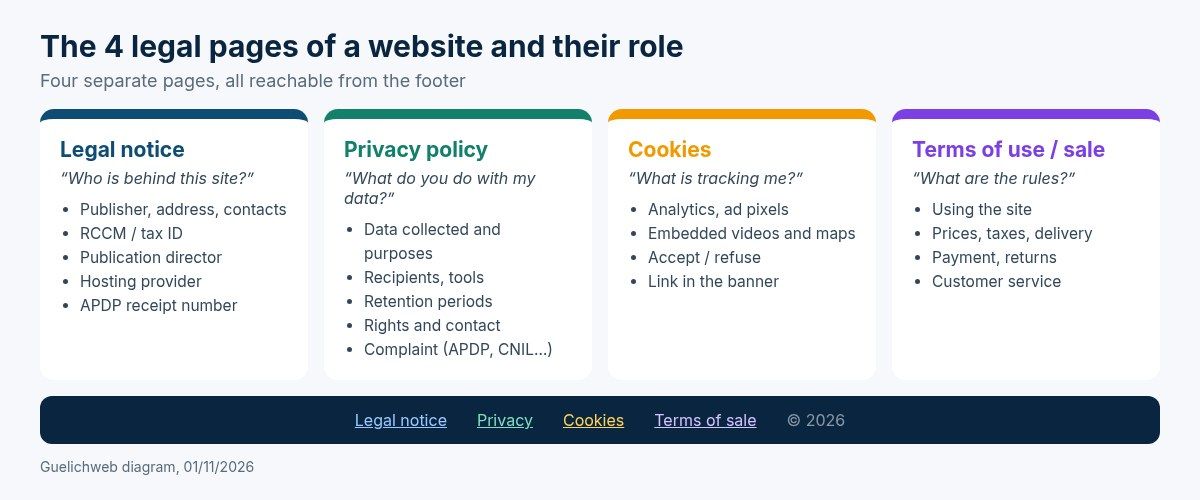
Guelichweb diagram, 01/11/2026: the four legal pages and the question each one answers.
France's data protection authority, the CNIL, says it clearly: the legal notice must be distinguished from the information about personal data (CNIL source, in French). And the privacy policy must be separate from the terms of sale and terms of use (CNIL, information and transparency). Merging everything into one catch-all page is the most common mistake, and it makes every piece of information harder to find.
For a simple showcase website, you need at least the first two. The cookie page becomes necessary as soon as you use analytics, advertising pixels or embedded content that sets trackers; we covered that in our article on cookies and the consent banner. Terms of sale become essential as soon as you sell online.
Is it mandatory? It depends on your country and your activity
The honest answer is: in the vast majority of cases, yes, at least in part. But the laws are not the same everywhere, and this is exactly where templates copied from the Internet mislead people.
In Benin: the Digital Code and the APDP
The reference text is Law No. 2017-20 of 20 April 2018 on the Digital Code of the Republic of Benin, amended by Law No. 2020-35 of 6 January 2021 (text on the APDP website). Two parts directly concern your website:
- Book IV, on electronic commerce. Anyone carrying out e-commerce in Benin, or aimed at users in Benin, must give easy, direct and permanent access to their identity (name or company name), full address, email and phone number and, where relevant, their trade register (RCCM) number, share capital, tax number, authorisation reference or professional body. Displayed prices must be clear, stating whether taxes and delivery are included.
- Book V, on personal data protection. As soon as your site collects data (contact form, newsletter, sign-up, payment), you are a "data controller". You must complete the prior formalities with the APDP (declaration or authorisation depending on the case, Articles 405 and 407, unless exempted under Article 410), inform people at the latest when the data is collected (Article 415) and protect the data (Articles 425 and 426).
Benin's Personal Data Protection Authority (APDP) even publishes a legal notice template) (in French) with a paragraph titled "Declaration to the APDP", where you write the receipt number obtained after your declaration. That detail speaks volumes: for the Beninese authority, this number belongs on your website.
Our practical reading: a showcase website that only presents a business, without selling, may not fall under every case covered by Book IV. But as soon as it has a contact form, it collects personal data and Book V applies. In other words, almost every professional website in Benin is concerned.
In France and for a European audience: LCEN and GDPR
In France, the Law for Confidence in the Digital Economy of 21 June 2004 (LCEN) requires every website to identify its publisher and its host. Since the SREN Law of 21 May 2024, this obligation sits in Article 1-1 of the LCEN (older templates still cite Article 6 III). The French public service website lists the expected details and the penalties: fines of up to €75,000 for a sole trader and €375,000 for a company (Service Public Entreprendre).
For data, the GDPR applies. A point people often miss: it doesn't only concern organisations based in Europe. An African organisation that targets people located in the European Union (diaspora, customers, donors, partners) may also be covered for that processing. If your website speaks to Europeans, your privacy policy needs to reflect those requirements.
In Senegal, Côte d'Ivoire and Cameroon
- Senegal: Law No. 2008-08 on electronic transactions (Article 10) requires a list of information very close to Benin's, including the NINEA business ID; data protection is supervised by the CDP.
- Côte d'Ivoire: personal data protection is supervised by ARTCI, which also handles prior formalities.
- Cameroon: a personal data protection law (French text) was enacted on 23 December 2024 (Law No. 2024/017), with a compliance period. If you are in Cameroon, now is the time to review your pages.
Our position, after dozens of websites: don't ask "what is the exact legal minimum for my case?" Ask "what does a cautious visitor need to know to trust me?" The answer almost always covers the legal obligations, and it reassures your prospects. Google's published guidelines for its search quality raters also stress one point: being able to identify who is responsible for a website.
What your legal notice should contain
Here is the list we use for business and NGO websites in French-speaking Africa. It follows Benin's requirements, completed by French good practice for websites that also address a European audience.
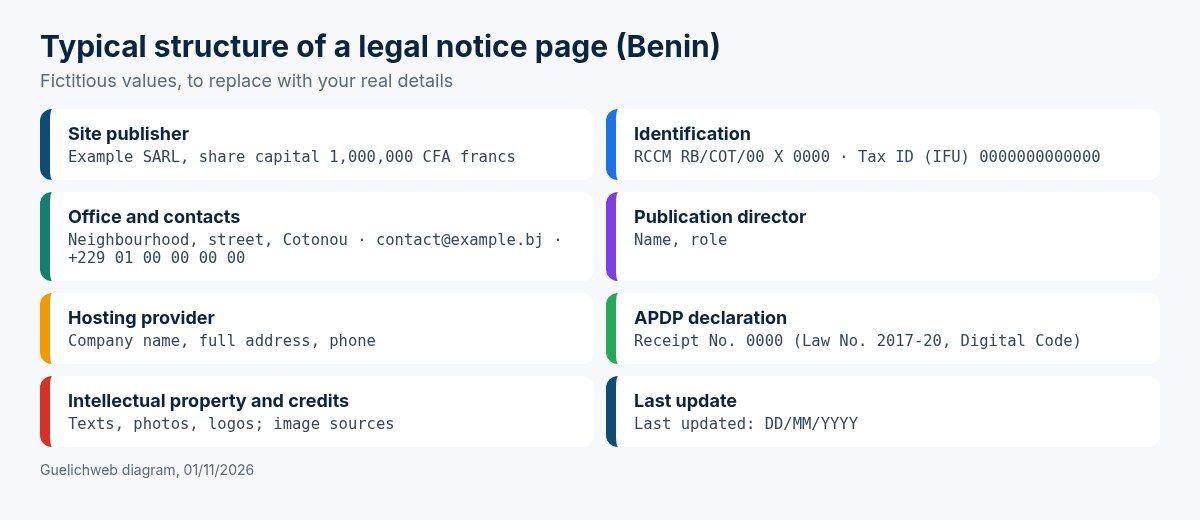
Guelichweb diagram, 01/11/2026: typical structure of a legal notice page for an organisation based in Benin. Values are fictitious.
- The publisher: for an individual, first and last name; for a company, the registered name, legal form (SARL, SA, SAS…) and share capital; for an association or NGO, the exact name shown on its registration receipt.
- The full address: not just "Cotonou". Neighbourhood, street or plot, PO box if you have one. A partner must be able to write to you.
- Direct contact details: an email address and a phone number (in Benin, in the 10-digit format: +229 01 …). A form alone is not enough.
- Registration numbers: RCCM for a company, tax ID (IFU) if applicable, registration number for an association; in France, RCS or RNE and VAT number.
- The publication director: the person responsible for published content (often the manager).
- The hosting provider: name or company name, address and phone number. Not "hosted in the cloud": the actual provider. If you don't know who hosts your website, that is already a warning sign; our guide to web hosting will help.
- The APDP declaration (Benin): the receipt number once the formality is done.
- Information for regulated activities: the authority that granted the licence, professional body, authorisation references.
- Intellectual property and credits: who owns the texts, photos and logos, and the source of licensed images.
- The last update date. It isn't always required, but it shows the page is maintained.
Sample paragraph to adapt
The website [site address] is published by [Organisation name], a [legal form] with a share capital of [amount] CFA francs, registered with the RCCM under No. [number], tax ID (IFU) [number], with its registered office at [full address]. Contact: [email] – +229 01 [number]. Publication director: [name and role]. Hosting provider: [company name], [address], [phone]. In accordance with Law No. 2017-20 on the Digital Code of the Republic of Benin, the data processing carried out on this website has been declared to the APDP under receipt No. [number].
Replace every bracket with a real value. If something doesn't apply to you (no share capital for an NGO, for example), remove the line instead of leaving it empty.
What your privacy policy should contain
The privacy policy is the worst-written page on the French-speaking web, because it is almost always copied. Yet it must describe your processing, not that of an online shop in Paris. The items to cover are similar in Benin (Article 415 of the Digital Code) and under the GDPR:
- Who is responsible: your organisation's identity and address, plus a dedicated contact for data questions (an email address is often enough).
- What data: name, phone, email, message, delivery address, CV, payment data… List what you actually collect.
- Why: answering requests, preparing a quote, delivering an order, sending a newsletter, recruiting, measuring traffic.
- Who has access: your team, and your technical providers (host, email tool, CRM, payment gateway, form tool).
- For how long: one period per purpose, for example "3 years after the last contact for prospects". "A reasonable period" says nothing.
- Transfers abroad: if your data is stored by a host or tool located in another country, say so.
- People's rights: access, correction, objection, deletion, and how exactly to exercise them, with the response time.
- The right to complain to the authority: the APDP in Benin, the CDP in Senegal, ARTCI in Côte d'Ivoire, the CNIL in France.
- Cookies and analytics, with a link to the cookie policy.
Start from your real processing, not from a template
Before writing a single line, list everything on your website that collects data. On a typical SME or NGO website, you'll find:
- the contact form, and where the messages end up (inbox, Google Sheets, CRM);
- the WhatsApp button, which moves the conversation to a third-party messaging app;
- newsletter sign-ups;
- visitor analytics, for example Google Analytics 4;
- online payment, through a mobile money gateway or card payment;
- job applications or CV uploads, event registrations, donations for an NGO;
- more and more often, a chatbot or AI tool that reads visitors' messages; in that case, read our article on AI in business and AI usage policies.
For each line, write down what data, why, who can access it and for how long. You now have the skeleton of your policy, and you'll often find things to fix: a contact spreadsheet shared with the whole team, CVs kept forever, an old tool still connected.
Sample paragraph to adapt
When you fill in our contact form, we collect your name, your WhatsApp number, your email (optional) and your message, only to answer your request and, if you wish, send you a quote. This information is stored in [tool] and accessible to [team]. It is kept for [period] after our last exchange, then deleted. You can ask to see, correct or delete it by writing to [email]. We reply within one month. You can also contact the APDP (apdp.bj).
The APDP declaration in practice
Many organisations in Benin discover this step during a tender or a donor audit. The principle: before carrying out personal data processing, the data controller completes a formality with the APDP, either a declaration or an authorisation request depending on the nature of the data, unless exempt. The APDP states in its practical guides that this procedure is free.
For websites, the APDP provides a specific supplementary form (Article 406 of the Digital Code). Once the formality is done, you receive a receipt whose number can appear in your legal notice, as the authority's template suggests.
Our advice: don't declare "the website" as an abstract block. Come with the list of your processing activities (from the previous section). The APDP itself recommends coming with the list of databases and the categories of data involved. Forms and procedures change, so always check the current process on the APDP website.
Where to place these pages and how to link them
- In the footer of every page, with clear labels: "Legal notice", "Privacy", "Cookies", "Terms of sale".
- Under every form, a short sentence explaining what the data is used for, with a link to the privacy policy. That is the information "at the time of collection" required by law.
- In the cookie banner, a link to the cookie policy.
- At checkout, a link to the terms of sale, which the customer must be able to read before paying.
- In both languages if your site is bilingual. A French-only policy on the English version doesn't do its job.
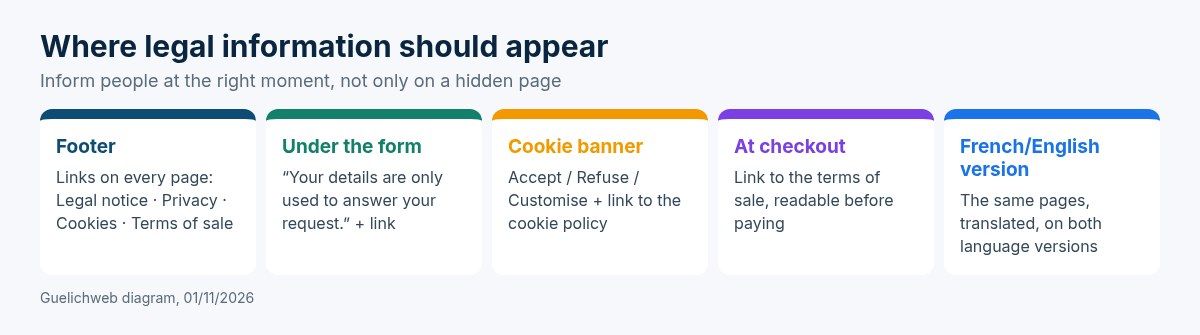
Guelichweb diagram, 01/11/2026: where legal information should appear on a website.
The 8 mistakes we see most often
- The French template copied as is, citing the CNIL and the French trade register for a Beninese business, without a word about the APDP.
- Forgotten brackets: "[Company name]", "[address]", "Lorem ipsum". It happens even on institutional websites.
- A vague hosting provider: "hosted by a cloud provider" or "Vercel (or equivalent)". You need the actual provider's name, address and phone number.
- The impossible promise: "We never share your data with third parties", while the site uses Google Analytics, a form tool and a payment gateway. Those providers are recipients; say so.
- Vague retention periods: "as long as necessary".
- No information under the form, with a policy hidden somewhere in a menu.
- A page never updated after adding a chatbot, a newsletter or a new payment method.
- Everything on one page called "Legal notice, terms and privacy", impossible to read.
None of these mistakes needs a big budget to fix. What it takes is someone who knows the website, its tools and the law, and who spends an hour reviewing everything. That is exactly the kind of thing we check during a website audit.
Free legal notice generators: useful or a trap?
Free generators are handy for making sure the structure is complete. But almost all of them are designed for France or Europe: they ask for a SIRET number, cite the CNIL and ignore Benin's Digital Code. They also have no idea which tools actually run on your website.
Use them as a list of headings, never as a final text. And be wary of generators that insert a link to their own website or show an advert inside the generated text.
The same goes for templates bundled with WordPress themes or website builders: they often include paragraphs about features you don't use (comments, customer accounts) and forget the ones you do use (WhatsApp, mobile money).
Special cases: online shop, NGO, institutional website
Online shop
Add complete terms of sale: prices and currency, delivery fees, delivery areas, payment methods, lead times, return and refund conditions, customer service. Prices must clearly state whether taxes and delivery are included. Our guide on creating an online store in Benin covers the rest of the journey.
NGOs and associations
Show your registration or accreditation number, and be especially precise about the data of beneficiaries, donors and volunteers: some of it is sensitive (health, social situation). Donors pay more and more attention to this. See also what an NGO website should include.
Institutions, health and education providers
The data processed (student records, patient data) often falls under stricter regimes than a simple declaration. In these cases, we recommend having the texts reviewed by a lawyer and contacting the APDP before going live.
Checklist: your legal pages in 30 minutes
- Open your website on a phone and check that the legal links are visible in the footer of every page.
- Click each one: no empty page, no brackets, no placeholder text.
- Check the publisher's identity, address, email and phone number in the current format.
- Identify your actual hosting provider and complete its details.
- List the tools that collect data (form, WhatsApp, analytics, payment, newsletter, chatbot) and compare them with your policy.
- Add precise retention periods.
- Add an information sentence with a link under every form.
- Check your status with the APDP (or your country's authority) and add the receipt number.
- Translate the pages if your website is bilingual.
- Add an update date, and plan a review every time a new tool is added to the website.
Frequently asked questions
Is a legal notice mandatory for a showcase website?
In France, yes, for every professional website. In Benin, the identification requirement primarily targets e-commerce, but a showcase site with a form collects data and must inform visitors. In practice, always publish a complete identification page: it is also a sign of seriousness.
What is the difference between a legal notice and a privacy policy?
The legal notice says who publishes the website. The privacy policy explains what you do with visitors' personal data. They are two separate pages, both linked from the footer.
Can I copy another website's legal notice?
The structure, yes. The content, no: it describes another organisation's identity and processing, and may be protected by copyright. A copied text almost always contains false information about you.
Do I need to declare my website to the APDP?
It is the personal data processing that gets declared, not the website as such. If your site collects data (form, sign-up, payment), you must complete the prior formalities unless exempt. The APDP provides a supplementary form dedicated to websites.
Is a privacy policy required without a form or cookies?
If your website truly collects no personal data, the information obligation has nothing to cover. But that is rare: server logs, analytics and embedded content such as videos or maps often collect data. A short page explaining this is still the best option.
What are the risks of having no legal notice?
In France, fines of up to €375,000 for a company. In Benin, the Digital Code provides for administrative and criminal penalties for breaches of the data rules. The most frequent risk, though, is commercial: a prospect or donor who walks away because they can't tell who they are dealing with.
Does a showcase website need terms of use?
Not always mandatory, but useful as soon as visitors can post content, create an account or download resources. For a website that sells, terms of sale are essential.
In short
A complete legal notice says who you are. An honest privacy policy says what you do with data. In Benin, both rely on the Digital Code and the APDP, not on the CNIL; if you also target Europe, the GDPR comes on top. Start from your real tools, remove the brackets, name your hosting provider, inform people under every form and review everything whenever something changes.
If you'd like us to check your legal pages along with the rest of your website (forms, cookies, hosting, security), get in touch. We start with a diagnosis of your website and the tools it uses, then send you a quote that fits your situation. You can already browse our offers and services.