Web hosting: what it is, free or paid, and where to host your website in West Africa
G. CHRIST
Published on October 23, 2026

A website is a set of files: pages, images, sometimes a database holding your products or quote requests. For someone in Cotonou, Abidjan, Dakar or London to open them at any hour, those files have to live on a computer that is always on and always connected to the Internet. That computer is the server. The service that rents it to you is web hosting.
On paper, it is simple. In practice, it is one of the areas where we see the most expensive mistakes among SMEs, NGOs and public institutions: a "free hosting" site that vanishes one morning, a foreign host that cannot be paid without a Visa card, a renewal three times the price you expected, or login details nobody can find after the developer has left.
At Guelichweb, we host, migrate and fix websites for organisations in Benin and French-speaking Africa. This guide answers three questions: what hosting actually is, whether free hosting is worth anything, and where to host your site when you operate in West Africa. With clear opinions, and the reasons behind them.
Web hosting: a plain definition
Web hosting is renting space on a server connected to the Internet 24/7, where you store a website's files so the public can reach them. The host provides the machine, the power, the bandwidth, the physical security and, depending on the plan, extra services: an HTTPS certificate, backups, email accounts, a control panel.
A comparison that works: your domain name is your shop's street address, hosting is the premises. You can own the address with nothing built on it (a domain with no site), or have premises with no readable address (a site reachable only through a technical address). You need both, and they do not have to come from the same provider.
What happens when someone opens your site
- The visitor types your address or clicks a link. Their browser asks the DNS system which server matches that name.
- DNS replies with an IP address: the address of your host's machine.
- The browser contacts that server, sets up a secure connection (HTTPS) and asks for the page.
- The server sends the files back, or builds the page on the fly if the site is dynamic (WordPress, an online store, a members' area).
- The page appears. All of this should take a second or two, on a phone over 4G, in the middle of the afternoon.
If you want the full journey of the data, our article What is the Internet? walks through it step by step. For now, keep one thing in mind: hosting quality shows up mostly in steps 3 and 4. A slow, overloaded server, or one far from your visitors, drags down the whole experience.
The 5 types of hosting, without the jargon
Hosts love inventing product names. In reality, nearly every plan fits into one of five families.
- Shared hosting. Your site shares a server with dozens or hundreds of others. It is the cheapest and simplest option, usually with a cPanel-style dashboard. A good fit for a brochure site or a blog. The catch: if a neighbour uses a lot of resources, you slow down.
- VPS (virtual private server). A reserved slice of a physical server, with your own operating system. More guaranteed power and more freedom, but someone has to run it: updates, firewall, backups.
- Dedicated server. A whole machine for you. Useful for large volumes or strict compliance requirements. Rarely justified for a small business.
- Cloud and PaaS. Resources you scale on demand, sometimes a ready-made platform that deploys your code automatically. Very flexible, billing can be hard to predict.
- Static site hosting. For sites with no database (HTML, CSS, JavaScript, or sites generated by modern tools). Services such as GitHub Pages, Netlify, Cloudflare Pages or Vercel. Very fast and often free to start, but with terms of use you need to read.
There is also the hosting "included" with site builders like Wix or Squarespace: you choose nothing, everything stays with them. Convenient, but you cannot move your site elsewhere. We compared those options in Wix, Squarespace or a custom website: the real cost.
Our view: for around 80% of websites run by SMEs, associations and small institutions, good shared or managed hosting is more than enough. A VPS starts to make sense when you run a business application, get heavy traffic, or have automations running around the clock. Buying a VPS "for peace of mind" with nobody to manage it is the opposite of peace of mind.
Free web hosting: what you really get
This is the query that keeps coming up in Google suggestions, in Benin as much as in Côte d'Ivoire, Senegal or France: "free web hosting", often followed by "forever", "no ads" or "with a custom domain". The honest answer: yes, it exists, and it is sometimes very good. Just rarely for a business website.
The serious free options
Three families hold up, each with its own trade-off:
- Free PHP hosts such as InfinityFree: PHP, MySQL, SSL and WordPress are possible, 5 GB of disk space advertised, and no ads on your site according to their homepage. The trade-off: variable performance, community-only support, and no guarantee the service will last.
- GitHub Pages: excellent for a static site. But the official documentation is explicit: the service is not intended for or allowed to be used as free web hosting to run an online business or an e-commerce site. Published sites are capped at 1 GB, with a "soft" bandwidth limit of 100 GB per month.
- Netlify, Cloudflare Pages, Vercel: generous free plans for static sites. Careful with Vercel: its fair use guidelines restrict the free Hobby plan to personal, non-commercial use. A site that sells a product or service must move to a paid plan. Cloudflare Pages publishes technical limits (20,000 files, 500 builds a month on the free plan) without banning professional use.
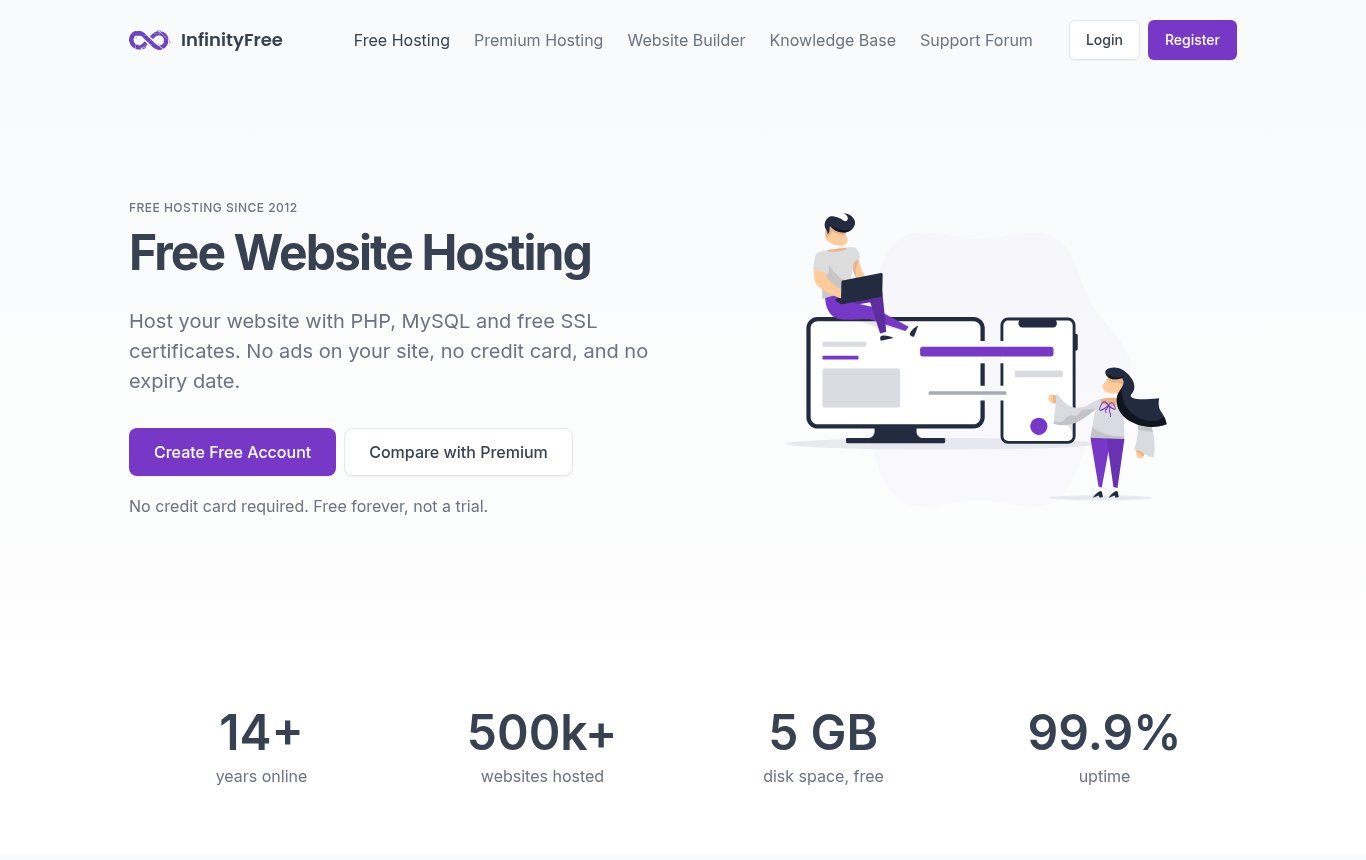
Source: infinityfree.com, homepage, screenshot taken 23/10/2026 (consent pop-up hidden).
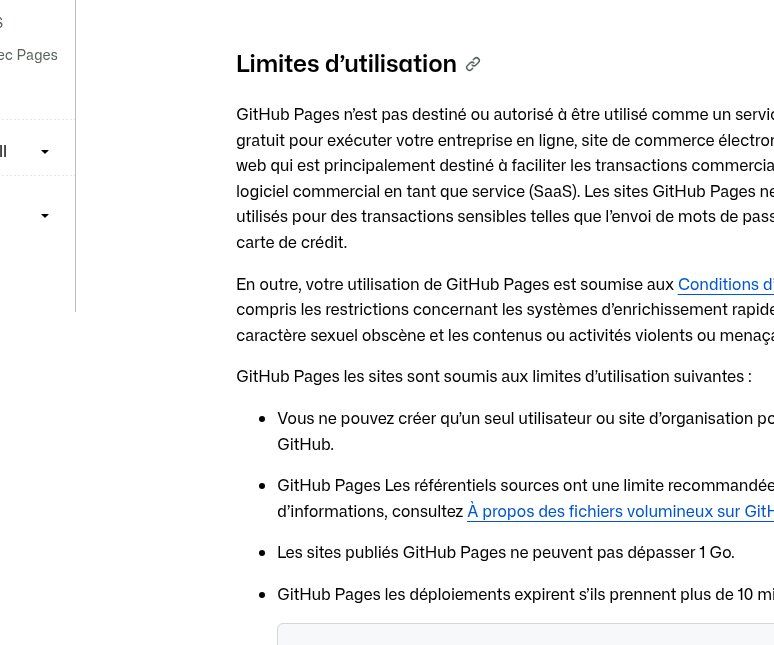
Source: docs.github.com, "GitHub Pages limits" page (French version), screenshot taken 23/10/2026.
What free hosting will almost never give you
- A commitment. A free service can change its terms or shut down. Nobody owes you anything. 000webhost, once listed in every comparison, closed its free service and the sites living there had to move.
- Someone to call. When the site goes down the day before a tender deadline, all you have is a forum.
- Professional email. Free plans almost never include contact@your-domain mailboxes. You need a separate service.
- Reliable backups. Often missing, or left entirely to you.
- A credible image. A subdomain like mycompany.free-host.net sends a clear message to a donor or a client: "we didn't invest".
Our position is simple. Free hosting is perfect for learning, testing a mock-up, hosting a portfolio or a temporary event page. For the site of a business, an NGO accountable to donors, or a public institution, it is not a saving: it is a risk pushed into the future. We made the same point about site builders in Free website: what you really get.
One exception deserves a mention: a well-built static site, hosted on a platform that allows commercial use, can cost next to nothing and stay very fast. But that assumes a developer designed it that way, and that someone keeps hold of the access details.
Free or paid: how much does hosting cost in West Africa?
Prices vary hugely depending on the host, the resources and, above all, what is included. To give you real orders of magnitude, here are some entry-level prices as displayed on local hosts' websites on 23 October 2026. This is neither a ranking nor a recommendation: we have no commercial ties with them, and prices can change.
- Benin: Open BJ shows hosting "from 19,000 FCFA a year"; Hodi shows a managed MINISITE plan at 5,990 CFA a month, with a free .bj, .africa or .com domain.
- Côte d'Ivoire: Hodi offers the same plans from a datacenter in Grand-Bassam; several Abidjan-based hosts list yearly packages in FCFA with Mobile Money payment.
- Senegal: Wanekoo shows a Starter pack at 10,000 FCFA a year; dakar.dev a managed WordPress plan at 2,000 FCFA a month.
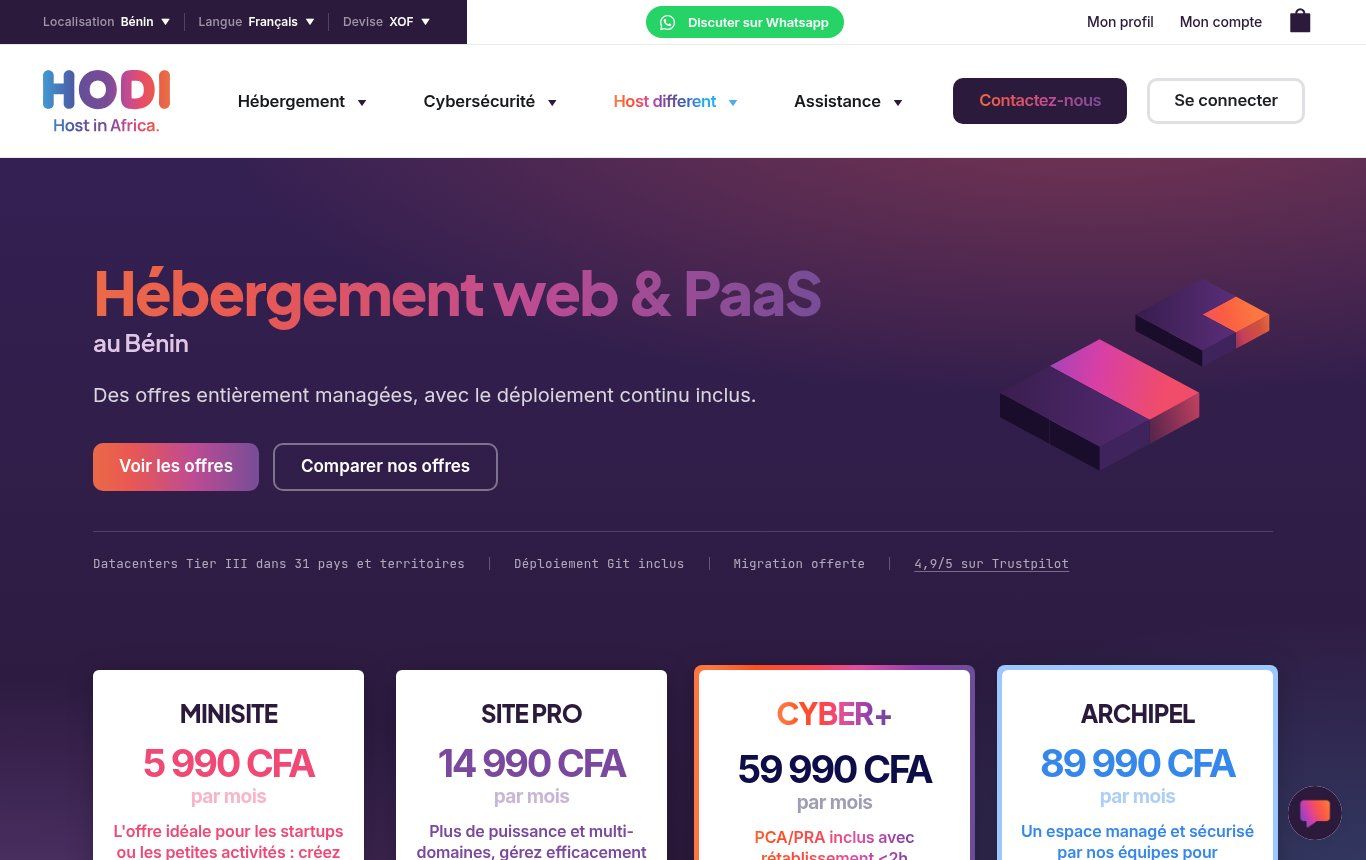
Source: hodi.host, web hosting & PaaS page for Benin, screenshot taken 23/10/2026. Prices as displayed by the host; check them when you order.
Notice the gap: from 10,000 FCFA a year to more than 70,000 FCFA a year for an "entry-level" plan. Both can be fair. The difference lies in things you don't read on the first line: guaranteed resources or not, daily or weekly backups, number of email accounts, real support, whether migration is included.
The three pricing traps we see most often
- The teaser price. Many international hosts show a very low monthly price that only applies if you prepay two to four years, with a much higher renewal price. Always compare the cost over three years, renewals included.
- The "free" domain. It is free for the first year. After that it renews at the host's price, and it is sometimes registered in the host's name rather than yours. Check who the registrant is.
- Currencies. Hosting billed in euros or dollars follows the exchange rate and your card fees. Hosting billed in FCFA and payable through MTN MoMo, Moov Money, Orange Money or Wave avoids those surprises, and above all avoids a site cut off because the organisation's card expired.
To place hosting within a website's overall budget, our guide Website cost in Benin: what a quote should include breaks down every line.
Where should you host your site if you operate in West Africa?
This is the angle missing from almost every comparison Google shows on page one: they are written for France or the US, with prices in euros or dollars and Western hosts. Or they are sales pages from local hosts, who naturally argue for local hosting. Here is our reading, with nothing to sell on that front.
Hosting locally: the real advantages
- Distance. A server in Cotonou, Abidjan or Dakar is physically closer to your visitors. Shorter trips, faster response times, especially for dynamic sites that make many round trips.
- Payment. FCFA, Mobile Money, a local invoice: this is often decisive for an association or a public body.
- A real contact. French-speaking support you can reach on WhatsApp, in your time zone, who understands your constraints.
- Data. For a site that collects personal information (forms, case files, registrations), knowing which country stores it is not a detail. In Benin, the APDP is the personal data protection authority, and the Digital Code regulates transfers of data outside the country. An institution or NGO handling sensitive data should ask the question before choosing.
Myths worth correcting
"Google ranks sites hosted in-country higher." It is a common sales argument, and an overstated one. In its documentation on geotargeting, Google does list server location among the signals, but warns against relying on it alone, since many sites use content delivery networks (CDNs). The signals that carry more weight for a local audience: a national domain such as .bj or .ci, a local address and phone number, language, currency and your Google Business Profile. Local hosting helps mainly through speed, not through any favour from Google.
"A local host is bound to be less reliable." Also wrong. Several players in the region advertise local datacenters, daily backups and round-the-clock monitoring. But an advert is not proof: ask where the servers really are (some "local" hosts resell servers located in Europe, which is perfectly fine if they say so), and what happens during an outage.
Our decision rule
- Your audience is mostly in Benin or the sub-region, and your site is dynamic (WordPress, online store, members' area): go for local or regional hosting, payable in FCFA, with daily backups.
- Your audience is international, or split between Africa and Europe: a good international host with a CDN works very well. The CDN copies your static files close to each visitor.
If you need an international host (card or crypto payment, cPanel, datacenters outside your country), Shinjiru has offered offshore shared hosting since 2000 from about $3.95/month, plus VPS from $11.90/month and 24/7 support. It is not a substitute for local FCFA-billed hosting when most of your visitors are in West Africa, but it is a credible option to compare over three years including renewal. Shinjiru plans (affiliate link: if you sign up through this link, we may earn a commission at no extra cost to you).
- Your site is static and light: a static hosting platform that allows commercial use, behind a CDN, is often the fastest option everywhere.
- You handle sensitive data (health records, beneficiary files, student data): location and the hosting contract come before price.
Whatever you choose, measure. Test your current site with PageSpeed Insights on a phone, look at the server response time, and run the test again after any migration. That is the only judge that counts.
8 criteria for choosing a host (and the questions to ask)
Before you pay, send these questions in writing to each host. The answers, and how quickly they arrive, will tell you a lot.
- Where are the servers for this plan physically located? Country, city, datacenter.
- What is the renewal price over three years? In writing.
- Are backups daily, how long are they kept, and is restoring one free?
- Is HTTPS included and renewed automatically?
- How many professional email accounts, and how large?
- Which resources are guaranteed (memory, CPU), and what happens during a traffic spike?
- How do I reach support, and how fast does it reply? Test it before buying.
- Can I get all my files and my database back if I leave? A good host says yes without hesitating.
For a WordPress site, add two questions: which PHP version is offered, and whether caching is available. For an online store, also ask how the host handles payments and automatic order emails.
Costly mistakes we see in the field
We run into these situations regularly when taking over existing websites. None of them starts as a technical problem: they are organisational.
- Hosting in the developer's name. The account, the invoices and sometimes the domain belong to the former developer. They leave, and the organisation can no longer change anything. Insist on an account in your name, or at the very least an admin login and the invoices.
- No backup outside the host. If the only copy of the site sits with the host, their incident becomes yours. Keep a copy elsewhere, at least once a month.
- Forgotten email. The site gets migrated, the mailboxes don't. On Monday, nobody receives anything. A migration needs planning: DNS, email, HTTPS, redirects.
- A missed renewal. Expired card, reminder emails landing in an inbox nobody reads. The site is cut off, sometimes deleted after a few weeks. Put a reminder in the calendar and use a shared billing address.
- An unmanaged VPS. A powerful server that never gets updated. The perfect entry point for a hack.
Most of these risks are handled through regular follow-up. That is exactly what website maintenance is for: updates, tested backups, renewals kept under watch.
What we do at Guelichweb
We don't push a single host. For each project, we start from the target audience, the type of site, the data involved and the organisation's payment options, then recommend a solution: local, international or static. The domain and hosting are registered in the client's name, the access details are handed over, and the migration is planned so email keeps working.
We don't publish a single hosting price, because it depends on those choices. You can browse our offers and our services: the price is set in a quote, after a diagnosis of your needs or your current site.
Related reading: What does www mean, What is a web browser and The difference between the Internet and the Web.
FAQ: web hosting
What is the difference between a domain name and hosting?
The domain name is the address (your-organisation.bj); hosting is the space where the site's files are stored. The domain points to the hosting through DNS settings. You can buy them from two different providers. Our article on URLs explains each part of a web address.
Is there free web hosting forever?
Some services claim it, such as InfinityFree for PHP or GitHub Pages for static sites. "Forever" means "as long as the service exists and its terms don't change". That is acceptable for a personal project, not for an organisation's website.
Can I host a WordPress site for free?
Yes, on free PHP hosts. But WordPress needs updates, backups and a minimum level of performance. For a professional site, paid shared hosting with daily backups remains our recommendation.
How much does web hosting cost in Benin or Côte d'Ivoire?
On 23 October 2026, entry-level plans displayed by hosts in the sub-region ranged from about 10,000 FCFA a year to nearly 6,000 FCFA a month, depending on resources and included services. Compare the three-year cost and what is included, not the first number you see.
Does hosting in Benin improve my Google ranking?
A little, indirectly, through speed. Google says server location is one signal among others but should not be relied on alone. A .bj domain, a local address, relevant content and a Google Business Profile carry more weight.
Can I switch hosts without losing my site?
Yes, as long as you have access to your files, your database and the domain's DNS settings. The site is copied, tested on the new host, then DNS is switched over. Email needs special care.
Shared hosting or VPS for a small business?
Shared or managed hosting in the vast majority of cases. A VPS is justified for a custom application, high traffic or heavy automations, and only if someone actually manages it.
In short
Hosting is not the most visible line in a website project, but it is the one that decides whether the site stays online, fast and under your control. Free hosting is for learning and testing. For an organisation that relies on its website, choose hosting you can pay for without friction, with backups, reachable support and servers close to your audience, registered in your name.
Torn between several plans, or wondering whether your current hosting is up to the job? Get in touch: we'll look at your situation and suggest a clear solution, with a quote after diagnosis.