Buying a .bj domain name: how it works, what it really costs, and how never to lose it
G. CHRIST
Published on October 22, 2026
A website that won't load on a Monday morning, emails bouncing back, and nobody on the team who knows where the domain name was bought or what the password is. This is not a rare story. The .bj registry says it plainly: most lost domains start with a renewal reminder that nobody answered.
We have already covered how to pick a good name in our article What is a URL, and how to choose yours. This guide is about what comes next, the part businesses, NGOs and institutions neglect most: buying a .bj (or .com) domain name properly, paying the right price, and staying the real owner for years. We are a web and automation agency in Benin, and this is the first thing we check on every website we take over.
What is a domain name? The short answer
A domain name is the readable address of your website and your email on the internet, such as yourcompany.bj. You don't buy it once and for all: you rent it, usually year by year, and you must renew it to keep it.
Behind the name, the DNS system links it to the numeric address of the server hosting your site, and to the service that receives your mail. So the domain is not the website, nor the hosting, nor the mailbox: it is the key that connects them. Lose the key and everything that depends on it stops, even if the website and mailboxes still exist somewhere.
Remember one word: you are the registrant of the domain, not its owner in the way you own land. You hold an exclusive right to use it, as long as you pay for renewal. That is why a "lifetime domain name" does not exist. For .bj, the official guide published by Benin's government says you can rent a domain up to 10 years in advance from your provider (gouv.bj, in French).
Who does what? Registry, registrar and you
For .bj as for .com, three players are involved. The .bj registry (NIC BJ) describes it as the "3R" model recommended by ICANN: Registry, Registrar, Registrant.
- The registry keeps the official database for an extension. For .bj it is JENY SAS, which runs the national domain on behalf of ARCEP Benin, under the NIC BJ brand (nic.bj). You don't buy anything from it directly.
- The registrar is the accredited company that sells you the domain, bills the renewal and gives you access. As of 22 October 2026, nic.bj lists 17 accredited registrars for .bj (official directory).
- The registrant is you: the person or organisation listed as holder of the domain. That name is what counts in a dispute, not the name of whoever paid the invoice.
Your web agency or hosting company may be a registrar, or may go through one on your behalf. That is where trouble often starts: the domain is bought "for you", but in the provider's name and account.
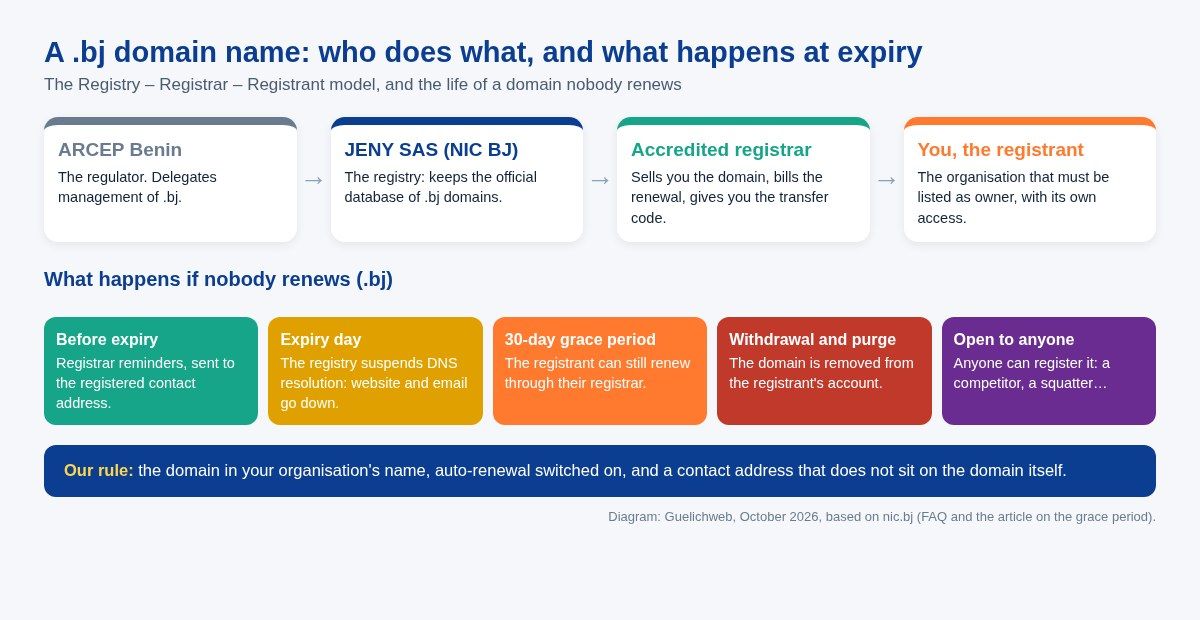
Diagram: Guelichweb, October 2026, based on nic.bj.
.bj in practice: the rules that matter before you buy
The registry publishes simple rules, summarised here because details sometimes differ from one reseller to another:
- Open to everyone. According to the registry FAQ, you don't need to be Beninese: .bj is open with no nationality or residence requirement (nic.bj FAQ). The 2020 government guide added that no documents are needed for a plain .bj, and that you pay by bank card or Mobile Money on the provider's website.
- First come, first served, using letters, digits and hyphens, from 2 to 63 characters (naming policy). Some registrars set their own minimum: Afriregister states 3 characters minimum on its .bj page.
- Annual, renewable registration, under your registrar's terms.
- 22 second-level extensions exist (.com.bj, .org.bj, .co.bj, .net.bj, .africa.bj…). Some ask for proof: a trade register number (RCCM) recommended for .co.bj and .com.bj, statutes or a registration receipt recommended for .org.bj, and mandatory authorisation for .edu.bj, .univ.bj or .assur.bj, among others (second-level extensions page).
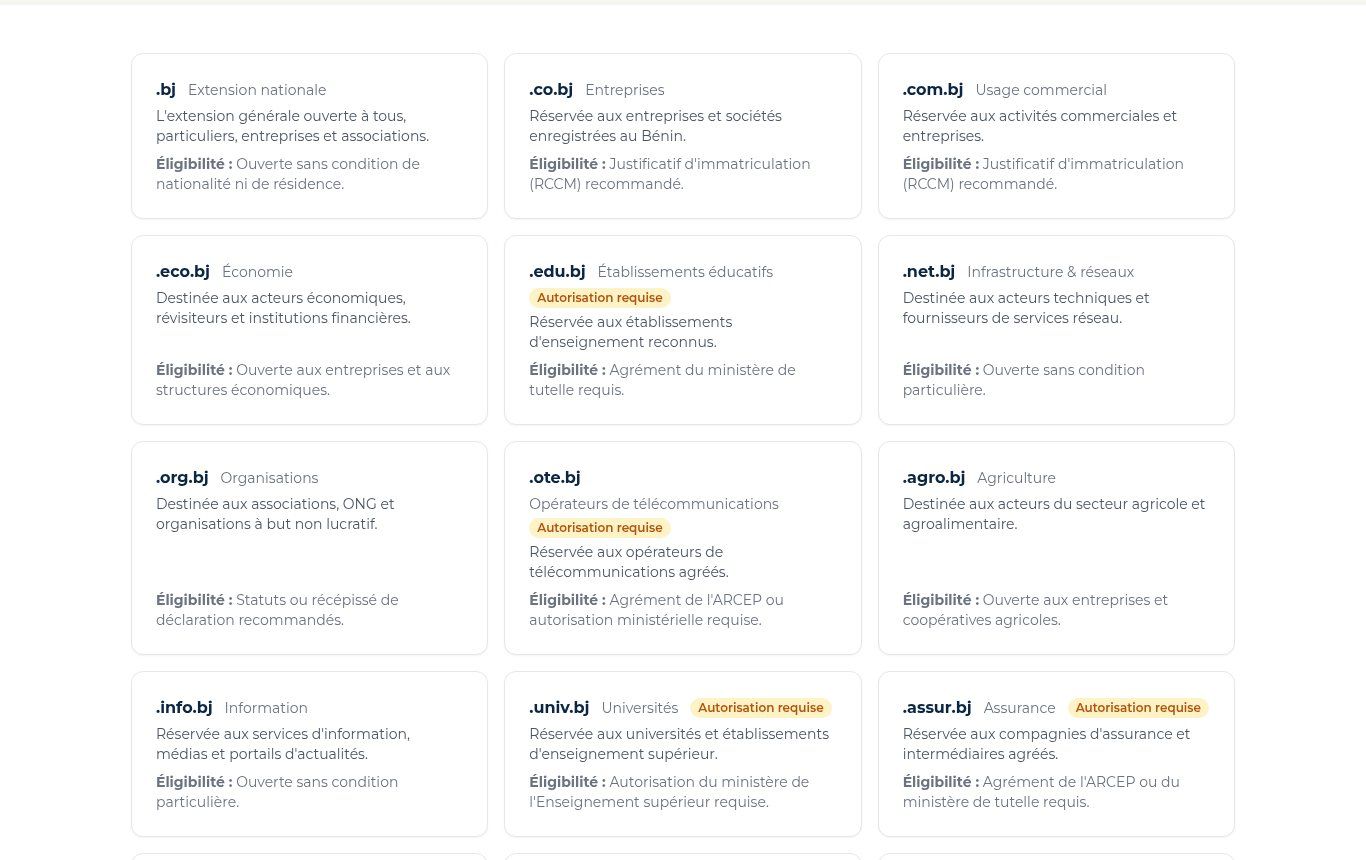
Source: nic.bj, second-level extensions page, screenshot taken 22/10/2026.
One detail to check when ordering: some registrars require an administrative contact based in Benin. Afriregister states this clearly and offers to provide one if you don't have a local contact. For diaspora organisations, get this clarified in writing, because that contact receives important notices.
How much does a .bj domain cost in 2026?
There is no single price: the registry sells to registrars, who set their own rates. Here is what we checked ourselves on 22 October 2026 on three providers' public pages. These are yearly prices, excluding promotions, and you should re-check them when you buy. For reference, 10,000 FCFA is roughly 15 euros, as the CFA franc is pegged to the euro.
- Afriregister: 9,900 FCFA per year, for both registration and renewal, terms up to 10 years (Afriregister .bj page).
- JENY SAS (the registry also runs a shop): 10,000 FCFA per year for registration, transfer and renewal (JENY cart).
- Benin Hosting: 20,000 FCFA shown for .bj on its home page (beninhosting.com).
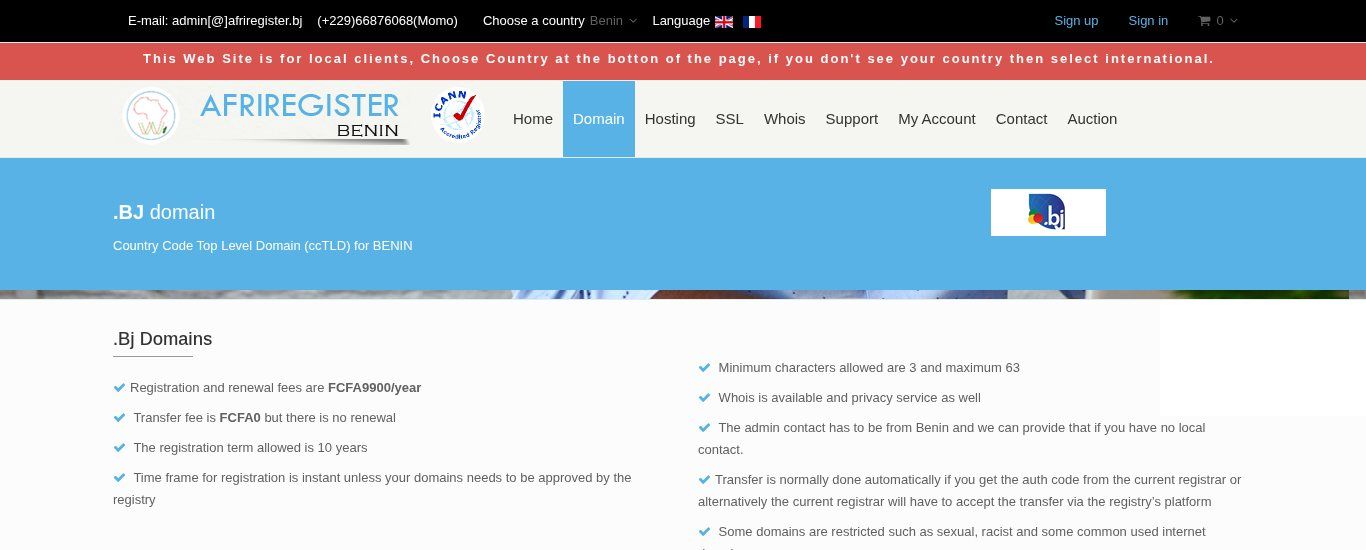
Source: afriregister.bj, ".BJ domain" page, screenshot taken 22/10/2026 (chat widget hidden).
The 2020 government guide gave a range of 9,000 to 13,000 FCFA depending on the provider and the type of applicant. Our checks show you can still pay twice as much today for the same name, with no obvious extra service. Our view: don't compare first-year prices, compare renewal prices. A cheap first year followed by an expensive renewal is something you pay for ten years.
For a .com, .org or .africa, the principle is the same: an accredited registrar, an introductory price, a renewal price. Rates vary a lot between sellers and change often, which is why we don't quote them here. Always get the renewal price in writing, and be wary of "domain + hosting" bundles where the domain doesn't appear as a separate line.
How to buy a .bj domain name, step by step
- Check availability with the registry's search box on the nic.bj home page. The result is instant and also shows whether a domain is in its grace period.
- Pick your registrar from the official directory, comparing the renewal price, payment methods (Mobile Money or card), support responsiveness and how clear the customer area is.
- Open the customer account in your organisation's name, with a shared email address that several people read (for instance a dedicated Gmail or Outlook address, not an intern's personal inbox).
- Fill in the registrant: the company's legal name, or the exact name of the NGO or institution. Not the developer's name, not the agency's.
- Pay for several years if you can. A .bj can be rented for up to 10 years. Two or three years ahead already gives you a safety margin.
- Turn on auto-renewal and put the expiry date in the organisation's shared calendar, with a reminder one month before.
- Point the domain at your hosting and email service (name servers or DNS records). Allow 15 minutes to 24 hours for propagation, according to the government guide.
- Store the access details: registrar account login, invoice, expiry date and the name of the person in charge, in a document that management knows about.
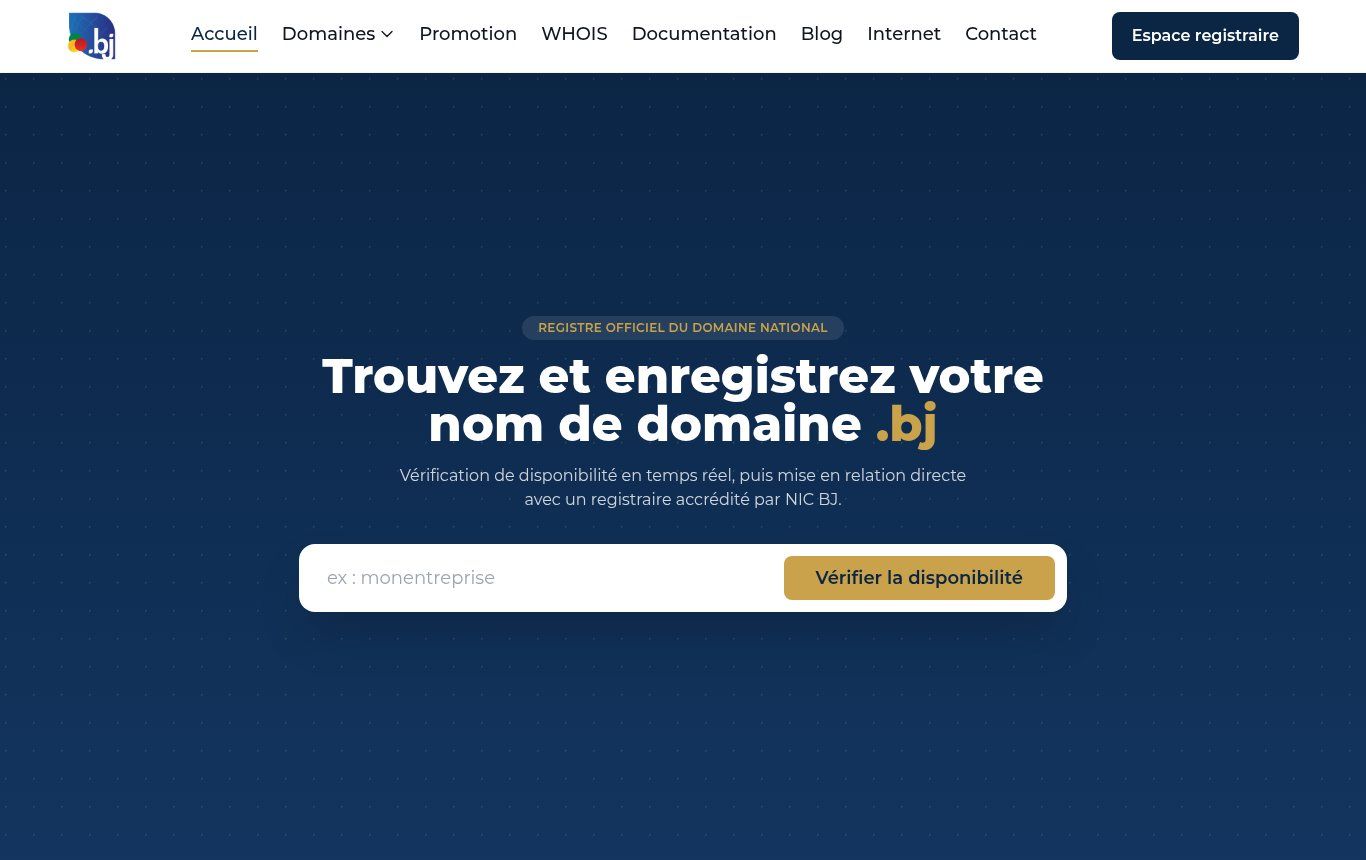
Source: nic.bj, home page, screenshot taken 22/10/2026.
"Free domain name": what these offers hide
This is one of the most common searches about domains, in Benin and elsewhere. There are three cases, and none is really free.
- A domain "included" with hosting. It is often free for the first year only, then billed at the provider's renewal price. Check whose name it is registered in and whether you can transfer it if you leave.
- A platform subdomain, like yourcompany.platform.com. It is not your domain: it belongs to the platform, it disappears if you leave, and it looks unprofessional on a business card. We go through these limits in free website: what you really get.
- Free extensions. Freenom, which gave away .tk, .ml or .ga names, showed the risk: it stopped new registrations in 2023, then exited the domain business in early 2024, and its free domains stopped working (Freenom, Wikipedia).
Our position is clear: for a business, an NGO or an institution, a domain costs about as much per year as a few meals out. It is the best-value expense of your whole online presence. "Free" gets paid for later, in an address you have to change and contacts you lose.
The domain you want is taken: what now?
- Look it up in the registry WHOIS (nic.bj WHOIS) to see the domain's status. If it is in its grace period, the current registrant can still get it back.
- Join the waiting list offered by the registry: the nic.bj FAQ says you will be notified as soon as the domain becomes available again.
- Consider variants: a suitable second-level extension (.com.bj, .org.bj), or the same brand in .com. The registry itself recommends reserving several variants from the start.
- If someone is using your brand, it becomes a legal matter. A registered trademark (with OAPI, which covers Benin and most French-speaking African countries) is a strong asset. Talk to a lawyer before contacting the registrant.
Avoid one thing: buying a long name full of hyphens just because it is available. Better to take a little time and find a short name, as we explain in our article on URLs.
Who owns your domain? The five-minute test
We ask this at the very first meeting, and many people we meet don't know the answer. Take the test now:
- You can name the registrar where the domain is registered.
- Someone in your organisation can log into that account, with a login that does not belong to a contractor.
- The registrant on record is your company, NGO or institution. Check it in the customer area or the WHOIS (if privacy protection hides the data, the customer area is the reference).
- The domain's contact email is valid and read every week.
- You know the expiry date, and auto-renewal is on or a reminder is set.
If you answer no to any of these, don't panic, but fix it this week, while everyone is still reachable. Ask your provider to move the domain into your name and hand over the access. A serious provider does so without arguing: it is your asset, not theirs.
Renewal and expiry: what really happens
For .bj, the registry published a clear article on this in October 2026 (understanding the grace period, in French). On the expiry date, the registry suspends DNS resolution: the website and email addresses stop working. The registrant keeps priority to recover the name during a thirty-day grace period, by paying the renewal through their registrar. After that, the domain is withdrawn from the registrant's account and released, and anyone can register it.
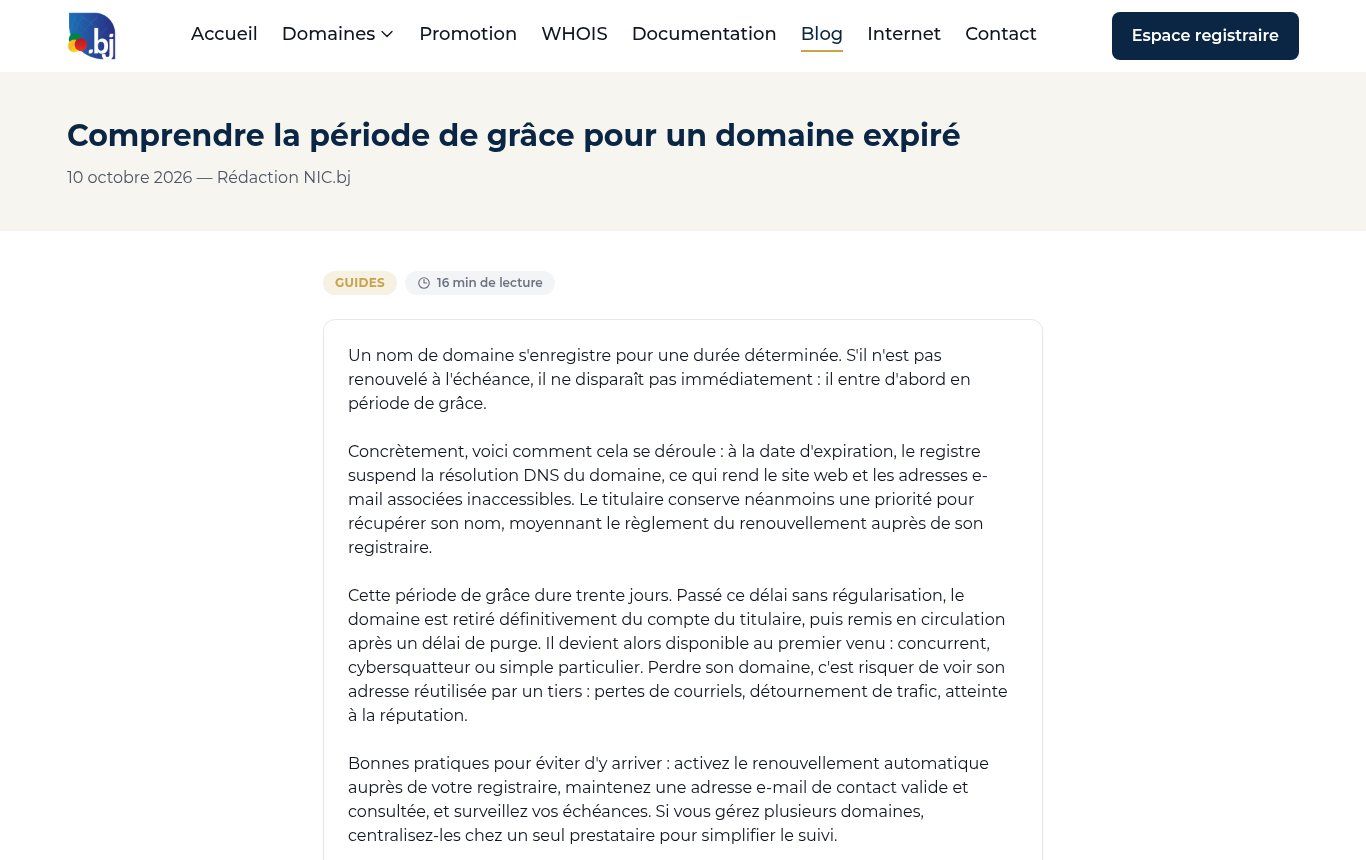
Source: nic.bj, blog article of 10/10/2026, screenshot taken 22/10/2026.
For generic extensions such as .com, .org or .net, ICANN imposes a common rule on registrars, the Expired Registration Recovery Policy: at least two reminders before expiry (about one month and one week before), one reminder within five days after, and the website being interrupted at some point during the post-expiry period (ERRP, ICANN). The exact recovery windows and fees then depend on the registrar.
The classic trap is mechanical: the renewal reminder goes to an address on the domain itself. The domain expires, email stops, and the next reminders never arrive. Hence our rule: the domain's contact address must be off the domain, and read by more than one person.
Switching registrar or provider without breaking the site
Your domain is not locked in with your registrar. To move it you need the authorisation code (called authinfo, auth code or EPP code), which your current registrar must give you. For .bj, the registry FAQ explains that changes of registrant go through the registrar and advises planning for transfer times and re-authentication with the authinfo code. Afriregister states that transfers happen automatically with that code, or through the registry's platform.
For generic extensions, ICANN's transfer policy sets safeguards worth knowing (Transfer Policy, ICANN):
- The registrar must give you the authorisation code within five calendar days.
- A transfer may be refused within 60 days of the domain's initial registration.
- After a change of registrant, the domain may be locked against transfers for 60 days, unless you opted out of that lock when making the change.
In practice: if you need to change both the registrant and the registrar, change the registrant first, then prepare the transfer. And don't move a domain in the week it expires or the day before a launch.
Something many people don't know: you can keep your domain with one registrar and host your website elsewhere. The nic.bj FAQ confirms you remain free to choose your host and set your name servers (NS). So changing agency doesn't necessarily mean moving the domain, only updating its DNS settings.
DNS: three settings to understand, without becoming a technician
You don't need to master DNS, but you should know what the person changing it is touching:
- Name servers (NS) say who manages your domain's DNS zone: your registrar, your host or a third-party service.
- A or CNAME records point your domain (and the www) to the website's server. On whether to use www or not, see what does www mean, should you use it.
- MX and TXT records run your business email (and its authentication). This is the most sensitive setting: delete an MX record by mistake and you stop receiving mail.
Before any change, ask for a screenshot of the current DNS zone. It is a free backup that saves hours of detective work. And once the site is live, the domain should serve it over HTTPS: our article what is HTTPS and an SSL certificate explains why.
.bj, .com or both: the effect on Google
We have already given our advice on picking an extension: reserve both the .bj and the .com if the name is free, and redirect one to the other. On the Google side, one point is worth spelling out. Google treats country-code extensions as a strong signal that a site targets a given country: a .bj speaks to Benin. Conversely, some country codes widely used in tech, such as .io, .co, .me or .tv, are treated as generic and give no local signal (Google Search Central).
Put simply: if you mainly work in Benin, .bj is a good choice for your main website. If you target several countries, a well-organised .com, with country pages where needed, is more flexible. For local customers, your Google Business Profile and local SEO will weigh more than the extension anyway.
NGOs, funded projects, institutions: special cases
NGOs and funded projects. A pattern comes up often: a website built for a project, on a project budget, by a consultant. When the funding ends, nobody has the budget line or the access, and the domain expires. Our advice: register the domain in the organisation's name (not the project's or the consultant's), use .org.bj or a .org where it makes sense, pay for several years while the budget exists, and put renewal into the organisation's running budget.
Institutions and schools. Some second-level extensions are reserved and need authorisation: .edu.bj for recognised educational establishments, .univ.bj for higher education, among others. Allow time to get approval before your launch date. And give management of the domain to a department (IT or communications), not to one person who may change jobs.
SMEs operating in several countries. Each country-code extension has its own registry and rules: NIC.CI, under the ARTCI regulator, for Côte d'Ivoire's .ci (nic.ci), and NIC Sénégal for .sn (nic.sn). If you open an office in Abidjan or Dakar, check the local conditions before buying, and keep all your domains with as few registrars as possible so you don't multiply expiry dates.
The handover sheet to demand from any provider
Whether it's a new website or a change of provider, ask for a document that contains at least:
- The domain name, its extension and the registrar's name.
- The registrant on record, and proof that it is your organisation.
- The registrar account login, in your name, with a password you have changed yourself.
- The expiry date and the auto-renewal status.
- The name servers and a copy of the DNS zone (A, CNAME, MX, TXT records).
- Any other domains or variants bought for you (.com, .com.bj…), with the same details.
If you are writing a brief for a new website, add these points from the start: our website requirements document template has a section for it. And when comparing quotes, read what a website quote in Benin should include: the domain should appear as a separate line, in your name.
Our honest view
The domain name is the smallest cost of a website, yet the one whose loss costs the most: the address printed on your vehicles, invoices and signs, your email, your search rankings. We don't recommend one registrar over another. We recommend three things, everywhere: the domain in your name, auto-renewal turned on, and one named person who knows where the access details are. Everything else, price included, can be compared calmly.
Related reading: Web hosting, What is the Internet and What is a web browser.
Frequently asked questions about .bj domain names
How much does a .bj domain name cost?
Based on our checks of public pages on 22 October 2026, between 9,900 and 20,000 FCFA a year depending on the provider (9,900 FCFA at Afriregister, 10,000 FCFA at JENY SAS, 20,000 FCFA at Benin Hosting). Above all, compare the renewal price.
Do I need to be Beninese to buy a .bj?
No. According to the nic.bj registry FAQ, .bj is open with no nationality or residence requirement. Some second-level extensions do require proof or authorisation, and some registrars require an administrative contact in Benin.
Can I buy a domain name permanently?
No. A domain name is rented for a set period and renewed. For .bj you can pay up to 10 years in advance. Turn on auto-renewal to avoid any outage.
What happens if I forget to renew my .bj?
On the expiry date, the website and email stop working. You have a thirty-day grace period to renew through your registrar. After that, the domain is withdrawn and anyone can register it.
Can I get a free domain name?
Not in a lasting way. "Free" offers are either limited to the first year with paid hosting, or subdomains owned by a platform. For a professional organisation, pay for your own domain.
How do I check whether a domain name is available?
For a .bj, use the search box on the nic.bj home page or the registry WHOIS. For a .com, any registrar offers an availability search.
Can my domain be with one provider and my website with another?
Yes. The registrar handles the name's registration; you then point the name servers or DNS records to the host of your choice.
How do I get back a domain registered in my former provider's name?
Ask them in writing to change the registrant to your organisation and to give you account access or the transfer code. Keep the invoices that prove you paid for the domain. If it stalls, contact the registrar concerned.
Want a clear picture of your domain?
We check who owns your domain, where the access details are and whether the DNS settings are clean, then help you put everything back in your name. For new projects, we register the domain directly in your organisation's name. Our services are listed on the Services page, and the way we work is described on Website design in Cotonou. Pricing depends on your situation: we quote after a diagnosis, as explained on our offers page.
A domain you know little about, or a new website to launch? [Contact us](https://guelichweb.online/en/contact) for an initial diagnosis.