What is local SEO? Definition, and how to rank first on Google in your city
G. CHRIST
Published on October 20, 2026
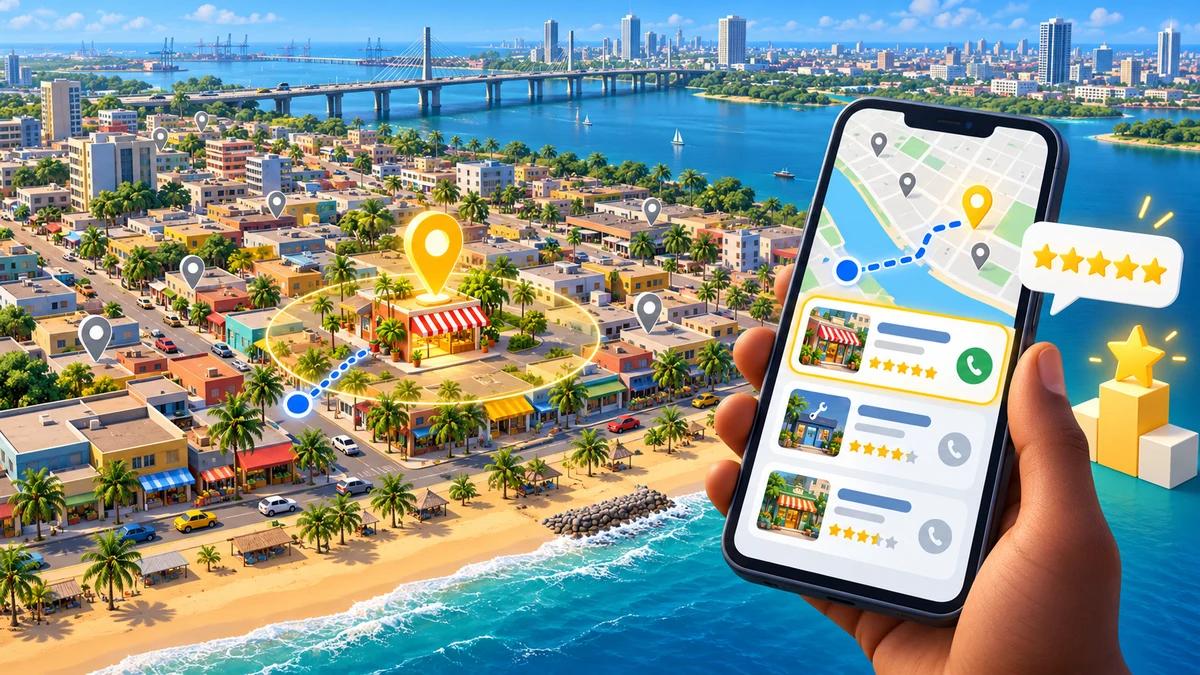
It's a Tuesday evening in Cotonou and the air conditioner gives up. What do you do? You don't search for "refrigeration and air conditioning company in Benin". You grab your phone and type "AC repair Fidjrossè", or just "air conditioning near me". Google shows a map, three listings with stars and a button to call. You call the first one that looks serious. Every other technician in town, even the better ones, doesn't exist for that customer.
That invisible sorting is what local SEO is about. Type "local SEO" into Google from Cotonou, Abidjan, Dakar or London and the suggestions look alike: "local SEO meaning", "what is local SEO in simple words", "how to rank on Google Maps". The guides at the top of the results are written by agencies in Europe and North America, with examples of plumbers in Lyon or dentists in Texas. At Guelichweb, we help SMEs, NGOs and institutions in Benin get found on Google. Here is a clear definition, what Google officially says about its local ranking, and the method we use, including the realities of West African cities that those guides never mention.
Local SEO: a simple definition
Local SEO (local search engine optimisation, or "référencement local" in French) is everything a business does to show up in Google's results when someone searches for a product or service near them: on Google Maps, in the map block at the top of the results and in the regular links below it.
"Local SEO", "local search optimisation", "Google Maps SEO", "Google My Business SEO": it's the same discipline under different names. SEO stands for Search Engine Optimization. The word "local" adds a location constraint: the goal isn't to be visible everywhere, but where your customers are.
How it differs from "regular" SEO
Regular SEO tries to rank a page for a query wherever it's typed from. An article on "what is a CRM" targets the same reader in Cotonou and in Montreal. Local SEO works on queries tied to a place: "pharmacy on duty Porto-Novo", "hotel Parakou", "printing shop Akpakpa", "business lawyer Abidjan Plateau". Two people typing exactly the same words two kilometres apart won't necessarily see the same results. That's the big difference, and we'll come back to it because it changes how you aim for "first place".
There's a second, very practical difference: in local search, your main "page" often isn't your website. It's your Google business listing, the free tool that used to be called Google My Business and is now called Google Business Profile.
What Google shows for a local search
- The local pack: a small map and a handful of business listings at the top of the results. It's the most sought-after spot.
- Google Maps: the same logic inside the maps app, with more results as you scroll down the list.
- The regular results: the blue links under the map. Your website can show up there thanks to a well-built page about your business and your city.
A well-filled listing shows the essentials before the customer even visits your website: category, rating, address, opening hours, phone number, website and a directions button.
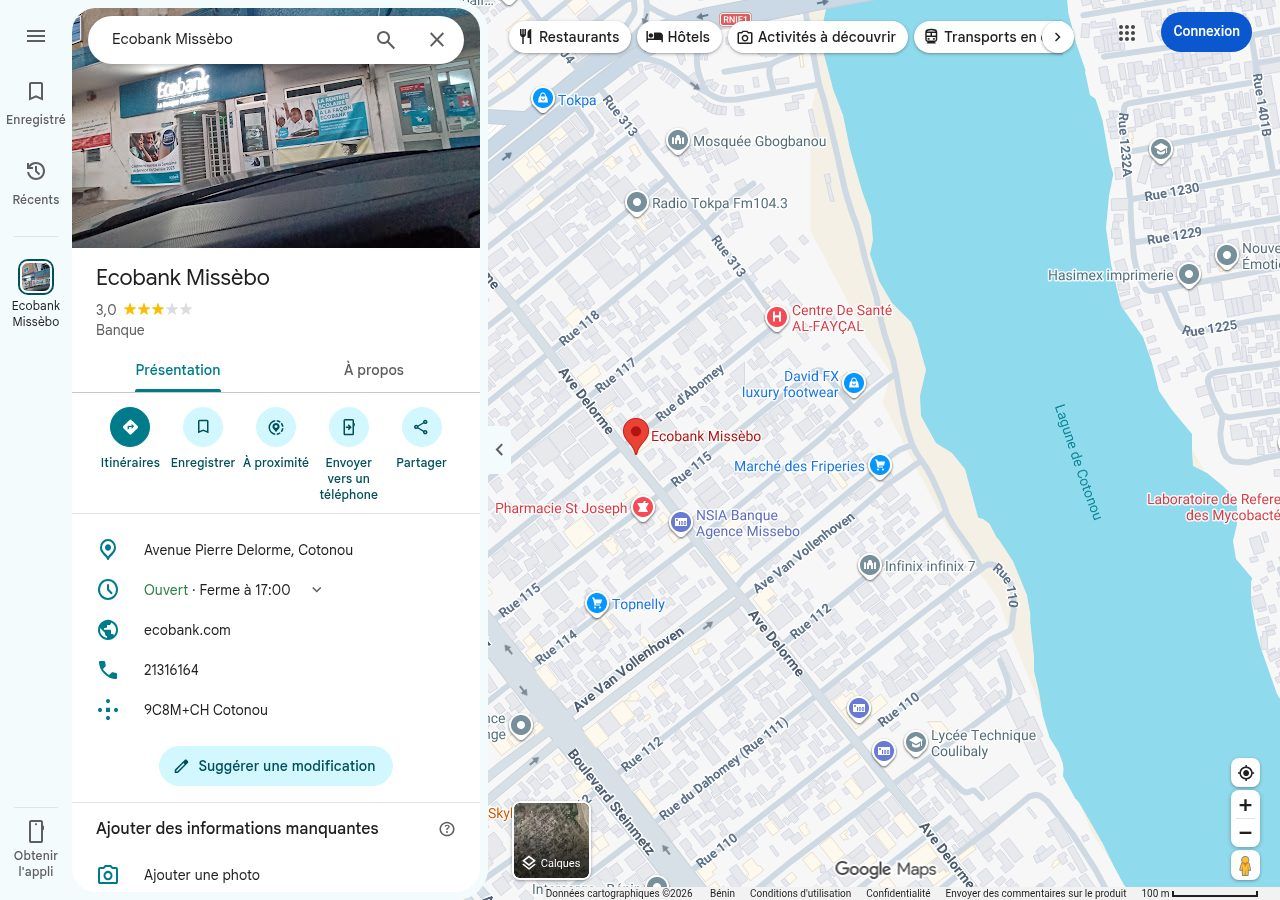
Source: Google Maps screenshot (Ecobank Missèbo search, Cotonou), 15 October 2026. Public example of how a listing displays; no commercial link with Guelichweb.
Who needs local SEO?
Any organisation that welcomes people on site or travels to customers within a given area. In practice:
- Shops and local services: stores, restaurants, hair salons, garages, pharmacies, hardware stores, print shops.
- Professional practices: lawyers, notaries, accounting firms, clinics, laboratories, dental practices.
- Schools, training centres, hotels and event venues.
- Service providers who travel: air conditioning, plumbing, electrical work, caterers, movers, security. Google offers them a listing with a "service area" and no visible address.
- NGOs and institutions that welcome the public: an office that receives beneficiaries, an administrative service, a town hall, a health centre. Google's guidelines even allow separate listings for departments of a university, a hospital or a public building.
Who doesn't need it? A 100% online shop with no premises and no service area, or a business that works only remotely with clients in ten countries. Google actually forbids creating a listing at a mail-forwarding address or a "virtual office" (Google guidelines). For those businesses, regular SEO is what matters, the kind we cover in how to appear on Google.
How Google ranks local results: the 3 official factors
Good news: on local ranking, Google is more open than usual. Its help page Tips to improve your local ranking on Google explains that local results are mainly based on three factors.
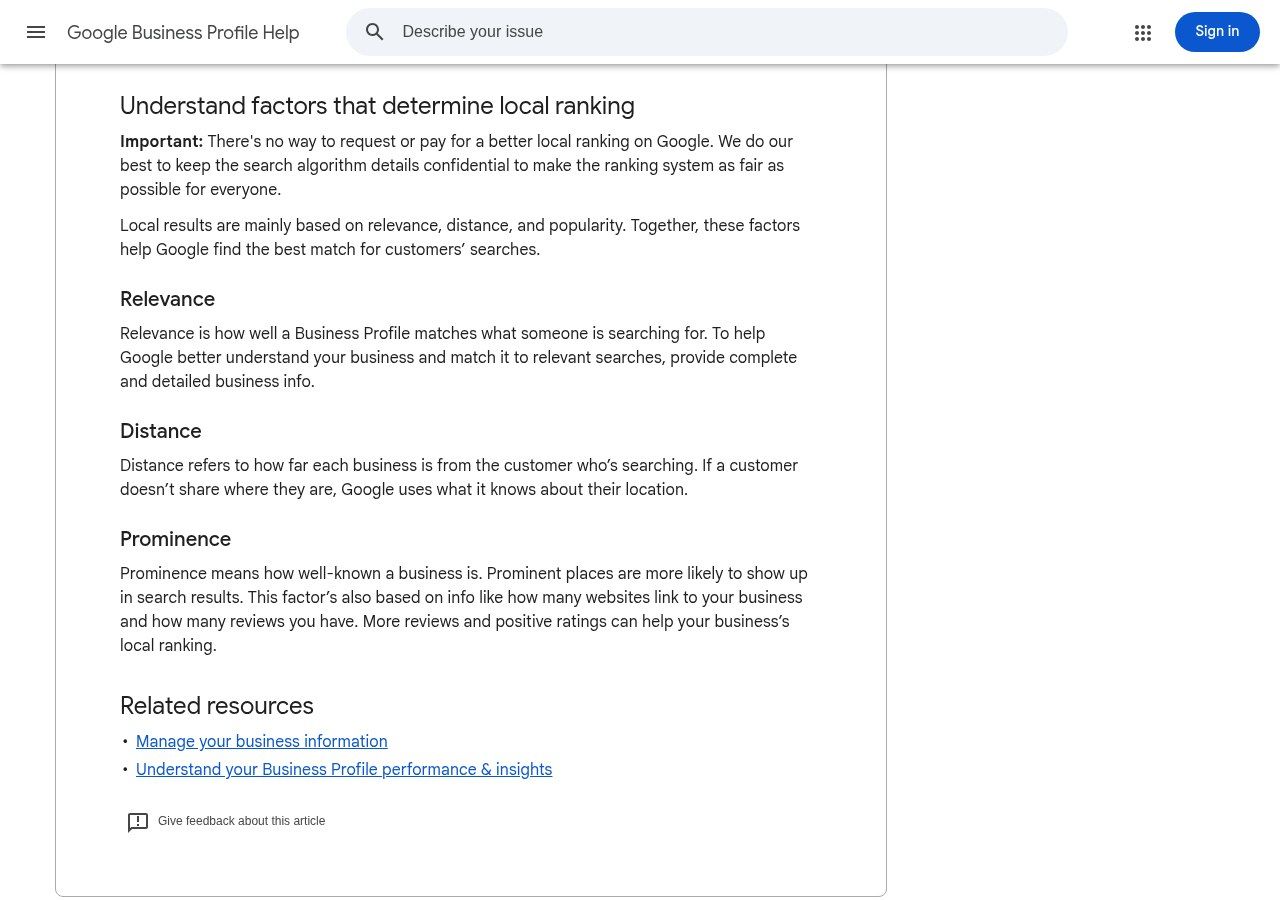
Source: screenshot of support.google.com/business/answer/7091?hl=en, viewed on 20 October 2026.
- Relevance: how well your listing matches what the person typed. A complete, accurate listing (right category, services, description) is easier to match with the right searches.
- Distance: how far your business is from the person searching, or from the place they named in their search. You can't cheat on this one.
- Prominence: how well known your business is. Google specifically mentions how many websites link to your business and how many reviews you have, and says more reviews and positive ratings can help your local ranking.
The same page contains a sentence every business owner should remember: "There's no way to request or pay for a better local ranking on Google." In other words, when someone sells you "guaranteed first place on Google Maps", they're selling something Google itself says can't be bought. You can pay for ads, which are labelled "Sponsored". You can't pay for the organic ranking.
Why "number one in my city" barely means anything
Because of the distance factor, there isn't one single ranking for "restaurant Cotonou". There are as many as there are places to search from. A customer typing "restaurant" in Ganhi doesn't see the same list as someone in Calavi. A business can be first in Cadjèhoun and invisible in Godomey.
So the realistic goal isn't "number one across the whole city". It's being in the top three listings within your catchment area, on the three to five searches that actually bring you customers. That's achievable, and that's where the money is. And if your customers come from all over town, the answer lies in prominence (reviews, links, reputation) and in well-built web pages, not in a doctored listing.
What makes local SEO different in Benin and West Africa
Guides written in Europe assume an address with a street number, a well-established review culture and plenty of local directories. Here, the ground is different. This is what we see, and what we do about it.
Addresses without street numbers
In Cotonou, many addresses are given by neighbourhood, by plot number ("carré") or by landmark: "behind the petrol station", "opposite the church". Google has planned for this. Its guidelines allow cross-streets and landmarks only where the official address isn't enough to locate the business, and, if the address has no street number, let you place the pin on the map yourself. Put that pin in the right place, on the actual entrance, not in the middle of the neighbourhood.
Use the Plus Code too: the short code based on latitude and longitude (such as "9C8M+CH Cotonou") that Google Maps shows for every place (Google Maps help on Plus Codes). Put it on your website, in your WhatsApp signature and on your quotes. Delivery riders and first-time customers will find you without calling three times.
The switch to 10-digit phone numbers
Since 30 November 2024, every Beninese phone number has 10 digits with the 01 prefix, and the regulator ARCEP Benin asked everyone to update the numbers shown on all platforms and materials. It's the easiest thing to check, and still often forgotten. A customer who taps "Call" on a listing still showing 8 digits gets an error message and calls a competitor. And a different number on the listing, the website and the Facebook page blurs the consistency Google relies on to recognise you. Write it the same way everywhere: +229 01 XX XX XX XX.
WhatsApp before the website
Here, many customers would rather send a WhatsApp message than call or fill in a form. The number on your listing must be one that actually answers, ideally your WhatsApp Business number. And your website should offer a WhatsApp button that's visible on mobile. We cover that trio of website, WhatsApp and customer follow-up in website, WhatsApp and CRM for an SME in Cotonou.
Few reviews, but sleeping competitors
The Google review habit is less established than in Europe, and customers must be signed in to a Google account to leave one. The result: in many sectors, a few recent reviews and careful replies are enough to stand out. Try it: open Google Maps, type your trade and your neighbourhood, and look at the listings that come up. How many have up-to-date hours, real photos and reviews from the last six months? Often, not many. That's your opening.
The method: 9 steps to get ahead on Google in your city
Logo: Google Business Profile product icon (Google brand resource), used here to identify the tool.
- Pick your searches. Write down three to five searches your customers type: trade + city, trade + neighbourhood, "near me". Google's own suggestions, as you start typing, are a free and reliable source.
- Create or claim your listing, then verify it. According to Google, a verified listing is more likely to show up. Every step is in our guide how to create a Google Business Profile.
- Use your real name, and nothing else. Google forbids adding keywords, slogans or a location to the business name, and listings that do it can be suspended. "Clinic X" is fine; "Clinic X, best clinic in Cotonou" isn't.
- Choose the right primary category. Google advises asking what your business IS, not listing everything it offers. Few categories, but accurate ones.
- Set the address or the service area. A real storefront sign and a precise pin if you receive customers; a service area and a hidden address if you travel to them (Google generally limits it to two hours' drive).
- Keep your identity consistent everywhere. Same name, same address, same 10-digit number on the listing, the website, Facebook, WhatsApp Business, directories and your shop sign. Specialists call this NAP (Name, Address, Phone).
- Fill in the listing as if it were your shop window. Opening hours, including public holidays and special closures, services, a description, and real photos of the storefront, the inside, the team and your work.
- Organise review collection. A review link or QR code, asked for at the right moment, and a reply to every review, especially the negative ones (see below).
- Build a website that backs up the listing. One page per service and per key city, with the address, a map and the phone number visible, links from other local websites, and monthly tracking of results.
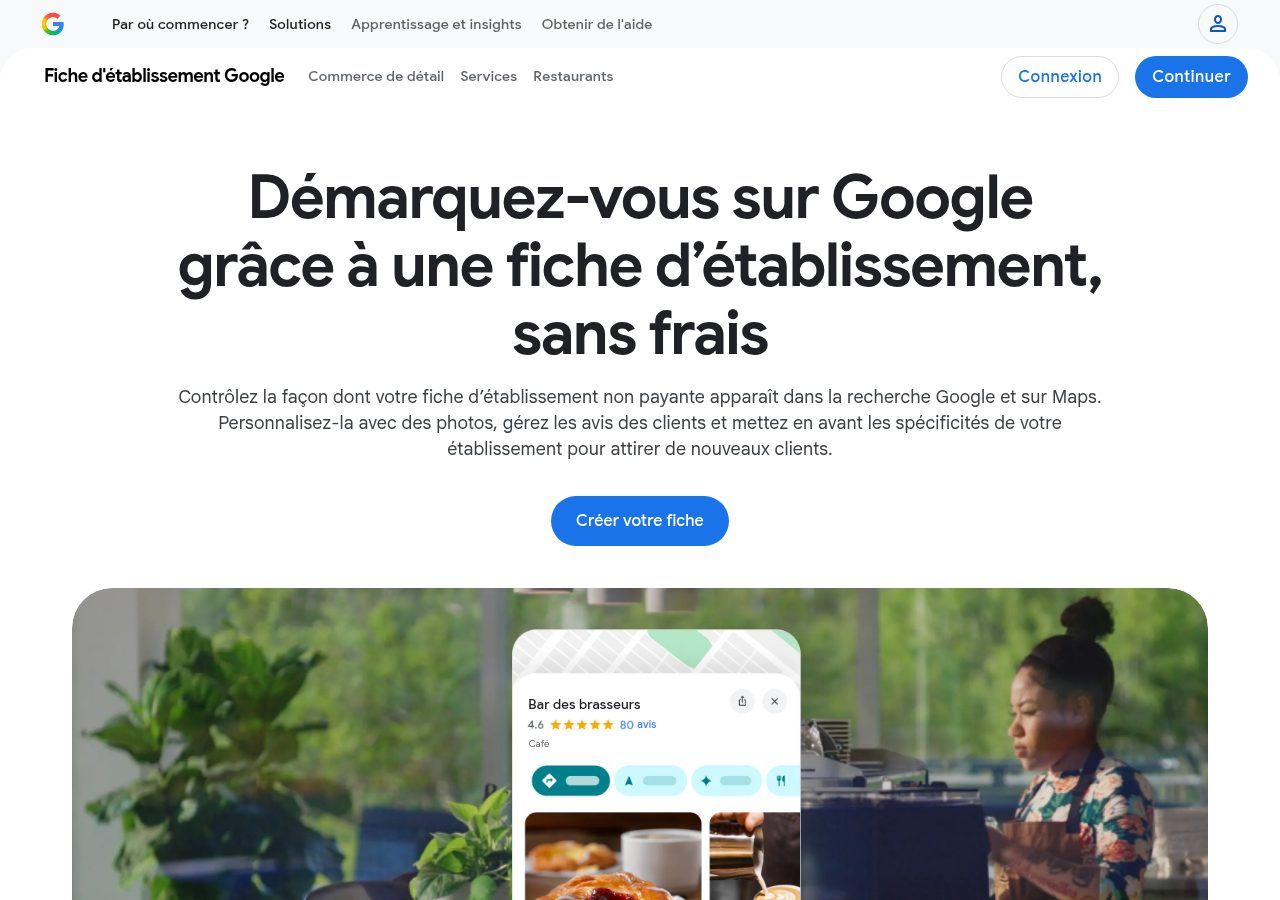
Source: screenshot of business.google.com/fr/business-profile/ (French version of the page), viewed on 15 October 2026.
Reviews: the strongest lever, and the most misused
Reviews work twice: on prominence (Google says so explicitly) and on the customer's decision, since people compare ratings before calling. Our view is simple: a 4.3 listing with forty recent reviews and polite replies inspires more trust than a 5.0 listing with three reviews from 2022.
What Google allows and recommends (official tips to get more reviews):
- Asking customers for a review with a link or QR code generated from the listing.
- Replying to reviews, briefly, politely and without a sales pitch.
- Replying to negative reviews without personal attacks, owning what needs owning and offering to sort out the problem offline.
What's forbidden, in black and white: offering an incentive (a free product, a discount) in exchange for a review, for changing a review or for removing a negative one. Google calls this fake engagement. Buying reviews, getting relatives to write them or posting them from accounts created for the purpose exposes the listing to restrictions, or even suspension. It isn't worth it.
Our approach on the ground: ask for the review when the customer is happy (successful delivery, end of a stay, completed appointment), on WhatsApp, with the direct link and a personal sentence. Not a bulk message sent to your whole contact list.
Your website: the complement your listing can't replace
A listing without a website works for a small shop. As soon as you want to compete on several services, in several towns, or against well-established competitors, the website makes the difference. It feeds relevance (Google better understands what you do) and prominence (other sites link to it).
- One page per key service and per city that matters, with real content, not the same page duplicated with a different city name. That's what we did for ourselves with our website design in Cotonou and web agency in Abomey-Calavi pages.
- Full contact details as text (not only inside an image): name, address or landmark, Plus Code, 10-digit phone number, opening hours.
- An embedded map and a link to your Google listing.
- LocalBusiness structured data, a small invisible piece of code that describes your business to search engines: name, address, phone, hours, GPS coordinates. Google documents the format on its local business structured data page.
- A fast mobile website on HTTPS. Most local searches happen on phones, often over 4G. See also what is HTTPS and an SSL certificate.
And if your website exists but doesn't show up anywhere, start with the technical basics: indexing, Search Console, sitemap. We explain them in how to appear on Google.
Local links and mentions
Prominence is also built outside Google: an article in a local outlet, a mention on a partner's website, a chamber of commerce, a trade association, a fair where you exhibit, a donor or an NGO network. Every link from a serious website to yours is a signal. Steer clear, though, of the "500 directories" packages sold online: old directories with no visitors bring nothing, and contact details that vary from one directory to the next create confusion rather than trust.
Measuring: knowing whether it works, without fooling yourself
Local SEO is measured in customers, not impressions. Three sources are enough to start:
- The Performance tab of your listing: it shows how people find your listing on Google Search and Maps, and what they do next (views, calls, direction requests, website clicks). This data is only available for verified listings (Google help on performance).
- Google Search Console for the website: the searches that show your pages and the clicks they get.
- Your own count: always ask "how did you find us?" and write down the answer. A simple spreadsheet will do.
To check your position, don't trust your own phone, which knows your habits. Ask two or three people in different neighbourhoods to type your main search and send you a screenshot. It's low-tech, but it's the reality your customers see.
How long before you see results? It depends on where you start and how crowded your sector is. A newly verified, well-filled listing can start appearing for its own name fairly quickly; climbing on competitive searches takes months of consistency, especially on reviews and links. Be wary of anyone who promises you a precise timeline.
Mistakes that cost you rankings (or your listing)
- Stuffing keywords into the business name. It's the number one temptation, and a reason for suspension under Google's guidelines.
- Creating several listings for the same business, for example one per service or one per employee when nothing justifies it.
- Leaving an old 8-digit number or a number nobody picks up.
- Listing an address where you don't receive anyone: mail forwarding, a virtual office, a coworking space with no sign and no staff on site.
- Buying reviews or rewarding positive ones.
- Abandoning the listing: wrong hours during Ramadan or the holidays, unanswered reviews, no photos since the day you opened.
- Believing "guaranteed number one" promises. Google itself says local ranking can't be bought.
What about artificial intelligence?
AI-generated answers, on Google or in assistants such as ChatGPT, are starting to recommend local businesses. Their sources? The same ones: business listings, reviews, websites and articles that mention you. A business that's invisible in regular local search has little chance of being recommended by an AI. The work described here is still the foundation, AI or not.
How much does local SEO cost?
A Google Business Profile listing is free. The real cost is time: filling it in properly, taking photos, replying to reviews, keeping hours accurate and producing useful web pages. A small organisation can do most of it alone by following this guide. When you need a website that converts, city pages, structured data or automated review collection through WhatsApp, outside support saves time.
At Guelichweb, we don't quote prices at random: every project gets a quote after a diagnosis, as explained on our offers page. And if your current website brings in no customers, read why your website is not bringing customers as well.
Local SEO FAQ
What is local SEO, in simple words?
Local SEO is the set of techniques that help a business appear in Google and Google Maps results when someone searches for a product or service near them, or in a specific city.
What does local SEO rely on?
Mainly a complete, verified Google Business Profile, consistent contact details everywhere, customer reviews, and a website that confirms what you do and where you are.
What's the difference between SEO and local SEO?
Regular SEO aims for visibility regardless of location. Local SEO targets searches tied to a place and adds a factor you don't control: the distance between the customer and your business.
Can you pay Google to rank first on Google Maps?
Not in the organic ranking: Google states there's no way to request or pay for a better local ranking. You can, however, buy ads, which are labelled "Sponsored".
Do you need a website for local SEO?
Not to get started: a well-filled Google listing is enough to appear on Maps. But a website strengthens your relevance and prominence, and quickly becomes essential against established competitors or when you offer several services.
My business has no precise address. What should I do?
Give the neighbourhood and a clear landmark, place the pin yourself on the actual entrance, and share your Plus Code. If you travel to customers without receiving them, choose a service-area listing and hide the address.
Does Google My Business still exist?
The service still exists, under the name Google Business Profile. Searches for "Google My Business SEO" are about the same tool.
Related reading: What is a search engine, What are SEO keywords and how to find them for free for your website and How to create a business blog that attracts customers.
Want to be found by customers in your neighbourhood?
We start with a diagnosis: your key searches, the state of your listing, the consistency of your contact details, what your competitors show and what your website does or doesn't bring. Only then do we decide what's worth doing. Explore our services and our offers.
Let's talk about your local visibility: [contact us](https://guelichweb.online/en/contact) for a first conversation and a diagnosis.