What is an AI agent? A simple definition and concrete examples for an SME or an NGO
G. CHRIST
Published on October 19, 2026

In 2026, the term "AI agent" is everywhere: in announcements from Meta, Google and Microsoft, on LinkedIn, and in freelancers' offers promising a "virtual employee" for a few thousand francs. Type "agent ia" into Google from Cotonou, Abidjan or Dakar and the suggestions tell the story: "free AI agent", "AI agent WhatsApp", "what is an AI agent", "AI agent example". People want to know what it is, and above all what it can do for them.
At Guelichweb, we design automations and chatbots for SMEs, NGOs and institutions in Benin. Our position is simple: an AI agent can save an enormous amount of time, but the word is also used to sell things that aren't agents at all. In this article we give you a clear definition, the difference with a chatbot or a classic automation, concrete examples suited to an organisation in West Africa, the tools to build one, the real limits and the right way to start.
What is an AI agent? The simple definition
An AI agent is a piece of software that you give a goal, and that decides by itself which steps to take to reach it: it observes the situation, chooses which tools to use (a file, a calendar, a CRM, a messaging app), acts, checks the result and starts again if needed, without you giving it an instruction at every step.
Definitions from the big players point the same way. Google Cloud describes AI agents as "software systems that use AI to pursue goals and complete tasks on behalf of users", showing reasoning, planning and memory, with "a level of autonomy" (Google Cloud). IBM puts it even more briefly: an AI agent is "a system that autonomously performs tasks by designing workflows with available tools" (IBM). The French government's digital inclusion guide (ANCT, Les Bases) sums it up for non-specialists: you set it a goal, and it decides how to reach it using the tools it has (ANCT, Les Bases, in French).
So what makes the difference is not how clever its text is. ChatGPT already writes very well. It's the fact that it acts: it looks up real information, fills a row in a spreadsheet, sends a message, books an appointment. A model that only answers your questions is an assistant. A model that goes and fetches, decides and executes is an agent.
The five parts of an AI agent
- A language model (GPT, Claude, Gemini, Mistral…): the "brain" that understands the request and chooses what to do.
- Instructions: the agent's role, its tone, what it may do and what it must never do.
- Tools: the connections to your systems (Google Sheets, CRM, calendar, email, WhatsApp, product database). Without tools there is no agent, only a text generator.
- Memory: the conversation history and, sometimes, lasting information about the customer or the case.
- Guardrails: limits, human approvals and a log of what it did. This is the part most often forgotten, and it's what decides whether the agent is usable in a business.
How an AI agent works: the 4-step loop
An agent doesn't follow a recipe written in advance. It runs in a loop: goal, observation, action, check. Anthropic, the company behind Claude, says it plainly: agents are typically "just LLMs using tools based on environmental feedback in a loop" (Anthropic).
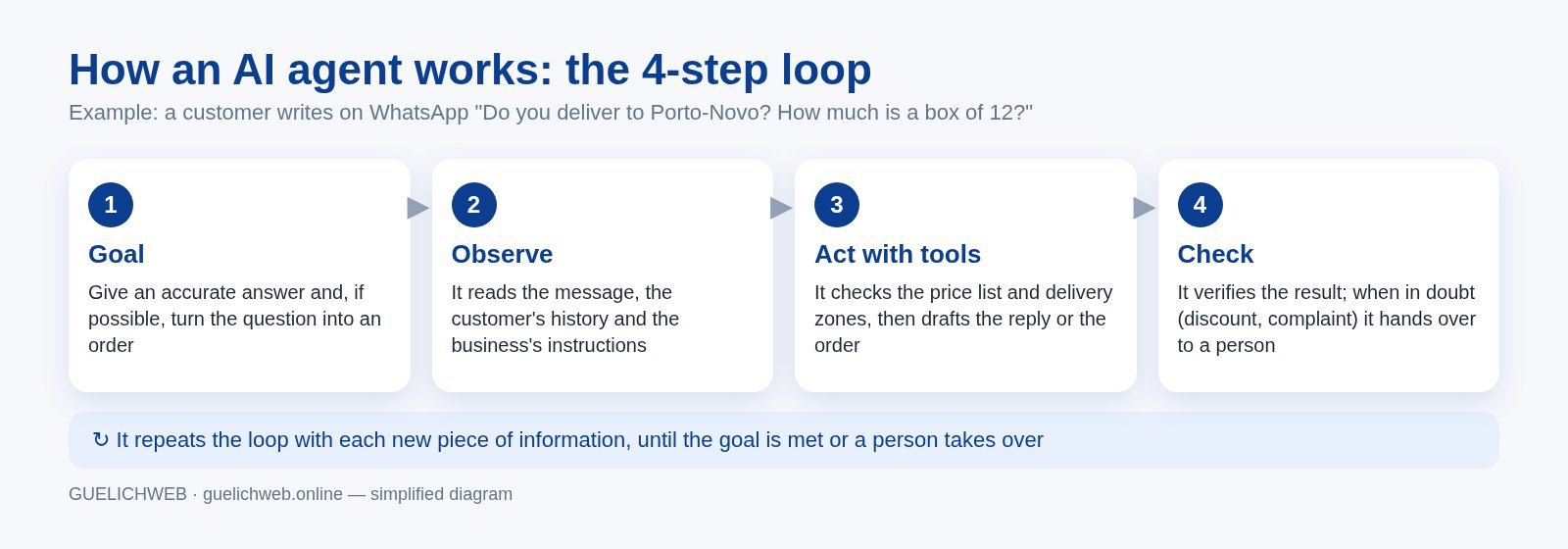
Source: Guelichweb diagram, simplified. The customer message is a made-up example.
Take a very common case in Benin. A customer writes on WhatsApp at 9 pm: "Do you deliver to Porto-Novo? How much is a box of 12?" A well-designed agent will:
- Understand the goal: give an accurate answer and, if the customer is ready, take the order.
- Observe: read the message, find the customer's history if there is one, re-read the business's instructions (delivery zones, lead times, payment methods).
- Act with its tools: check the up-to-date price list in a spreadsheet, confirm Porto-Novo is a delivery zone, work out the fees, draft the reply. If the customer confirms, record the order in the CRM or the tracking sheet.
- Check: make sure the price quoted matches the spreadsheet, and hand over to a person if the customer asks for a discount, complains or asks something outside its scope.
The next morning, the team finds the order recorded and the full conversation. Nobody wrote a rule saying "if the message contains Porto-Novo, then…". That's the whole difference with a menu-based bot.
AI agent, chatbot, assistant, automation: don't mix them up
This is where many offers get vague. Here's how we tell the four apart in practice:
- A classic chatbot follows a decision tree: "Type 1 for prices, 2 for delivery". It's predictable and cheap, but it gets stuck as soon as the customer leaves the script. We covered this in detail in WhatsApp chatbot: what it actually does.
- An AI assistant (ChatGPT, Gemini, Copilot used as they are) answers your requests, writes and summarises, but waits for you to tell it what to do, and you take the action afterwards. IBM puts it well: assistants suggest actions for users to approve, while agents can keep working on their own after the initial request (IBM).
- A classic automation (n8n, Make, Zapier) chains fixed steps: "when a form comes in, add a row to Google Sheets and send an email". No decisions, but complete reliability.
- An AI agent receives a goal and chooses its own steps and tools. It's the most flexible option, and therefore the least predictable.
Anthropic draws a distinction we find very useful: on one side workflows, where the language model and tools follow a path set in code; on the other agents, where the model directs its own process. And it recommends looking for "the simplest solution possible", adding complexity only when it's needed (Anthropic).
Our firm view: for most of the SMEs and NGOs we work with, the right starting point is not a fully autonomous agent, but a solid automation with one or two well-placed AI steps (understanding a message, sorting a request, drafting a reply). You move to a real agent when the need justifies it, not before.
Concrete examples of AI agents for an SME or an NGO
The examples on Google's first page often talk about global supply chains or year-end closing in large corporations. Here are uses that match the reality of an organisation in Benin or West Africa. For each one, we spell out what the agent does and where a person remains essential.
1. Answering customers on WhatsApp and taking orders
This is the number one use, because here WhatsApp is often a business's real shop window. The agent answers recurring questions (prices, opening hours, delivery zones, availability), relies on your real catalogue, records the order and alerts the team. People keep: discounts, complaints, and confirming mobile money payments as long as that isn't connected automatically.
2. Qualifying leads and filling the CRM
A prospect fills in the form on your website or writes on Messenger. The agent asks the two or three questions that matter (need, rough budget, timing, city), creates the record in the CRM, assigns the request to the right salesperson and writes a summary. It's the natural extension of the trio described in Website, WhatsApp and CRM. People keep: the call, the negotiation, the relationship.
3. Preparing quotes and proposals
From a customer request and your price grid, the agent drafts a quote in your template, with the right lines and quantities, then leaves it for approval. People keep: proofreading and sending. We never recommend letting an agent send a document that commits the business to a price on its own.
4. Sorting an overloaded inbox
An NGO receives job applications, partnership requests, supplier invoices and messages from beneficiaries at the same address. The agent reads, sorts, extracts the key information (amount, deadline, missing attachment), answers simple requests with an approved template and flags anything urgent. People keep: any sensitive or personal reply.
5. Consolidating an NGO's field reports
Field teams send their reports by form, voice note or photo of a paper sheet. The agent transcribes, puts the figures into a shared spreadsheet (see our Google Sheets guide), spots missing data and prepares a weekly summary for the coordination team. People keep: checking the figures before any report goes to a donor.
6. Chasing unpaid invoices and appointments
The agent checks the list of overdue invoices or tomorrow's appointments, writes a reminder suited to each case (a polite first reminder, a firmer second one) and sends it through the agreed channel. People keep: disputed cases and key customers.
7. Monitoring calls for tender
For a business that bids on public contracts or calls for proposals, the agent scans the chosen sources every day, filters them by your criteria (sector, region, amount) and sends a summary with the deadlines. People keep: the decision to bid.
The AI agent inside WhatsApp: what Meta offers in 2026
On 3 June 2026, Meta introduced Meta Business Agent, an AI agent built into WhatsApp Business. According to the official announcement, it answers questions specific to the business, recommends products from the catalogue, books appointments, qualifies leads, closes sales and lets the business decide when a team member steps in (WhatsApp Business, official blog). The same announcement says getting started is free and that the agent will later be offered through paid subscriptions. TechCrunch adds that Meta plans to include it in some tiers of its WhatsApp Business Premium subscription, and to bill large businesses by the tokens they use (TechCrunch).
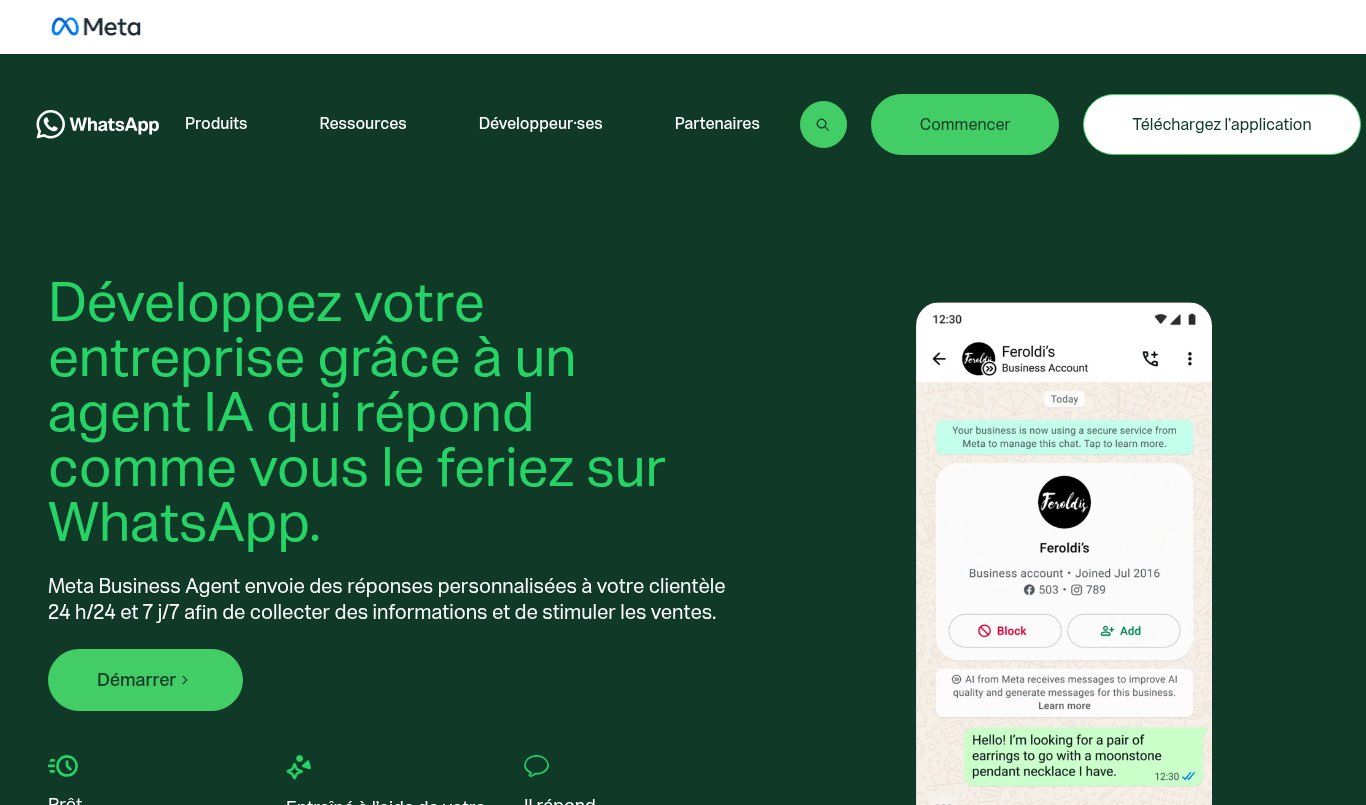
Source: whatsappbusiness.com, Meta Business Agent page (French version), screenshot taken on 19 October 2026.
One important point: the product page states the service is available "for eligible businesses in select markets" (WhatsApp Business). Before you build a strategy on it, check in the WhatsApp Business app, under Tools, whether the option shows up for your number.
Our view: for a shop that gets lots of simple questions, it's an excellent first step, with no development needed. But Meta's agent lives at Meta. It only knows what you give it (past chats, your website, your catalogue) and doesn't plug itself into your stock, CRM or invoicing. As soon as you want the agent to act inside your own tools, you need the WhatsApp Business API and an automation, as we do with our WhatsApp chatbots built on n8n in Benin.
Building an AI agent: the tools, from free to custom
Search suggestions make it clear: people look for how to build an AI agent "with Claude", "with Copilot", "ChatGPT", "Gemini", "Mistral", "with n8n". There are three families of tools.
Agents built into mainstream assistants
ChatGPT, Claude, Gemini, Copilot and Mistral let you create custom assistants with your own instructions and documents, sometimes connected to a few services. They're ideal for internal use (an assistant that knows your procedures, a meeting-notes writer). The limit: they do little inside your own systems and stay tied to a personal account.
Automation platforms with an agent module
This is our home ground. In n8n, the AI Agent node lets you build an agent by connecting a language model to one or more tools, and the agent decides which tool to call. The official documentation is explicit: you must connect at least one tool to an AI Agent node (n8n Docs). You then add memory so the agent can follow a conversation (n8n Docs, memory). Make offers a similar approach. To choose between them, read n8n or Make: which automation tool to choose.
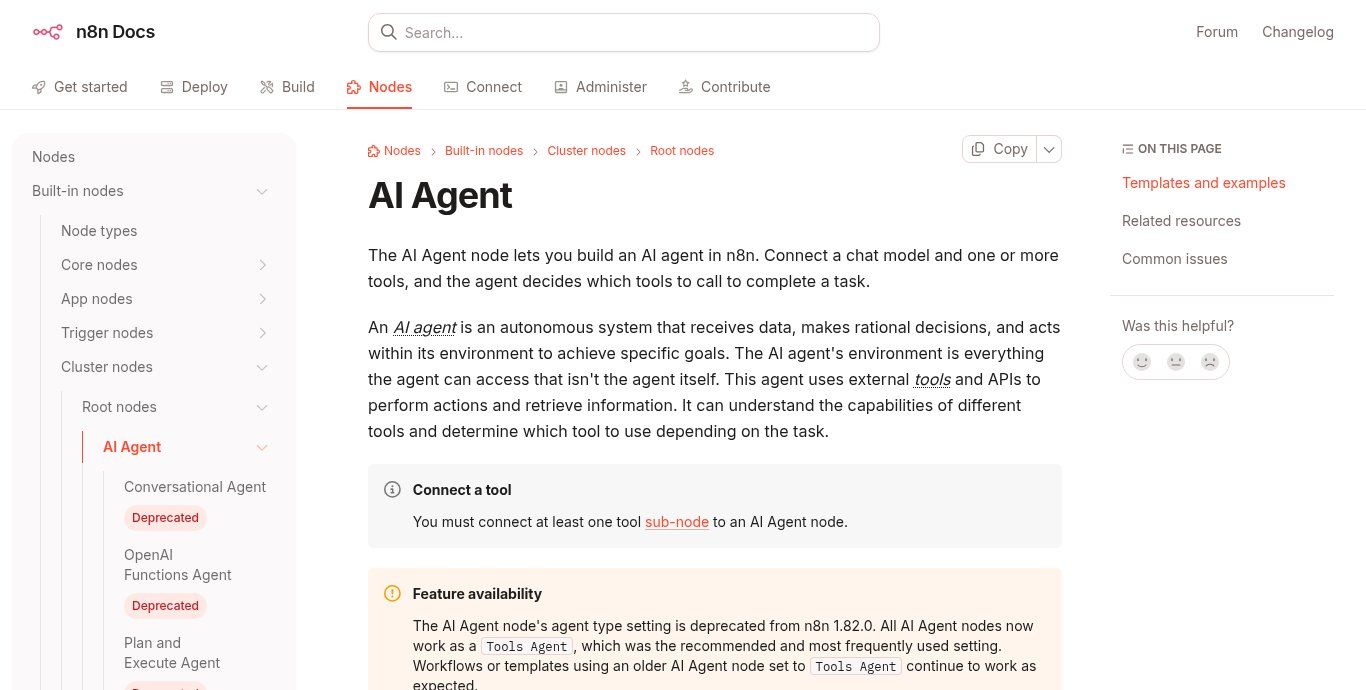
Source: docs.n8n.io, "AI Agent" page, screenshot taken on 19 October 2026.
Why it matters for an African SME: n8n can run on your own server, and it connects to WhatsApp, Google Sheets, CRMs, databases and almost any API, including those of mobile payment aggregators where they exist.
Custom development
For high volumes, sensitive data or complex business rules, the agent is coded directly against the model providers' APIs. More control, more work, more maintenance. It's rarely the right place to start.
"Free AI agent": true or false?
The tools can be free for testing: free tiers of the assistants, self-hosted n8n, Meta's free start. An agent in production never really is. There's the model usage (billed by the volume of text processed), hosting, the WhatsApp API, and above all the time spent setting it up and monitoring it. A free but badly tuned agent that quotes a customer the wrong price costs far more than a paid one with proper guardrails.
If you need an agent that answers calls or speaks out loud, platforms like ElevenLabs offer voice agents in many languages, with a free plan to test before committing a budget. Partner link: Guelichweb earns a commission if you subscribe, at no extra cost to you.
What an AI agent doesn't do well (yet)
We'd rather tell you now than have you find out with an unhappy customer:
- It can make things up. A language model can produce an answer that sounds right and is wrong. That's why you force it to rely on your data (catalogue, price grid) and forbid it from answering when the information is missing.
- Errors add up. Anthropic points out that agents' autonomy means higher costs and the potential for compounding errors, hence its advice to test extensively and add guardrails (Anthropic).
- It's only as good as your data. If your price list lives in three different files, the agent will be wrong three times as often. Tidying your data comes before AI.
- It costs more and responds more slowly than a simple rule. To "send a receipt after payment", a classic automation is more than enough.
- Local languages and habits need testing. Customers who mix French, Fon or English, or who send voice notes, must be part of your trials before launch.
Personal data: what you need to know in Benin
An AI agent reads names, phone numbers, addresses and, at an NGO, sometimes health or social information. In Benin, personal data protection is governed by the Digital Code (Law No. 2017-20 of 20 April 2018), whose Book V deals with the protection of personal data (text published by the APDP, in French; General Secretariat of the Government). The authority in charge is the APDP, Benin's personal data protection authority (APDP).
In practice, and without claiming to replace a lawyer, here are our basic rules for any agent project:
- Give the agent only the data it needs for its task.
- Tell customers or beneficiaries that they are talking to an automated system, and give them access to a person.
- Know where the data is sent (which model provider, which country) and, where possible, choose offers that don't use your data to train their models.
- Keep a log of the agent's actions.
- Check with the APDP which formalities apply to your data processing.
Where to start: the 5-step method
- Pick one repetitive, measurable task. Not "automate customer service", but "answer the 20 questions we get on WhatsApp every day".
- Measure where you are now: how many messages, how long replies take, how many requests are lost. Without that baseline, you can't tell whether the agent pays off.
- Tidy the data the agent will need: a single price list, an up-to-date FAQ, clear delivery zones.
- Start with a workflow that has one AI step, then give the agent more autonomy as results prove reliable. Keep human approval on anything that commits the business.
- Review the conversations closely in the first weeks and adjust the instructions. You tune an agent like a new employee you're training, not like a device you plug in.
How much does an AI agent cost for an SME?
It depends on the number of conversations, the tools to connect, hosting and how much control you want. We broke down the cost items (setup, subscriptions, model usage, maintenance) in How much does AI automation cost in Benin. At Guelichweb, we don't publish catalogue prices: we first diagnose your processes, then send a tailored quote, as explained on our offers page.
AI agent FAQ
What is the definition of an AI agent, in one sentence?
An AI agent is software that receives a goal and chooses its own steps and tools to reach it, acting inside your systems rather than just answering.
What is the difference between an AI agent and a chatbot?
A classic chatbot follows a script written in advance. An AI agent understands a free-form request, decides what to do and can act: check stock, book an appointment, record an order.
What is the difference between an AI agent and ChatGPT?
ChatGPT used as it is, is an assistant: it answers and you act. It becomes an agent when it's connected to tools and allowed to chain actions towards a goal.
Can you build an AI agent for free?
For testing, yes: free tiers of the assistants, self-hosted n8n, Meta Business Agent's free start. In production, you need to budget for model usage, hosting, the WhatsApp API where relevant, and monitoring.
Can an AI agent work on WhatsApp?
Yes, in two ways: with Meta Business Agent inside the WhatsApp Business app, where it's available, or with the WhatsApp Business API connected to a platform such as n8n so it can act in your own tools.
Will an AI agent replace my staff?
Not in a well-run SME. It takes over repetitive tasks (standard replies, data entry, reminders) so the team can focus on selling, advising and the difficult cases.
Is my data safe with an AI agent?
That depends on the choices made when it's designed: what data the agent sees, which provider it passes through, who can read the log. In Benin, the reference framework is the Digital Code and the APDP.
Related reading: What is a CRM, What is the WhatsApp Business API and What is Canva.
Want to know whether an AI agent makes sense for your organisation?
A good AI agent starts with a simple question: which task costs you the most time every week? We start there, look at the tools you already use, and tell you honestly whether an agent, a simple automation or nothing at all is the right answer. Explore our services and our offers.
Let's talk about your project: [contact us](https://guelichweb.online/en/contact) for a first conversation and a diagnosis.