Electronic invoicing: what it is, obligations and how SMEs in Francophone Africa can prepare
G. CHRIST
Published on November 5, 2026

Many SME owners, shopkeepers and NGO managers across French-speaking Africa believe they already “do electronic invoicing”… because they send a PDF over WhatsApp or email. Technically, that is a digital invoice. It is not necessarily an electronic invoice in the regulatory sense: one that is generated, certified and traced under the tax authority’s rules in that country.
The confusion is expensive. In Benin, the normalised invoice via MECeF / e-MECeF is already the expected standard for a large share of transactions. In Côte d’Ivoire, the Facture Normalisée Électronique (FNE) has been rolled out widely, and the DGI regularly reminds taxpayers that only FNE / RNE documents are accepted to justify certain expenses and deduct VAT. Elsewhere, calendars differ — inventing a “mandate” that is not clearly documented for a given country would be irresponsible.
At Guelichweb, we help organisations digitise their processes (website, forms, automation, data). In this guide we explain what electronic invoicing really is, how it differs from a plain PDF, what is happening in Benin and Côte d’Ivoire (official sources), how an SME can prepare without panicking, and where a web agency’s role stops. We do not invent our own price list: for hands-on help (API integration, automation, website), we send a quote after a diagnostic.
In short: a PDF sent on WhatsApp is not automatically a regulatory e-invoice. First check your country’s regime (Benin: e-MECeF; Côte d’Ivoire: FNE/RNE). Register on the official platform, pick the right channel (portal, API, terminal), train the team, and keep the evidence. For Senegal or Cameroon, do not copy the Ivorian calendar: verify with the local tax authority.
What is electronic invoicing, exactly?
An electronic invoice (e-invoicing / e-invoice in international discussions) is an invoice issued, transmitted and received in a structured electronic form that enables automated processing — and, in many African countries, certification by the tax administration before or at the moment of issuance.
Three ideas to keep separate:
- Paper invoice — physical document, stamp, booklet. Still useful in some contexts, but increasingly insufficient where electronic normalisation is mandatory.
- PDF / image invoice — a frozen digital file. Handy for archiving and WhatsApp, but only a rendering. Without the country’s fiscal platform, it is often not the normalised invoice that is required.
- Regulatory electronic invoice — created in (or certified by) the official system: e-MECeF in Benin, FNE/RNE in Côte d’Ivoire, or another scheme elsewhere. It carries security elements (signature, NIM, QR code, electronic sticker, official number…).
Internationally, the European Commission describes e-invoicing as the electronic exchange of invoices in a structured format (not merely a “photo” PDF). See What is eInvoicing and the eInvoicing portal. That European framework does not bind Benin or Côte d’Ivoire, but it helps explain why “PDF = e-invoice” is a false shortcut.
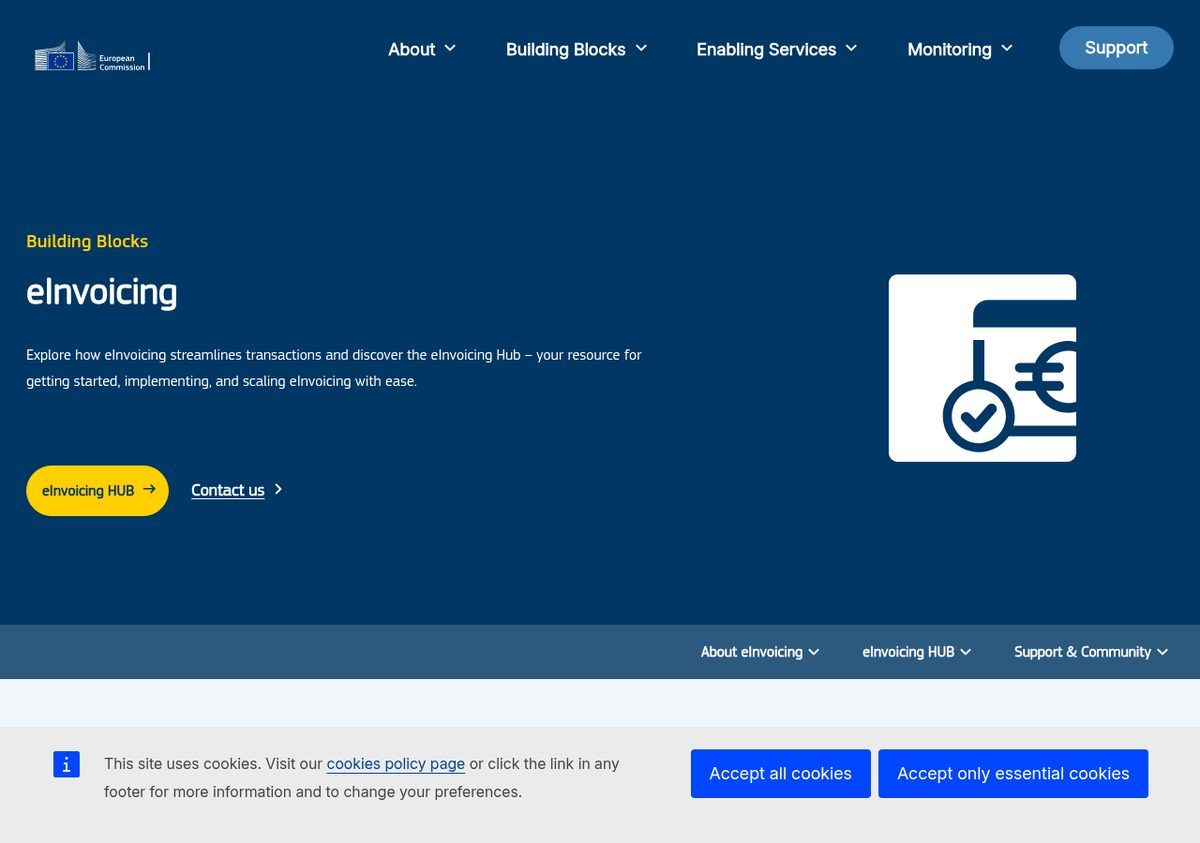
Source: European Commission — eInvoicing, captured on 05/11/2026.
Why governments push electronic invoicing
The motives are rarely “to please software vendors”. They are fiscal and operational:
- Reduce VAT fraud and fake paper invoices.
- Secure state revenue with a machine-readable trail.
- Simplify audits: an officer can check a QR / number instead of photocopying a booklet.
- Speed up B2B and B2G exchanges (government, local authorities, large buyers).
For an SME, the immediate interest is more down-to-earth: being able to deduct VAT when the rules require it, obtaining a tax clearance certificate, answering a tender, and avoiding a fine because “we always did it this way”.
WhatsApp PDF vs electronic invoice: the classic trap
Typical scene in Cotonou, Abidjan or Dakar: the salesperson builds a nice invoice in Word / Excel / Canva, exports a PDF, sends it on WhatsApp, the client pays with mobile money… everyone is happy — until an audit, or until a donor / large account demands a normalised invoice.
The PDF remains useful as a readable copy. That is not the weak point. The weak point is believing the PDF replaces the fiscal platform. Under electronic normalised invoicing:
- The “valid” invoice is the one certified (or issued) by the official scheme.
- The PDF / A4 downloaded from the platform is usually the rendering of that already sealed invoice.
- A homemade PDF without certification is, in those countries, only a working document — not a complete fiscal proof.
We say it bluntly: if your process stops at “generate a pretty PDF”, you are not ready for an FNE / MECeF audit. You are ready for WhatsApp. That is not the same thing.
In Benin: MECeF, e-MECeF and the normalised invoice
Benin moved early. The normalised invoice relies on Certified Electronic Invoicing Machines (MECeF) and on the online version e-MECeF, presented by the General Directorate of Taxes as the dematerialised version of those machines.
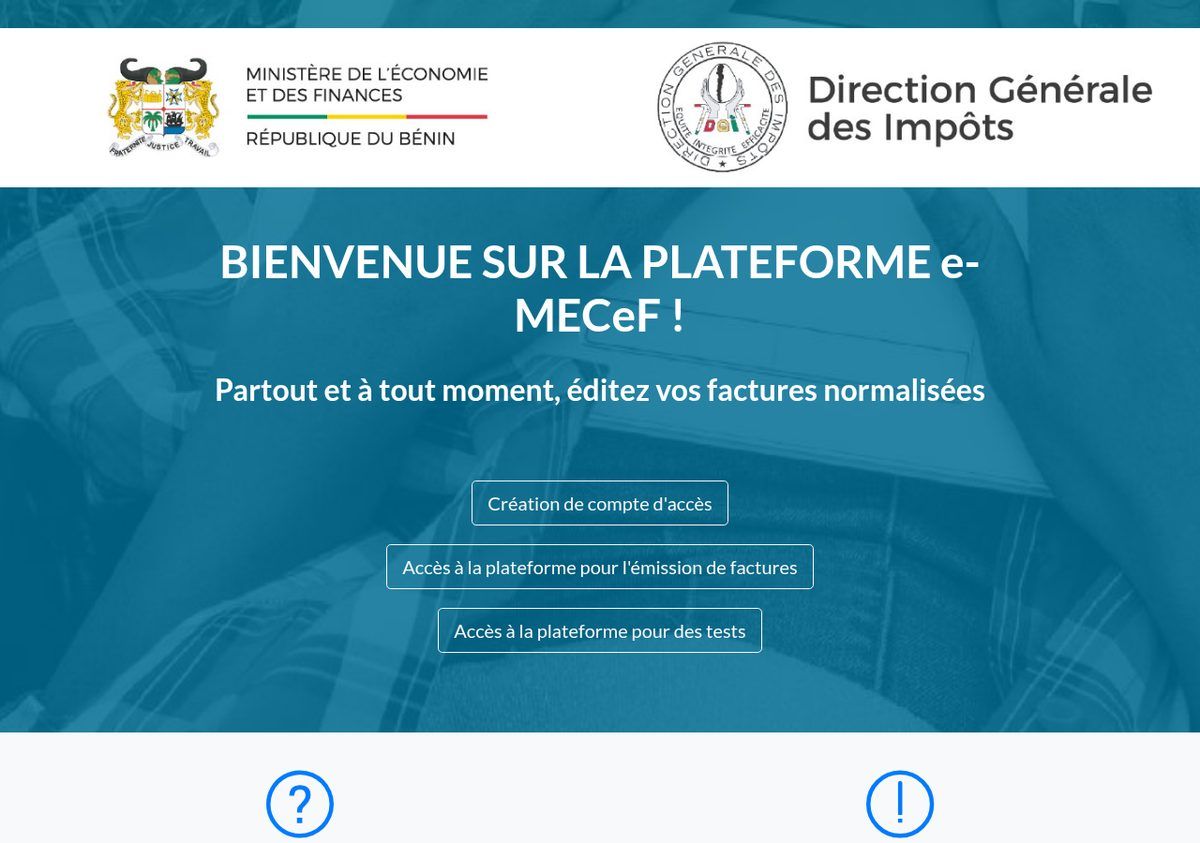
Source: e-MECeF — Benin General Directorate of Taxes, captured on 05/11/2026.
According to the official page e-mecef.impots.bj (HTTP 200 on 05/11/2026):
- e-MECeF lets you issue normalised invoices online, anywhere and anytime (subject to connectivity and an account).
- Announced features: retrieval of the MECeF/DGI code, invoice types, items and tax groups, A4 / PDF output, periodic reports.
- Typical access paths: create an account, access for issuance, access for tests.
- If you want to connect your own enterprise invoicing system (SFE), it must first be approved by the DGI.
The portal impots.bj remains the institutional entry point for tax services. For ministry communications, see also finances.bj.
What we state — and what we do not
We state, because it is documented on official sites: Benin runs a normalised invoice scheme (MECeF / e-MECeF) and an online platform to issue those invoices.
We do not replace your tax centre. The exact scope of the obligation (regimes, thresholds, exemptions, fines) depends on the General Tax Code and the texts / notices in force when you read this. If you fall under a special regime (for example outside VAT), check with your tax centre rather than trusting a blog summary — including ours.
In Côte d’Ivoire: FNE, RNE and the DGI portal
In Côte d’Ivoire the scheme is called Facture Normalisée Électronique (FNE) and Reçu Normalisé Électronique (RNE). The official information portal is fne.dgi.gouv.ci; the institutional DGI site is dgi.gouv.ci.
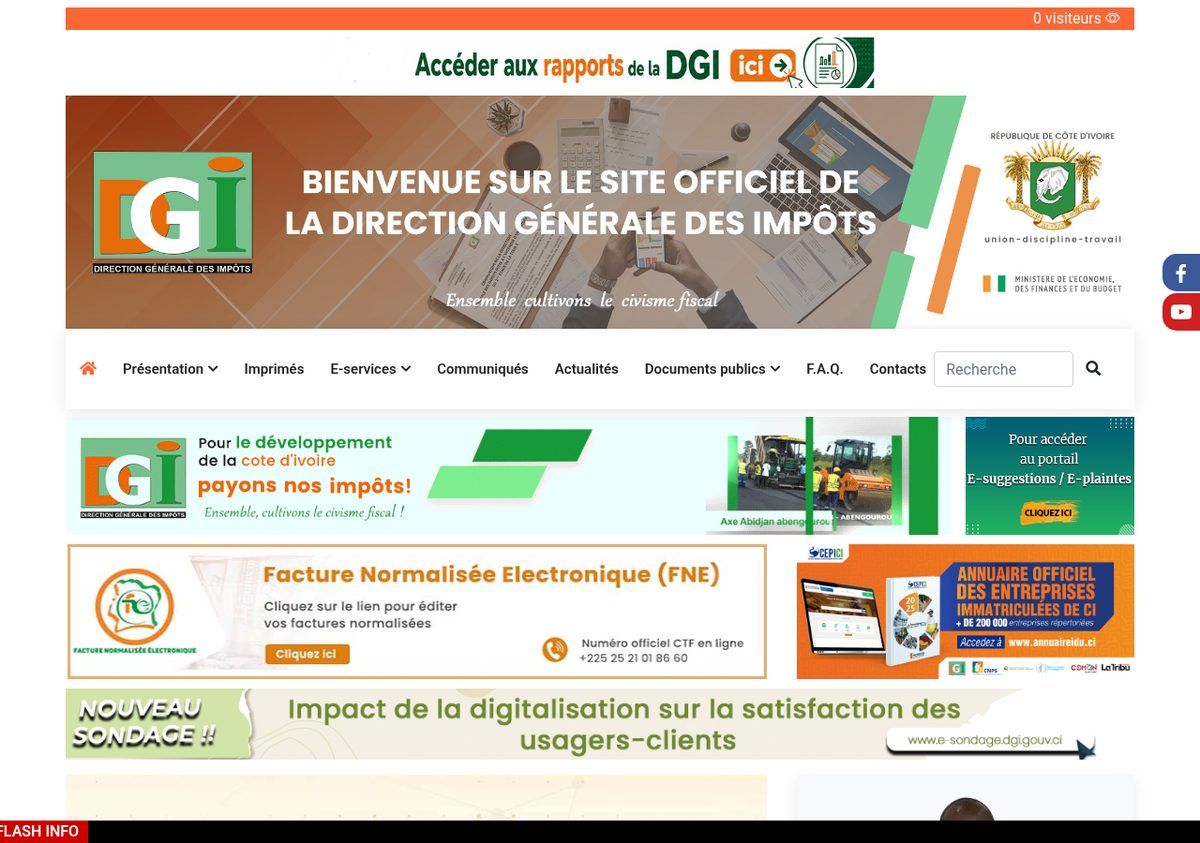
Source: General Directorate of Taxes — Côte d’Ivoire, captured on 05/11/2026. (The dedicated FNE portal is fne.dgi.gouv.ci.)
According to the official FNE FAQ and the invoice generation process page (checked on 05/11/2026, HTTP 200):
Three ways to generate an FNE / RNE
- Default path — FNE platform invoicing module and FNE mobile app. Open to all enterprise categories / tax regimes.
- API interfacing — for companies that already have invoicing software and want it certified against the FNE platform.
- TERNE (terminal for electronic normalised receipts) — especially for some lump-sum regimes, cash registers, multi-aisle stores: issuance of RNE.
Who is covered (per the FNE FAQ)
The FAQ states that, except for listed exemptions (the FAQ refers to article 145 of the Tax Procedures Book), businesses in activity must issue an FNE or an RNE. Exemptions are listed on the portal (examples cited in the FAQ / enterprises page: certain public utilities for water-electricity-phone, pharmacies, airlines for tickets, petrol stations for fuel, banks, insurers, etc.). The exact, up-to-date list lives on fne.dgi.gouv.ci/entreprises.php — that page prevails over our summary.
A practical point the DGI repeats in its notices: registration on the FNE platform is a condition for issuing the tax clearance certificate (ARF), and physical normalised invoices have been progressively replaced by FNE. Follow the portal notices for deadlines that apply to your regime — they change.
What about elsewhere (Senegal, Cameroon, France)?
Google suggestions for “facture électronique sénégal” or “cameroun” exist, but for this run we did not find a single official portal documenting a mandate as clearly as e-MECeF or FNE. So do not copy the Ivorian calendar onto Dakar or Douala.
In France / the EU, the 2026–2027 debate on B2B e-invoicing (accredited platforms, e-reporting) is noisy — hence the SEO chatter about “mandatory from when”. That is not the same scheme as FNE or MECeF. If you invoice European clients, also look at exchange networks such as Peppol, which are distinct from West African fiscal platforms.
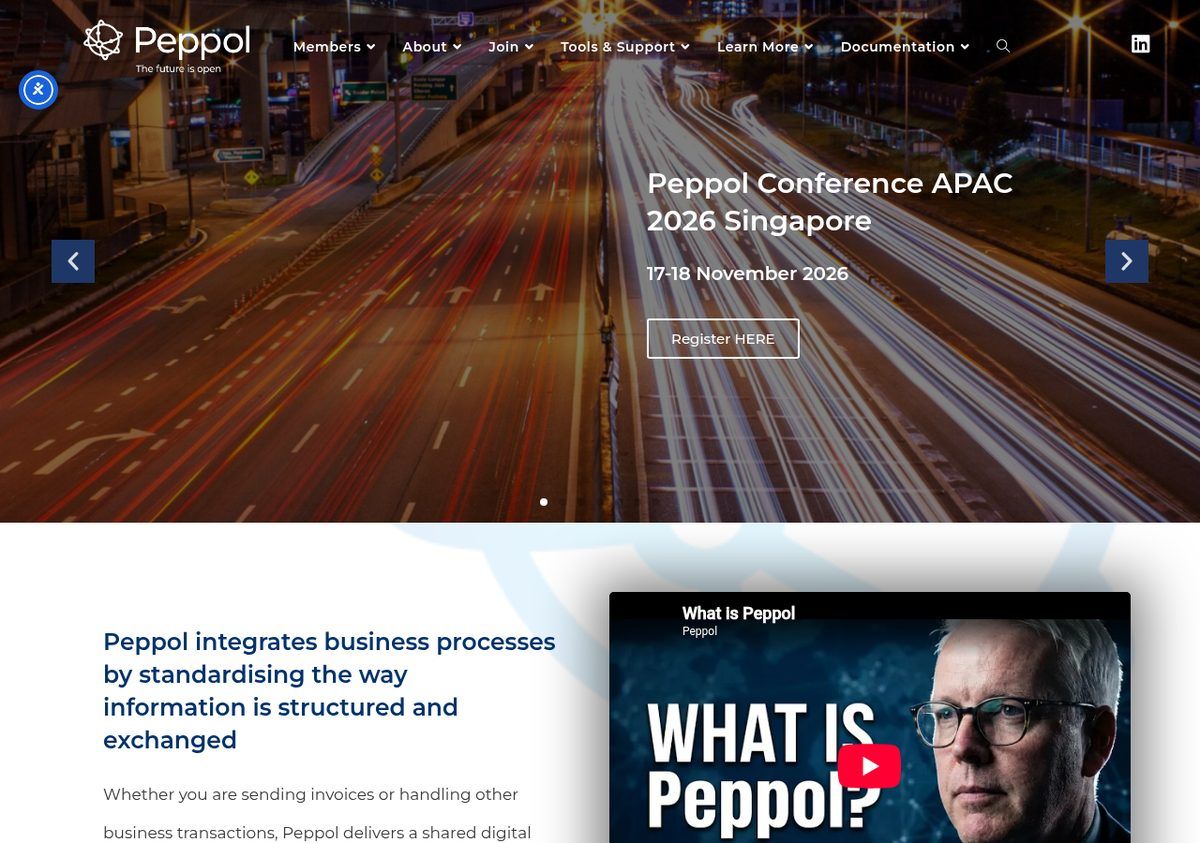
Source: Peppol, captured on 05/11/2026. Peppol is an international interoperability framework; it is not a substitute for e-MECeF or FNE.
How an SME / NGO can prepare (practical plan)
Here is the method we recommend — pragmatic, in order, without empty “digital transformation” talk.
1. Diagnose your tax situation (not your logo)
- Main country of taxation (Benin, CI, other).
- Regime (real, micro, entreprenant, exemptions…).
- VAT / TPS liability or not.
- Invoice volume / month and sales channels (shop, WhatsApp, website, public tenders).
Without that, you will buy “FNE-compatible” software while you are based in Benin — or the reverse.
2. Create the account on the official platform
- Benin: e-mecef.impots.bj — create an account, then use tests if needed.
- Côte d’Ivoire: register via dgi.gouv.ci / fne.dgi.gouv.ci / e-impôts per DGI instructions.
Keep credentials out of the shared WhatsApp box for the whole team. A tax login is a company secret.
3. Choose the issuance channel
- Low volume → official web portal / mobile app. Less tech, more human discipline.
- Medium volume + Excel / Sheets → often still the portal, with one dedicated person. If you already organise data in a spreadsheet, see What is Google Sheets?.
- Existing business software → request the API / SFE approval. This is where an API and task automation become useful.
- Cash desk / store → TERNE-type terminal (CI) or physical MECeF (Benin) under local rules.
4. Clean customer and item master data
Client IFU / NIF, address, stable item labels, correct tax groups. An electronic invoice with the wrong tax code is a time bomb. If you sell via a WhatsApp Business catalog, align product references with the fiscal platform.
5. Train the team and write a one-page procedure
- Who issues the invoice?
- In which tool?
- What if the client refuses the invoice?
- What if the Internet is down? (official fallback only — not an invented “we will send a PDF tomorrow”)
- Where do we archive the PDF + certification number?
6. Connect the rest of the information system (optional but powerful)
Once the official invoice is issued, you can still automate: WhatsApp alert to the accountant, copy to Drive, line in a KPI dashboard, payment reminder. Typical tools: n8n / Make. Caution: automation does not replace fiscal certification; it follows it.
30-minute checklist for a busy manager
- Open your tax authority’s official site (Benin: e-MECeF; CI: FNE / DGI).
- Check whether your organisation already has an account / registration.
- Count roughly how many invoices you issue per week.
- List sales channels (WhatsApp, shop, website, tenders).
- Name who, tomorrow morning, will own issuance.
- Ask your accountant / tax centre for written confirmation of your regime.
- Decide: portal alone, or need for API / terminal.
- Schedule two hours of team training this week.
- Create an archive folder (Drive / NAS) “Certified invoices 2026”.
- Update your terms of sale / legal pages if you sell online — a normalised invoice does not replace your legal pages.
Common mistakes (and how to avoid them)
- Confusing PDF with a normalised invoice — the most common. Fix: issue on the platform first, then share the official PDF.
- Waiting for an audit to register — in CI, FNE registration conditions the ARF among other things. Do not gamble.
- Leaving tax credentials in the WhatsApp group — internal fraud risk and ghost invoices.
- Raising prices “because of the normalised invoice” — in Benin, DGI notices have already reminded taxpayers that issuing a normalised invoice does not authorise abusively changing the price depending on whether the client asks for the invoice.
- Ignoring the buyer — in some texts the buyer must also demand a normalised invoice. Train your large accounts.
- Buying software before the diagnosis — start with the official portal; the API comes later.
- Copying another country’s calendar — Ivorian FNE is not e-MECeF, which is not Peppol, which is not Chorus Pro.
What Guelichweb can (and cannot) do
We are not a tax centre and we do not issue FNE / MECeF on your behalf. We can help you:
- Clarify your digital process (website, forms, shop, WhatsApp).
- Prepare API interfacing between your tool and the fiscal platform (when you have chosen that path and the administration allows it).
- Automate the after-invoice steps (archiving, alerts, KPIs).
- Update your web presence (online shop, legal pages).
For concrete support, reach us via /en/contact or see /en/offres. The quote follows a diagnostic — not a magic grid published here.
FAQ — Electronic invoicing (Francophone Africa SMEs)
Is a PDF sent on WhatsApp an electronic invoice?
Not in the regulatory sense. It is a digital invoice. The electronic invoice expected by the administration is the one certified / issued via the country’s official scheme (e.g. e-MECeF, FNE).
Is electronic invoicing mandatory in Benin?
Benin runs a normalised invoice system (MECeF / e-MECeF) documented on official sites. The precise obligation depends on your tax regime and current texts: confirm with your tax centre / impots.bj.
Is FNE mandatory in Côte d’Ivoire?
According to the official FNE FAQ, except for listed exemptions, businesses in activity must issue an FNE or an RNE. Check fne.dgi.gouv.ci and your tax centre for your case.
Do I need Peppol to invoice in Benin or CI?
Not for local tax compliance. Peppol mainly serves international / European exchange. Locally, use e-MECeF or FNE/RNE.
How much does a sticker / certification cost?
In Côte d’Ivoire the FNE FAQ publishes electronic sticker prices (amounts in FCFA incl. tax). They can change: read the FAQ / official notices. In Benin, check current conditions on e-MECeF / with the DGI — we do not freeze a tariff here.
Can I connect my software via API?
Yes: planned in CI (FNE API integration guide) and in Benin (approved SFE). Expect tests, administration validation, then production.
What if the Internet is down?
Use only the fallback procedure defined by the administration (not a homemade invention). Document the incident.
Are NGOs concerned?
If they issue invoices / receipts in commercial or taxable activities, potentially yes. “NGO” status does not automatically exempt you. Ask the administration for written confirmation.
Conclusion
For an SME in French-speaking Africa in 2026, electronic invoicing is no longer an “innovation” topic: it is about compliance and business continuity. Distinguish PDF from normalised invoice. Anchor yourself on official portals (e-MECeF, FNE, DGI CI). Train the team before buying software. Automate only after certification.
If you want an outside look at your website → WhatsApp → invoicing → archiving chain, write to us via /en/contact. We will tell you frankly what belongs to the tax authority… and what we can digitise with you.