Intranet: a clear definition and why it matters for an SME or NGO
G. CHRIST
Published on October 14, 2026

You often hear the word "intranet" in tenders, IT audits or conversations with a donor. But when you ask what it actually means, the answers float: "it's the internal website", "it's like a private Drive", "it's Facebook but for the company". None of these is completely wrong. None is precise enough to decide whether you need one.
At Guelichweb, we prefer to start with the definition, then look at the real benefit for an SME, NGO or institution working in Benin or elsewhere in French-speaking Africa. Not big-corporate jargon: what changes (or does not change) the way you share information.
Intranet definition, in one sentence
An intranet is a private computer network, reserved for the members of an organisation, that uses the same protocols and technologies as the Internet.
In other words: you browse with a browser, open pages, download files, sometimes fill in forms… but only authorised people can get in. It is not the public web.
That is exactly what the Grand dictionnaire terminologique of the Office québécois de la langue française records: a private computer network inside an organisation that uses Internet communication protocols and technologies. The OQLF also notes that in France the term intranet has been officially recommended by the Commission d'enrichissement de la langue française since 1999.
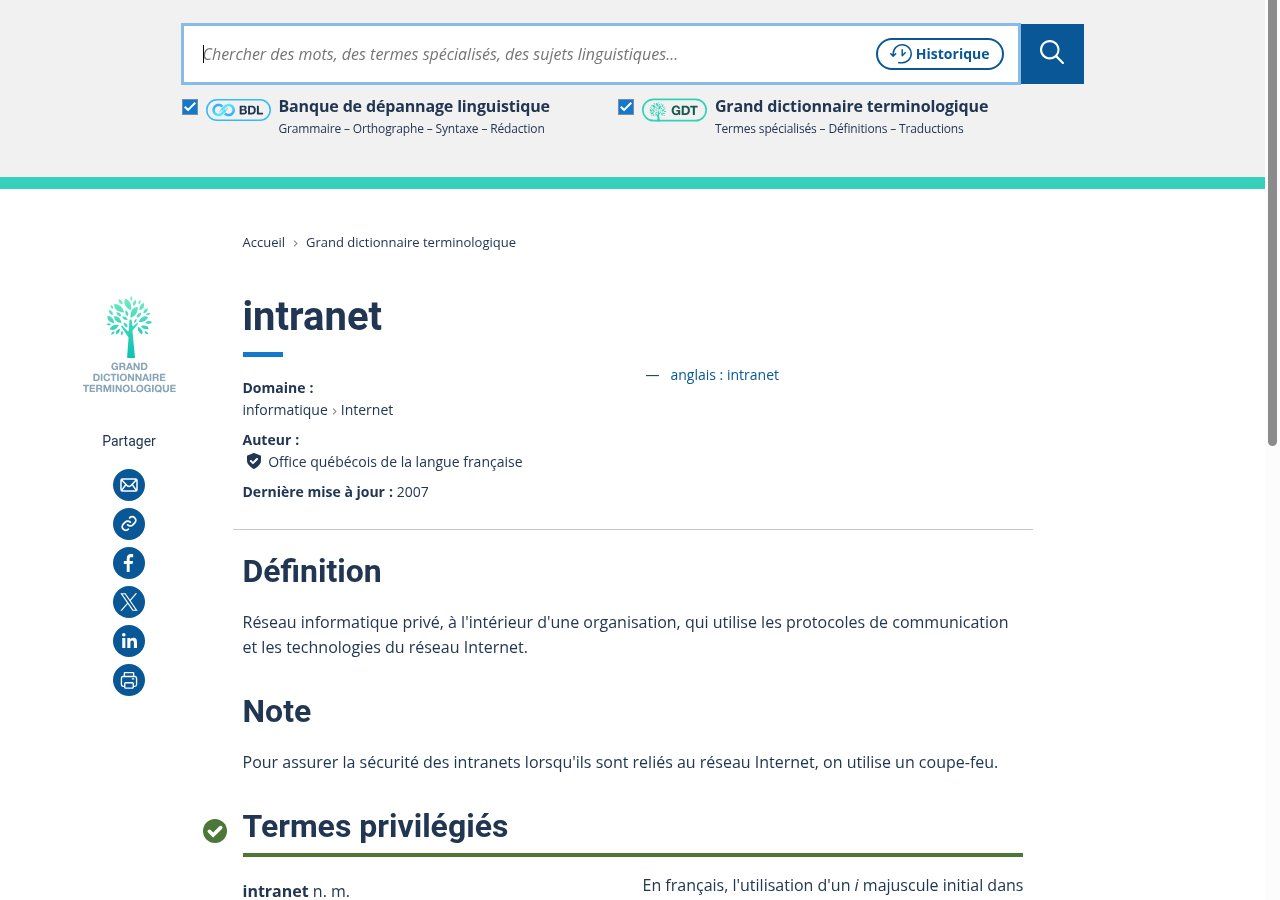
Source: screenshot of the "intranet" entry in the Grand dictionnaire terminologique, Office québécois de la langue française (vitrinelinguistique.oqlf.gouv.qc.ca), viewed on 14 October 2026.
Wikipedia says the same: a private network used by an organisation's staff, with Internet protocols (TCP, IP, HTTP, messaging, and so on). It does not have to be local: an intranet can link several offices, including over the Internet, as long as access stays controlled.
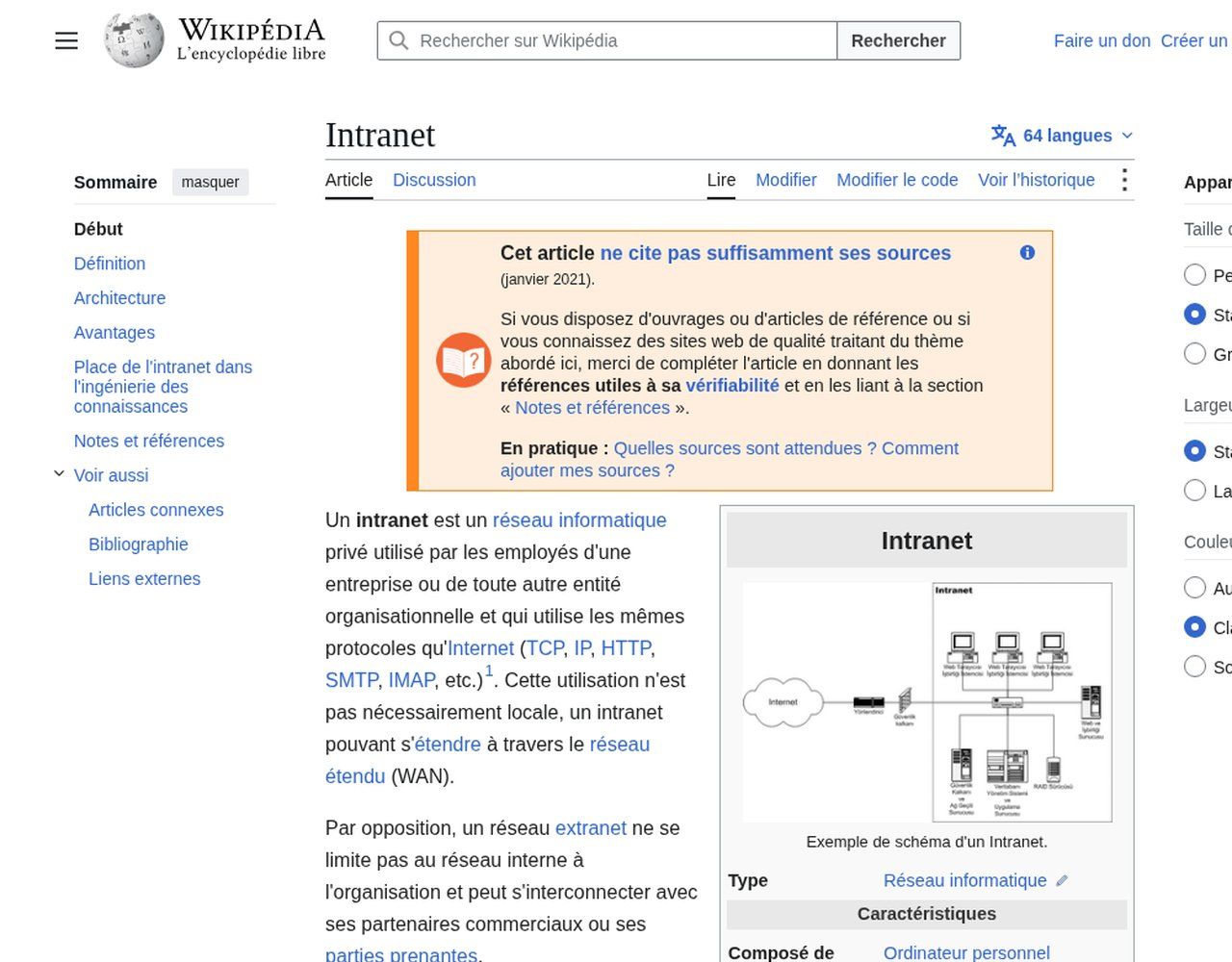
Source: screenshot of the French Wikipedia "Intranet" page (fr.wikipedia.org), viewed on 14 October 2026.
Intranet, Internet and extranet: no more mix-ups
The three words look alike, and that is where many quotes become vague.
- The Internet is the global public network. Your website, WhatsApp, Google: all of that runs on the Internet.
- An intranet is private: reserved for your team (employees, volunteers, interns, according to your rules).
- An extranet extends the intranet to selected external partners: a supplier, a donor, a consultant. The OQLF defines it as an intranet extended to communicate with certain outside organisations.
In everyday speech, people also say "intranet site" for the internal web portal: the home page with procedures, HR notices and document templates. That portal is often the visible part of the intranet, but an intranet can also include file sharing, internal messaging or business applications.
Do not confuse it with your public website either: the brochure site speaks to customers and partners; the intranet speaks to your team.
What is an intranet for, in practice?
Strip away the technical vocabulary and an intranet does three jobs:
- Centralise useful information: procedures, org chart, letter templates, fee grids, meeting notes, internal contacts. One up-to-date address instead of ten versions in WhatsApp chats.
- Collaborate without mixing everything: project folders, task tracking, spaces by department or programme. Each person sees what they are allowed to see.
- Simplify internal requests: leave requests, expense notes, activity sheets, field-mission checklists. Less paper, fewer forgotten steps.
For an NGO the benefit is often even clearer: donor reporting, template libraries, mission calendars, partner contact bases. For a service SME in Cotonou or Abomey-Calavi, it is often "finally one place to find the right quote template and the latest price list".
Why this matters for SMEs and NGOs in French-speaking Africa
In Benin, DataReportal estimates there were 4.80 million internet users in October 2025, or 32.2% of the population. The phone is the first screen. So many teams already run an "improvised intranet" on WhatsApp, Google Drive or a USB stick that travels around the office.
It works… until the day when:
- someone leaves and takes the history with them on a personal phone;
- three versions of the same document circulate and nobody knows which is official;
- a donor asks for a written procedure that nobody can find;
- an intern has access to too much information, or a colleague to too little.
An intranet is not magic. But it is the structured answer to that mess: a space you own, with access rights, a folder logic, and ideally someone responsible for keeping it up to date.
Our view is clear: if your team has more than five people exchanging critical files every week, "everything on WhatsApp" becomes an operational risk, not just a discomfort. It is the same reasoning as for a public website that is no longer enough without a CRM: we covered that in website, WhatsApp and CRM.
What an intranet is not
- It is not automatically a six-figure project. An SME can start with a simple portal: notices, documents, links to tools you already use.
- It is not a replacement for WhatsApp. WhatsApp remains excellent for urgency and closeness. The intranet keeps what must last.
- It is not a public website in disguise. If your customers must access it freely, you are talking about something else: a website, a client area, or an extranet.
- It is not "having a Drive". A shared folder helps. An intranet often adds the home page, finer rights, forms and governance.
When an SME or NGO really needs one
Ask yourself these questions:
- How many people must find the same information every week? Beyond a tiny close-knit team, the need rises quickly.
- Do you have traceability obligations? Funded NGO, firm, school, clinic: often yes.
- Do sensitive documents circulate without control? Salaries, contracts, beneficiary data: controlled access is then no longer optional.
- Who will keep it alive? Without an internal editorial owner, even the nicest intranet dies in three months. Same trap as a website never updated, described in why your website is not bringing customers.
If you answer "yes" to two of these, an intranet assessment makes sense. If you are two people and everything fits in a well-organised folder, start simpler.
Where to start (without picking the wrong project)
At Guelichweb we usually see three levels:
- Level 1 — Document portal: internal home page, directory, PDF procedures, templates. Quick to set up, already very useful.
- Level 2 — Portal + forms: leave requests, internal requests, light tracking. We often add a bit of automation to notify the right person.
- Level 3 — Digital workplace: intranet linked to business tools, dashboards, advanced rights. That is a real digital transformation project, not a "small website".
The price depends on the level, the number of users, hosting, security and how you migrate existing documents. We do not invent a price grid here: a serious quote comes after an assessment, as explained on our offers page and in our article on what a website quote should include.
Related reading: Cookies and trackers, The difference between the Internet and the Web and What is a URL.
Frequently asked questions
What is the simple definition of an intranet?
A private network for your organisation that uses Internet technologies but is only accessible to authorised people.
What is the difference between an intranet and the Internet?
The Internet is public and global. An intranet is private and limited to your organisation (or a defined group).
What is the difference between an intranet and an extranet?
An extranet opens part of the intranet to selected external partners, with controlled rights.
Does an 8-person SME need an intranet?
Often yes, in a light form: a document portal and access rules. Not necessarily an "enterprise" platform.
Can WhatsApp replace an intranet?
For quick discussion, yes. For reliable archiving, access rights and official procedures, no. The two complement each other.
Must an intranet be reachable outside the office?
It depends on your work. Many teams need access on mission, through a secure connection. Security (logins, HTTPS, rights) then becomes central, as for any exposed site: see our article on HTTPS and SSL certificates.
Want clarity for your organisation?
We first look at how your team works today, what gets lost, and what must stay private. Only then do we propose a scope: simple portal, forms, or a broader project. Explore our services, our website creation offer in Cotonou and our approach in Abomey-Calavi. Pricing comes after an assessment, on offers. Contact us to talk it through.