Landing page: a simple definition and the real difference with a showcase website
G. CHRIST
Published on October 17, 2026
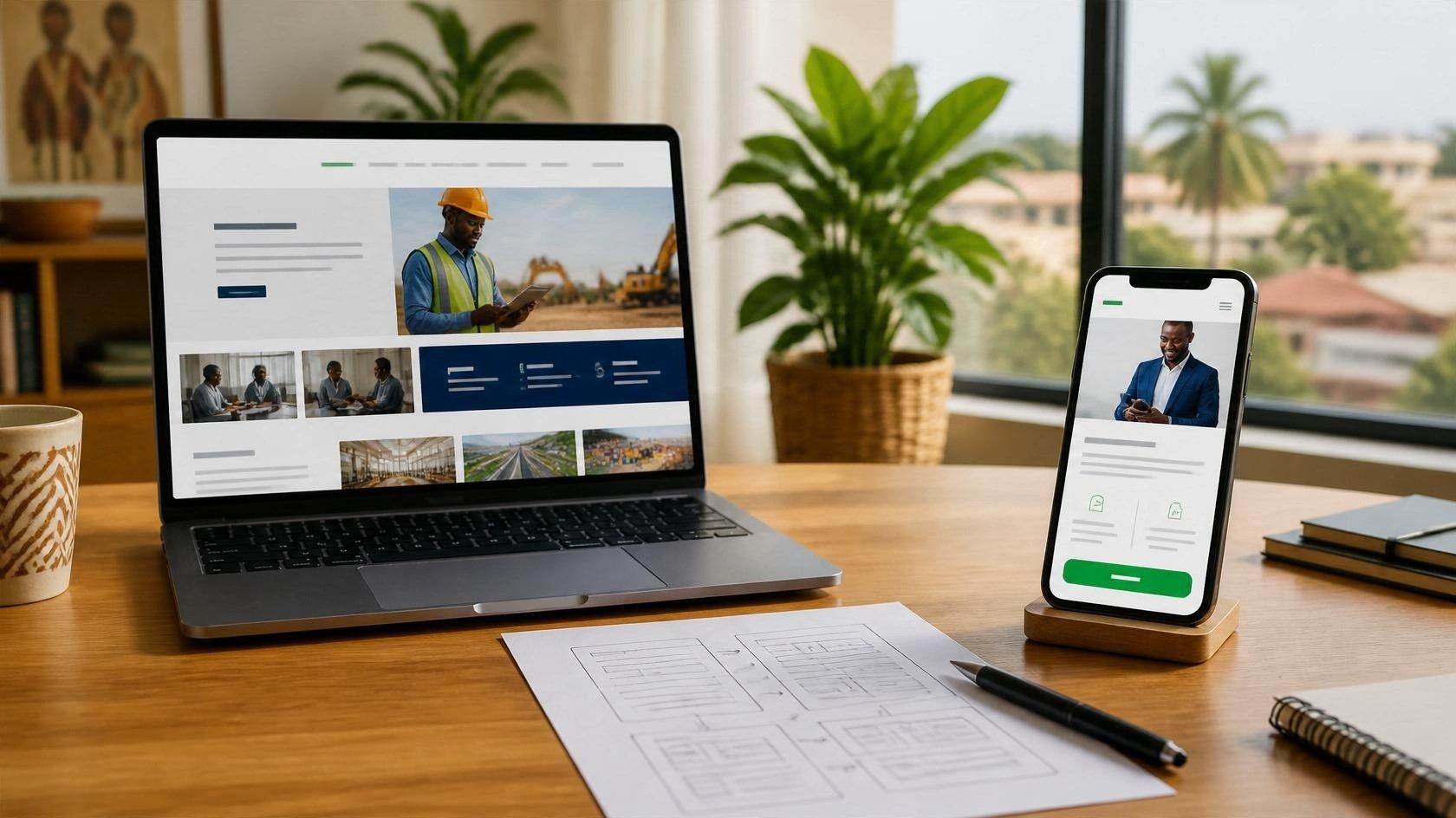
You run a Facebook ad for a training course, a promotion or a call for applications. The link points to your homepage. Visitors land, see a menu, a slider, five services… and leave without doing anything. The ad is not the problem. The page they landed on is.
That is exactly what a landing page is for. In this article we give you a plain-language landing page definition, the real difference with a showcase website, and our firm view on what an SME, an NGO or a public institution in Benin and French-speaking Africa should set up first.
Landing page: the one-sentence definition
A landing page is a web page built for one offer and one action, to which you send visitors from a specific campaign: an ad, an email, an SMS, a poster with a QR code, a link shared on WhatsApp.
Reference definitions agree. Unbounce describes it as a standalone page created for a marketing campaign, with a single goal called a call to action. HubSpot stresses conversion: turning a visitor into a lead or a customer.
Keep three words in mind: one offer, one audience, one action. If your page has two of each, it is no longer really a landing page.
Destination page, squeeze page, lead page: same idea
You will meet several names. Google Ads says « landing page » or « destination ». The terminology record of the Office québécois de la langue française lists landing page, destination page, squeeze page, jump page and lead page as English equivalents of the French « page de renvoi » (GDT record). Whatever word you use with your web provider, make sure you mean the same thing.
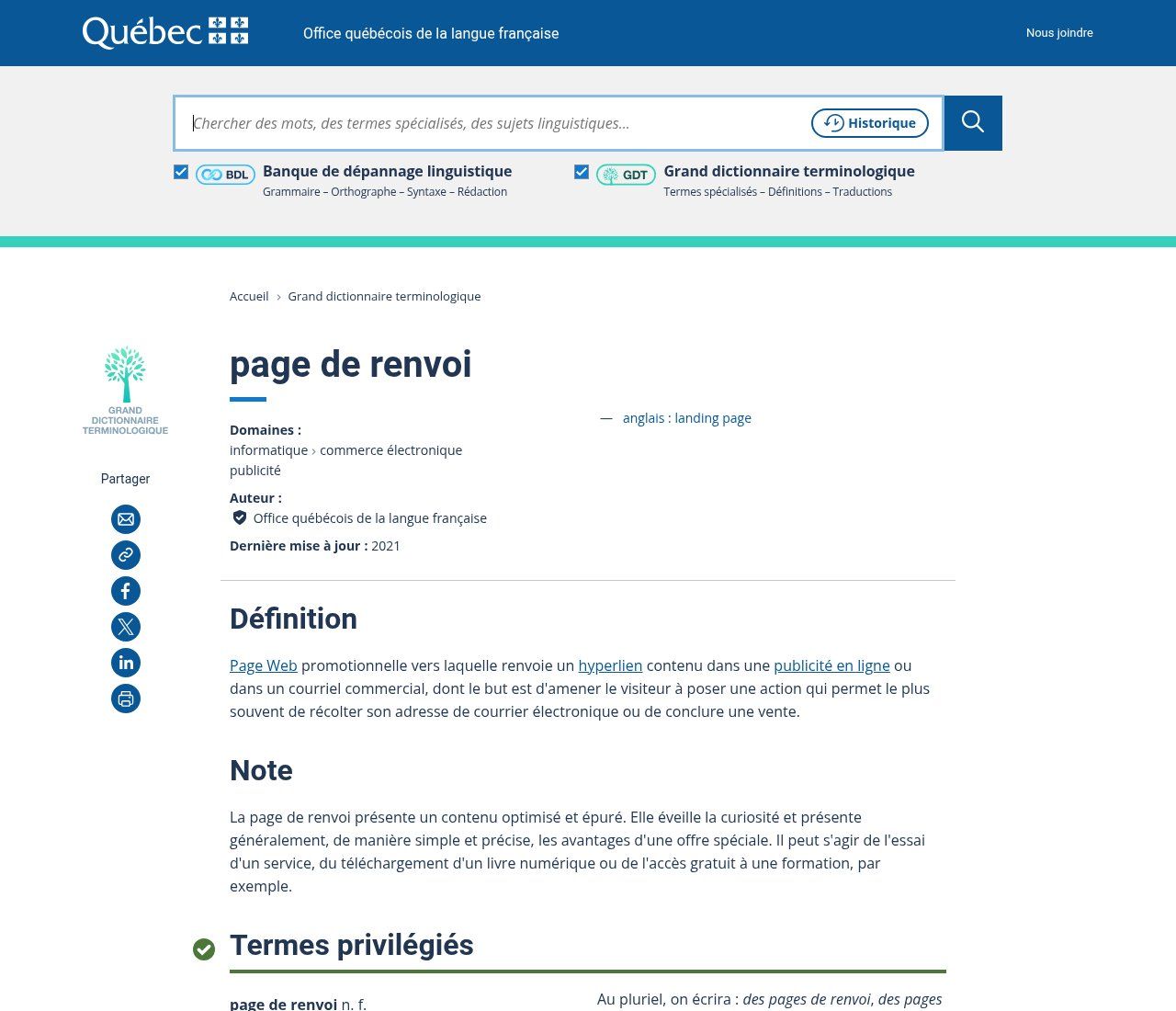
Source: vitrinelinguistique.oqlf.gouv.qc.ca, GDT record « page de renvoi » (English: landing page), screenshot taken on 17/10/2026.
What a good landing page contains
There is no magic recipe, but the pages that work share a structure:
- A headline that repeats the ad's promise. If the ad says « Excel training over 3 Saturdays in Cotonou », the page says the same thing, in the same words.
- The facts straight away: who it is for, what they get, the price or « on quote », the deadline, the place.
- Proof: real reviews, photos of your premises or sessions, partner logos if you are allowed to show them.
- Objections answered: a short FAQ (is Mobile Money accepted? is there a certificate? are places limited?).
- One button, repeated a few times: « Chat on WhatsApp », « Register », « Get the programme ».
Just as important is what it leaves out: no full menu, no link to your blog, no « our other services » block. Every possible exit is a lost sign-up.
Landing page vs showcase website: the real difference
A showcase website, as we explained in what is a website: definition and 6 types, presents your whole organisation: who you are, your services, your track record, how to reach you. People arrive from Google, word of mouth or your Google profile. They browse. It works for years.
A landing page does the opposite. It welcomes visitors coming from one place for one reason, and it has one job: getting an action. It lives for the length of a campaign, sometimes longer if the offer is permanent.
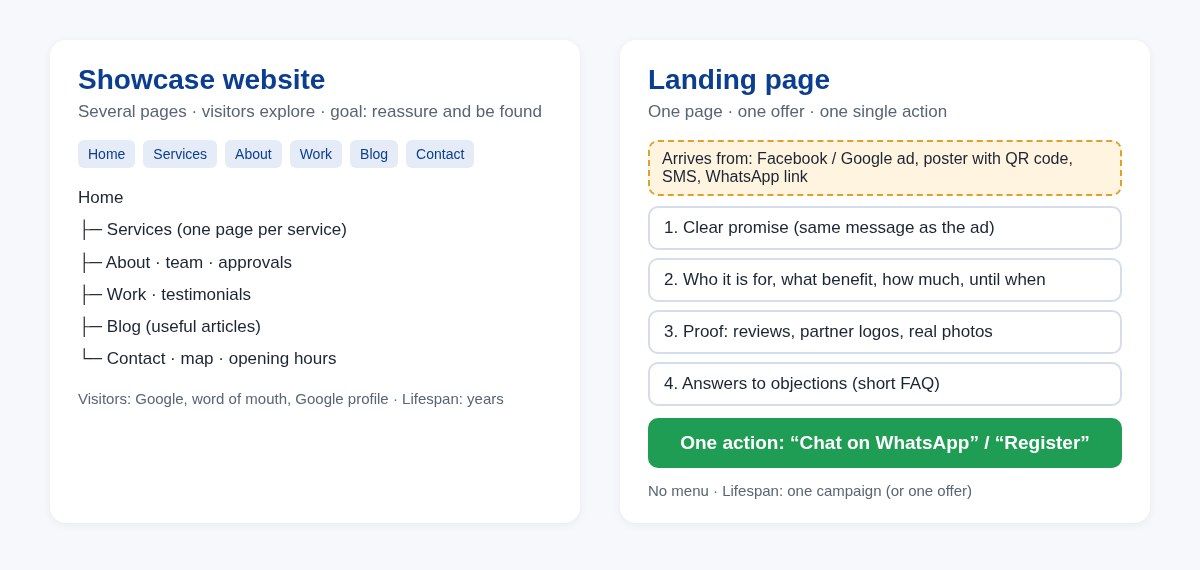
Source: diagram by Guelichweb.
- Goal: a showcase site reassures and informs; a landing page gets people to act.
- Structure: several pages and a menu; one page, no menu.
- Traffic: mostly organic (Google, referrals); mostly sent (ads, emails, SMS, QR codes).
- SEO: a showcase site is built to be found on Google; a landing page rarely relies on SEO.
- Measurement: you judge a showcase site on visibility and enquiries; you judge a landing page on one number, the share of visitors who clicked the button.
Your showcase website is your office. A landing page is the stand you set up at a trade fair: it does not replace the office, but during the fair, it is the one doing the work.
A one-page site is not automatically a landing page
Many small organisations have a single scrolling page: about, services, team, contact. That is a compact showcase site, not a landing page. It talks about everything and offers several actions. Nothing wrong with that, but do not plug it as is into a paid campaign.
Why this matters in French-speaking Africa
Most guides on the first page of Google are written for European businesses, with web forms and budgets in euros. On the ground in Benin, Côte d'Ivoire or Senegal, three realities change the picture.
1. Conversion often ends on WhatsApp
Your customers would rather send a message than fill in a form. WhatsApp provides « click to chat » links in the wa.me format, with a prefilled message, and lists landing pages among the places to use its button (WhatsApp help page). Your button can open a chat with a text such as « Hello, I would like the Excel training programme ». You know where the lead came from, and they have nothing to type.
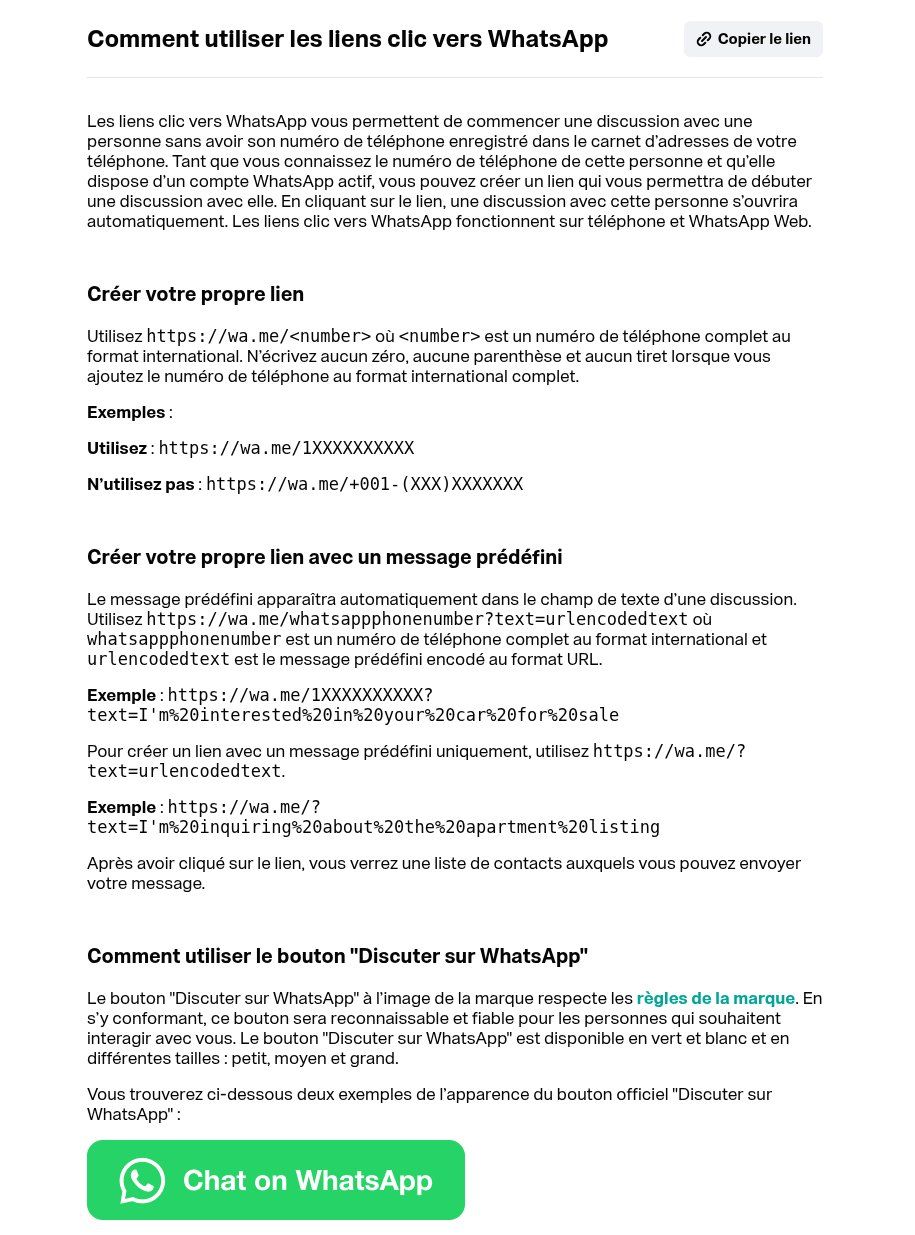
Source: faq.whatsapp.com (WhatsApp Help Center, French version), screenshot taken on 17/10/2026.
For handling the conversations that follow, see website, WhatsApp and CRM for an SME in Cotonou.
2. Visitors are on mobile, paying for data
A landing page weighed down by an autoplay video and 3 MB images is expensive to load. Aim for a light page, readable on a small screen, with the button visible without scrolling. Test it on PageSpeed Insights, Google's free tool, and look at the mobile result.
3. NGOs and institutions run campaigns too
A call for applications, a recruitment drive, an awareness campaign, an event, a fundraiser: each deserves its own page, with the criteria, the deadline, the documents required and a single button. It is clearer for the public, and it saves your team from answering the same questions fifty times on the phone.
If you advertise, do not send the traffic to your homepage
This is our firmest position. Paying for clicks and dropping people on a general page means paying for them to hunt for the information themselves.

Official logos: Google Ads (Google) and WhatsApp (Meta).
Google Ads actually measures this. One of the three components of its Quality Score is landing page experience, meaning how relevant and useful the page is to the person who clicked (Google Ads help, Quality Score). Google adds that well-rated pages are well organised and contain text that matches what people searched for (landing page experience definition).
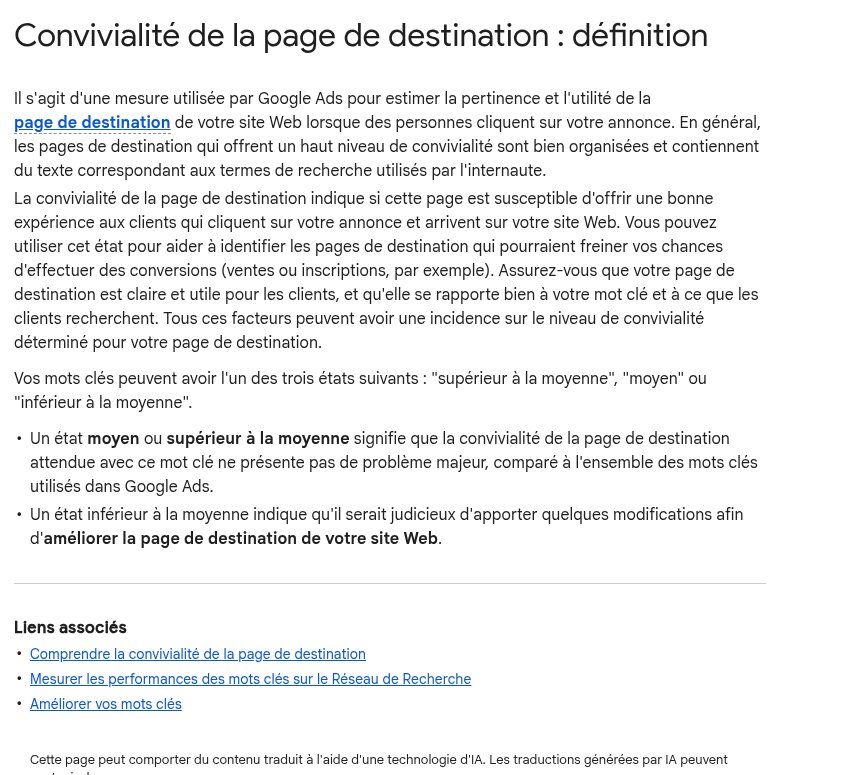
Source: support.google.com/google-ads/answer/1659694 (Google Ads Help, French version), screenshot taken on 17/10/2026.
The same logic applies to Facebook, Instagram or TikTok ads: one ad, one page that continues it.
And for Google search, without ads?
A landing page is not meant to replace your SEO. A single page without substantial content is unlikely to rank for a variety of searches. To be found you need a real website, a Google profile and content: see how to appear on Google and create your Google Business Profile.
Also beware of one shortcut: creating dozens of near-identical pages (« plumber Cotonou », « plumber Calavi », « plumber Porto-Novo ») that all funnel to the same form. Google classes this as doorway abuse, and its examples include pages targeting specific cities that funnel users to one page (Google spam policies).
Landing page, showcase website or both: our rule of thumb
- Nothing online yet and no campaign planned: start with a showcase website, even a compact one, plus a Google profile.
- Testing an offer before investing (new course, new product): a landing page is enough to measure interest.
- You have a site and you are launching an ad or an event: add a dedicated landing page on your own domain and keep the site as your foundation.
- You are an NGO or an institution: a showcase site for credibility with donors and the public, one dedicated page per call or campaign.
A landing page as your only online presence? We advise against it for any organisation that plans to last. The day a partner wants to check who you are, a promotional page reassures nobody.
If you want to build the page yourself, our guide how to make a web page walks you from sketch to going live.
Related reading: How to create an app, How to create a logo for your business and Website requirements document.
Frequently asked questions
What is a landing page, in simple terms?
A web page dedicated to one specific offer, where a visitor arrives after clicking in a campaign, and which offers only one action. It is also called a destination page, lead page or squeeze page.
Can a landing page be part of my showcase website?
Yes, and that is what we recommend: an address such as yoursite.bj/excel-training, with no menu, but on your domain. You keep the trust attached to your name and your statistics in one place.
How long should a landing page stay online?
For as long as the campaign runs. Once the offer is over, redirect the address to a useful page on your site rather than leaving an outdated page online.
Can a Facebook page act as a landing page?
It can help in a pinch, but you control neither the layout, nor the distractions around your offer, nor detailed statistics. A real landing page belongs to you.
How much does a landing page cost with Guelichweb?
It depends on the content to produce, the integrations (WhatsApp, form, payment, campaign tracking) and whether you already have a site. We quote after a diagnosis of your needs; see our offers and the benchmarks in our article on website cost in Benin.
Let's talk about your next campaign
At Guelichweb we build showcase websites that last and landing pages that get people to act, connected to WhatsApp and your tools, with automations that spare you from copying sign-ups by hand. Discover our website creation service in Cotonou, then contact us with your offer and your audience: we will tell you honestly whether you need a landing page, a showcase website, or both.