Digital transformation: definition and real examples for an African SME or NGO
G. CHRIST
Published on October 24, 2026

"We need to do our digital transformation." We hear that sentence almost every week from small business owners, NGO coordinators and people running public institutions. Ask what it actually means and the answer is often vague: a website, a Facebook page, maybe "some AI". That is usually the moment budgets start heading in the wrong direction.
At Guelichweb, a web and automation agency based in Benin, we help organisations across French-speaking Africa with websites, management tools and automations. This article gives a plain definition of digital transformation, separates it from digitisation and digitalisation, and walks through examples sized for an SME, an NGO and a public institution, not for Nike or Starbucks. We also cover where artificial intelligence really fits, and we leave you with a 90-day method to get started.
Digital transformation: a simple definition
Digital transformation means using digital tools to change the way an organisation works, serves its customers or beneficiaries, and makes decisions. The key word is not "digital". It is "transformation".
Our one-line definition: digital transformation is rethinking how you work with the help of digital tools, not just buying digital tools.
France Num, the French government's portal for the digital transformation of small businesses, puts it clearly: modernising your IT is not enough, you have to rethink your organisation, your business model and your performance with digital in mind (France Num, in French). The same page quotes a study by EM Normandie business school: more than half of the small and medium businesses surveyed (53.78%) say digital tools have had no impact at all on their strategy. They bought tools. They did not transform anything.
The same is true in Cotonou, Abidjan, Dakar or Lomé. A laptop, a WhatsApp Business account and an Excel file do not add up to a digital transformation. What matters is the question asked at the start: which problem are we trying to solve, and what will change in the team's daily work once the project is done?
Digitisation, digitalisation, digital transformation: three different levels
Google's search suggestions show it: plenty of people look up the "difference between digitisation, digitalisation and digital transformation". The confusion is understandable, since the three words get used interchangeably. Here is the distinction we use with clients, because it helps you see where you stand.
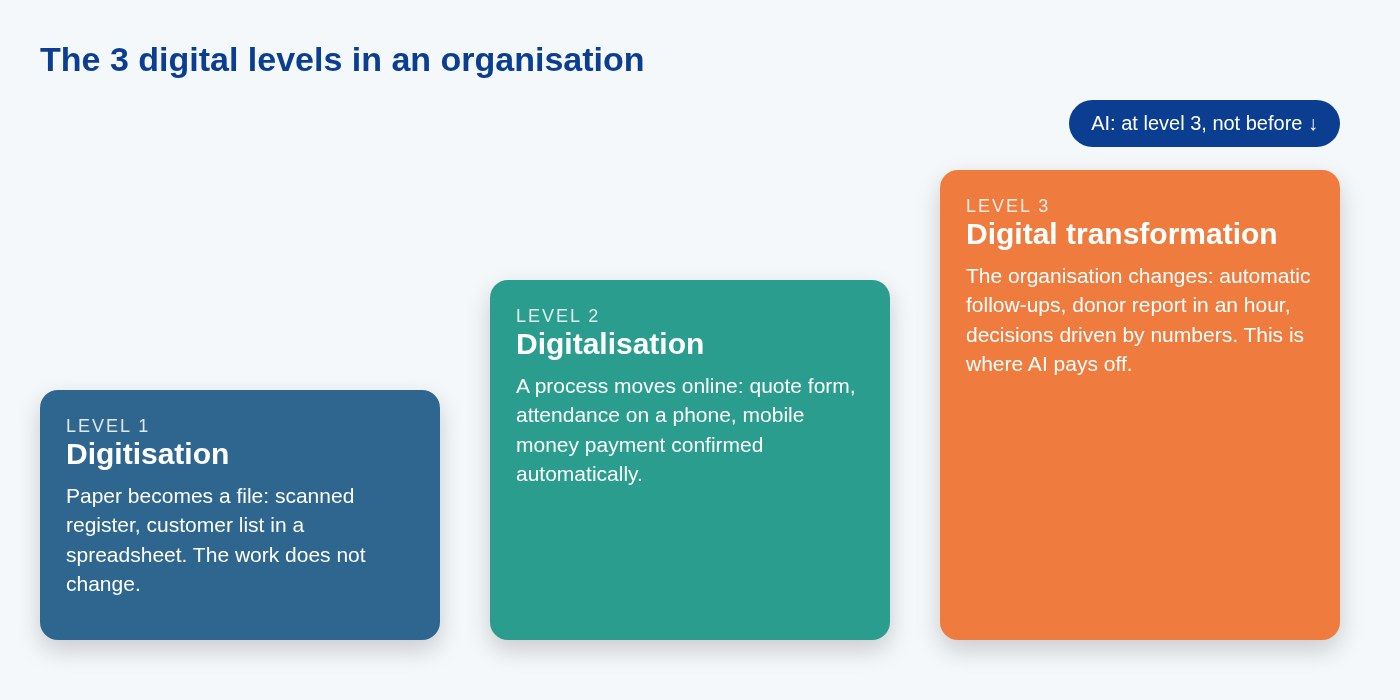
Guelichweb diagram: the three levels, from a scanned document to an organisation that changes how it works.
1. Digitisation: from paper to file
You convert physical information into digital information. Scanning receipts, photographing the members' register, typing the customer list into a spreadsheet. Useful, but the work itself does not change: you still hunt for information by hand, just in a folder instead of a cupboard.
2. Digitalisation: a process moves online
An existing process moves into a digital tool. Quote requests arrive through a form instead of missed phone calls. Training attendance is recorded on a phone. Payments go through mobile money with an automatic confirmation. The process is the same as before, but it runs faster and leaves a trace.
3. Digital transformation: the organisation changes
Here you stop copying the old way of doing things. Because the data finally exists, decisions are made differently: the salesperson sees today's follow-ups without asking the boss, the NGO coordinator produces the donor report in an hour instead of three days, management tracks three numbers that matter every week. Sometimes the offer itself changes: a classroom course becomes a blended programme, a neighbourhood shop starts delivering across the city.
Our view: most organisations we meet sit somewhere between level 1 and level 2. That is not a failure. It is an honest starting point. Trouble begins when level-3 tools (a full ERP, AI, a sophisticated dashboard) are bought on top of level-1 processes. The tool stays empty, the team goes back to the notebook, and everyone wrongly concludes that "digital doesn't work for us".
Why the question is different in French-speaking Africa
The guides on the first page of Google are almost all written for European or American companies, with multinational examples. The principles still hold, but the ground is different. Ignore those differences and you design solutions that do not survive three months.
- Mobile first, often mobile only. Your customers, field staff and sometimes your managers work on smartphones. According to the GSMA, mobile technologies contributed $240 billion, or 7.8% of Africa's GDP, in 2025, yet almost a billion people on the continent still do not use mobile internet despite network coverage (GSMA, The Mobile Economy Africa 2026). The practical takeaway: every tool must work on an average phone with an average connection.
- WhatsApp is already your information system. Orders, complaints, internal approvals, field photos: everything goes through it, usually with no usable archive. A realistic transformation starts from WhatsApp instead of fighting it.
- Mobile money is the norm. Payments through MTN MoMo, Moov Money, Wave or Orange Money are a huge lever for automating collections and receipts, as long as they are connected to everything else.
- Power cuts and expensive data. An app that needs a permanent connection will be abandoned. Plan for offline modes, lightweight pages and backups.
- Few in-house IT people. Solutions must be easy for a non-technical person to manage, otherwise every small change depends on a contractor.
The gap is real, but there is no need to dramatise it. In a 2021 report quoted by UNDP, the World Bank noted that in Senegal only 6% of firms used management software, and only 18% of informal micro-enterprises used a smartphone in their business (UNDP, in French). For an SME starting today, that mostly means one thing: a few good decisions are enough to get ahead of competitors.
Digital transformation examples for an SME
The examples below are typical scenarios built from the situations we come across most often. They are not case studies of named clients. They show what each level looks like in real life.
A shop or hardware store
Before: orders come in by phone and WhatsApp, stock is counted "by eye", customer debts live in a notebook. Digitalisation: a catalogue on WhatsApp Business, a shared spreadsheet for stock, mobile money payments. Transformation: every order automatically creates a tracking line, the manager gets an evening summary of sales and stock-outs, and customers who are late paying receive a polite reminder without anyone having to remember. The manager stops spending evenings recounting and starts deciding what to restock.
A service firm (accounting, legal, training)
Before: prospects write in, wait, chase, then go elsewhere. Transformation: a website that explains the offers clearly, a form that qualifies each request, a CRM where every prospect has a status and a next action, and automatic reminders. The business moves from depending on the owner's memory to a sales process any team member can follow. We cover this trio in our article on website, WhatsApp and CRM for an SME in Cotonou.
A small production or food-processing unit
Transformation: production sheets filled in on a phone, batch tracking, alerts when a raw material drops below a threshold, and an online store to sell beyond the city. The real gain is not the store itself: it is knowing, with numbers, which product actually makes money.
Examples for an NGO or association
NGOs have a constraint businesses do not always share: reporting to donors with precise indicators and tight deadlines. That is exactly where digital pays off most.
- Field data collection: facilitators fill in forms on their phones, even offline, with photos and GPS location. Data syncs as soon as the network comes back. No more retyping dozens of paper sheets at the end of the month.
- Donor reports: logframe indicators calculate themselves from the collected data. The quarterly report stops being a three-day sprint.
- Beneficiary and member management: one database instead of five Excel files in different versions, with access restricted by role.
- Communication and fundraising: a clear website showing activities, reports and ways to support the organisation, with automated email or message campaigns.
- Remote work: shared documents, meetings and tracked decisions, useful when the team is spread across several regions. A simple intranet is often enough.
On the French non-profit side, testimonies gathered by Solidatech point the same way: automating follow-ups and centralising files frees up time for the mission itself (Solidatech, in French). It is not about big budgets. It is about method.
What about a public institution?
Town halls, agencies, professional bodies, training institutes: their digital transformation is measured mainly from the user's side. Can people submit a request without travelling? Do they know where their file stands? Do they get an answer within a stated time? Benin, for instance, has made moving administrative procedures online a priority, with a national portal for online public services.
For an institution, the priority projects tend to be the same: an up-to-date website that answers common questions, online forms connected to an internal tracking board, SMS, email or WhatsApp notifications at each stage, and a clear policy on personal data. In Benin, that last point falls under the Digital Code and the personal data protection authority (APDP). You do not collect phone numbers, ID documents or health data without knowing where they are stored and who can access them.
Digital transformation and artificial intelligence: in which order?
This is the third big question people type into Google, and it is the one we have the strongest opinion on: AI comes after the data, never before. An AI that answers customers needs up-to-date information on your prices, stock and lead times. An AI that summarises activity needs clean data. If everything sits in voice notes and notebooks, it has nothing to read.
France Num makes the same point in its guide for small business owners: adopting AI should be treated as a transformation project, with clear goals, staff training and follow-up, not as a gadget (France Num AI guide, in French). IBM describes "AI transformation" along similar lines, starting with an audit of existing processes and data before any model is deployed (IBM).
Once the foundations are in place, AI brings very concrete gains, even for a small organisation:
- answering frequent questions on WhatsApp around the clock, with a handover to a human when needed (see what a WhatsApp chatbot actually does);
- sorting and summarising incoming requests, drafting quotes or replies;
- extracting information from a photographed invoice, purchase order or field sheet;
- writing a first draft of a report from the week's numbers;
- handing an AI agent a chain of simple tasks: read a request, check availability, suggest a time slot.
What not to do: plug AI into processes nobody controls, or let it make decisions that commit the organisation on its own (discounts, file approvals, legal answers). AI speeds up what is already organised. It makes worse what is not.
6 mistakes that sink a digital transformation
- Starting with the tool. "We need an ERP" is not a goal. "Stop losing orders" is.
- Wanting everything at once. One project at a time, measured, then the next. Grand three-year plans usually end up in a drawer.
- Forgetting the team. If the people entering data see nothing in it for them, they will stop. Train, listen, simplify.
- Copying a European model. A tool designed for fibre connections and card payments does not suit a mobile team that pays and gets paid with mobile money.
- Relying on a single person. Neither the owner, nor the intern who "knows computers", nor the contractor should be the only one holding the logins. Document everything and store credentials in a secure vault.
- Measuring nothing. Without a starting figure (time spent, lost orders, response time), you cannot tell whether the project worked.
Where to start: a simple 90-day plan
This is the approach we follow with organisations that come to us. It fits into three months because enthusiasm fades beyond that.
Days 1 to 15: diagnosis
List the week's repetitive tasks, the information people keep looking for, and the places where you lose customers or time. Talk to three or four team members, not just management. Pick one priority problem: the one that costs the most and is easiest to measure.
Days 15 to 45: a first visible project
Set up a modest but complete solution for that problem: for example a form connected to Google Sheets with a WhatsApp notification, or a well-configured free CRM. What matters is that the team uses it every day. The right tool is the one still in use six months from now.
Days 45 to 75: automate the links
Once the process runs, connect the tools to remove double entry. That is the job of automation platforms such as Make, n8n or Zapier; we compare them in our article on Zapier, Make and n8n.
Days 75 to 90: measure and decide
Compare against the starting figure. If the gain is there, document the solution, train a second person, and choose the next project. Only at this stage can AI come in profitably.
Self-assessment checklist: where do you stand?
Answer yes or no, honestly. Every "no" is something to work on.
- Can customers or beneficiaries find up-to-date information about you on Google (website, Google Business Profile)?
- Is every incoming request recorded somewhere, with someone responsible for it?
- Can you see this month's sales or activities in under five minutes?
- Are payments automatically matched to orders or invoices?
- Is your important data backed up somewhere other than a single phone or computer?
- Can a new team member find procedures and documents without asking everyone?
- Do you know who has access to the personal data you collect?
If you have more than three "no" answers, do not talk about AI yet. Start with the basics: that is where the fastest gains are.
How much does digital transformation cost?
We will not throw out a random number: the cost depends entirely on where you start and which project you pick. A first project can rely largely on free or low-cost tools that are properly configured; a custom project with an app, integrations and training obviously needs a different budget. That is why, as explained on our offers page, we prepare a quote after a diagnosis of your needs. For an idea of the cost items on the automation side, read how much AI automation costs in Benin.
One piece of advice whatever provider you choose: ask for a quote that spells out the problem being solved, what will be delivered, the training included, who owns the accounts and data, and the recurring cost of subscriptions. A quote that only mentions a "digital solution" does not protect you.
Digital transformation FAQ
What is the simple definition of digital transformation?
It is the use of digital tools to change how an organisation works, serves its customers and makes decisions. Buying software is not enough: the way of working has to change.
What is the difference between digitalisation and digital transformation?
Digitalisation moves an existing process into a digital tool (an online form instead of a paper one). Digital transformation goes further: work is reorganised using the data that this produces.
What is an example of digital transformation for a small business?
A shop that receives orders on WhatsApp, logs them automatically in a spreadsheet, collects payment by mobile money and gets an evening summary of sales and stock. The owner moves from counting to steering.
Does an NGO really need digital transformation?
Yes, often more than a business does: field data collection, beneficiary tracking and donor reporting are exactly the tasks where digital tools save the most time and improve reliability.
Should we start with artificial intelligence?
No. AI needs organised data and clear processes. Structure first, then add AI where it saves time on a specific task.
How long does it take?
A first useful project can show results within a few weeks. Transforming a whole organisation is an ongoing process, carried out one project at a time.
Is digital transformation only for large companies?
No. Small organisations often see faster results because decisions are quicker and processes are simpler to change. Many of the tools that used to be reserved for large groups are now available as affordable online services.
From intention to a first project
Digital transformation is neither a slogan nor a purchase. It is a series of simple decisions taken in the right order: a real problem, a tool suited to African conditions, a team that adopts it, then automation and AI once the foundations hold. Starting small is not a lack of ambition. It is the only approach we have seen work over time.
Want to know which project to start with in your SME, NGO or institution? Tell us about your situation on our contact page: we will suggest a diagnosis, then a plan and a quote that fit. You can also browse our services to see what we do in websites, automation and AI.