AI website builders: what they're really worth vs a professional website
G. CHRIST
Published on October 23, 2026

You type a sentence like "website for an accounting firm in Cotonou, clean, blue, with a contact page", wait thirty seconds, and a complete website appears: menu, copy, photos, buttons. In 2026, building a website with AI is no longer a trade-show demo. Wix, Hostinger, Squarespace, Durable and even ChatGPT offer it, often with a free trial.
So the question we hear more and more is simple: "Why pay an agency if AI builds a website in a minute?" It's a fair question, and it deserves better than an agency protecting its revenue. We are a web and AI automation agency in Benin, we use AI every day, and our answer is nuanced: AI does some things very well, and misses others that matter a lot to a small business, an NGO or a public institution in French-speaking Africa.
This article doesn't repeat what we covered about classic free plans in Free website: what you really get, or the cost comparison in Wix, Squarespace or a custom website: the real cost. Here, we look at what AI really changes, and what it doesn't.
What an AI website builder actually does
An "AI website builder" is almost always a classic site builder (drag and drop, templates, hosting included) with an assistant added on top. You describe your business; the tool picks a page structure, writes copy, suggests colours, inserts stock photos, and sometimes a logo. Then you edit by hand or by asking the AI again.
This matters: AI doesn't replace the platform, it speeds up the start. You stay with the vendor, under its rules, prices and limits. The generated site isn't "yours" in the way a website delivered with its files and its domain name is. With most of these tools, if you stop paying, the site stops.

Official logos as displayed on wix.com, hostinger.com, durable.co and chatgpt.com, captured on 23/10/2026.
The tools you'll come across in 2026
Search Google for "AI website builder" from Benin, Côte d'Ivoire, Senegal or France and the first page is almost entirely vendor sales pages. That's expected: they're the ones selling. Here is what their own pages say, checked on 23 October 2026, with no embellishment.
Wix: free AI to start, a paid plan to really exist
On its AI website builder page, Wix promises a free, ready-to-use AI website in minutes. That's true for creating it. But Wix also states that connecting your own domain, accepting online payments or unlocking some features requires a Premium plan. The free site stays on a Wix address, with Wix branding.
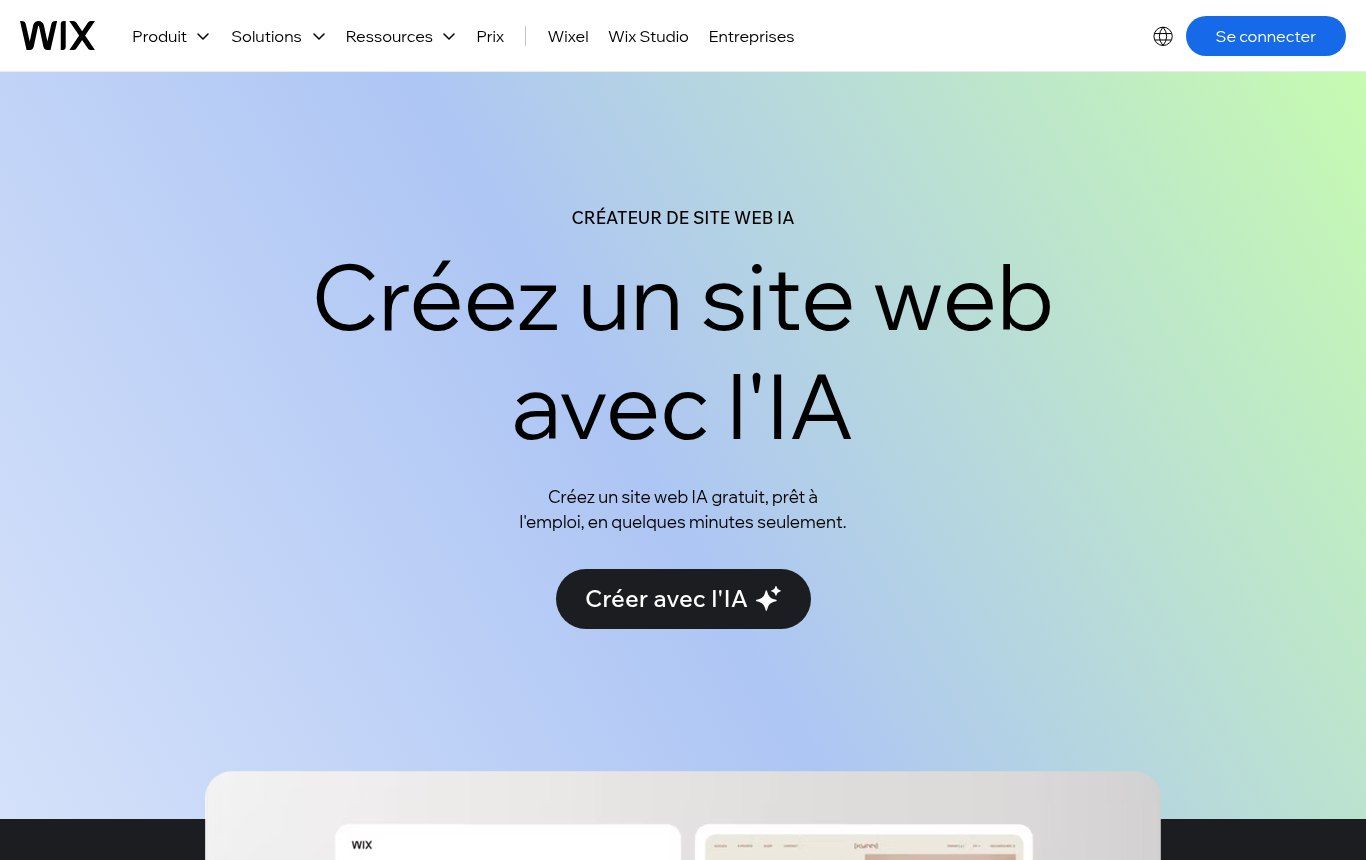
Source: fr.wix.com, AI website builder page, captured on 23/10/2026 (cookie banner hidden).
Hostinger: a low entry price, AI credits and one rule worth reading
On 23 October 2026, Hostinger's AI builder showed promotional prices from €2.49 per month, provided you prepay 48 months, with renewal announced at €9.99 per month. AI mode uses "credits" (manual mode doesn't), the domain is free for the first year on annual plans, and code export is available. One sentence in their FAQ deserves a second read: if the hosting plan expires and isn't renewed, the project is no longer accessible and its data is permanently deleted.
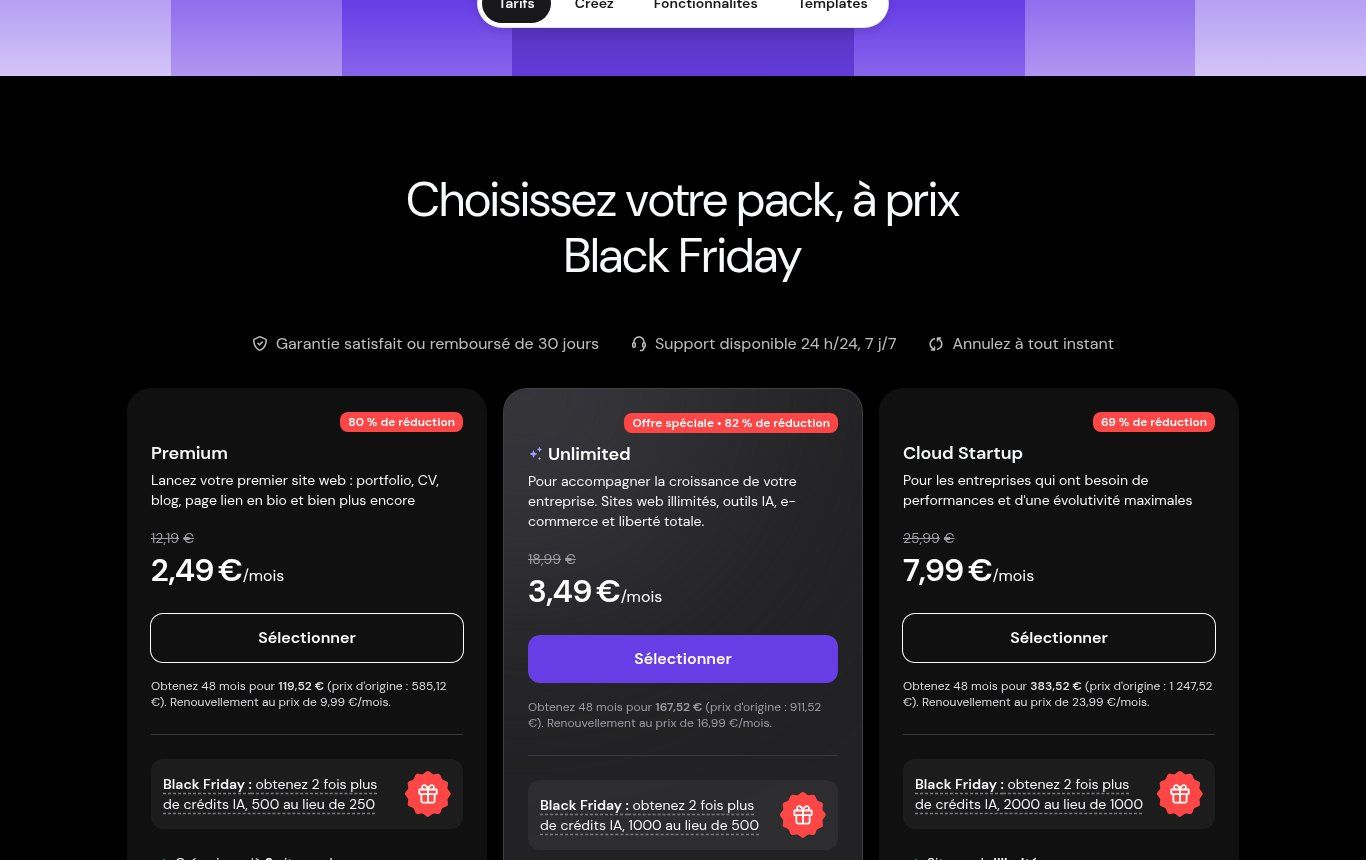
Source: hostinger.com/fr/ai-builder, pricing section, captured on 23/10/2026. Promotional prices may change.
Squarespace: AI during the trial, a subscription to publish
Squarespace offers its AI website builder during the free trial. Putting the site live requires a paid plan. The templates are elegant and the tool is solid, but everything assumes card payment in foreign currency.
Durable: the "30-second" website for small businesses
Durable targets freelancers and small businesses. Its pricing page shows a free plan (site preview, 300 AI credits to try), then Launch at $22 per month and Grow at $41 per month billed yearly. The free plan doesn't let you use your own domain. Durable's FAQ also says the tool isn't designed specifically for e-commerce and that extensive HTML customisation isn't possible.
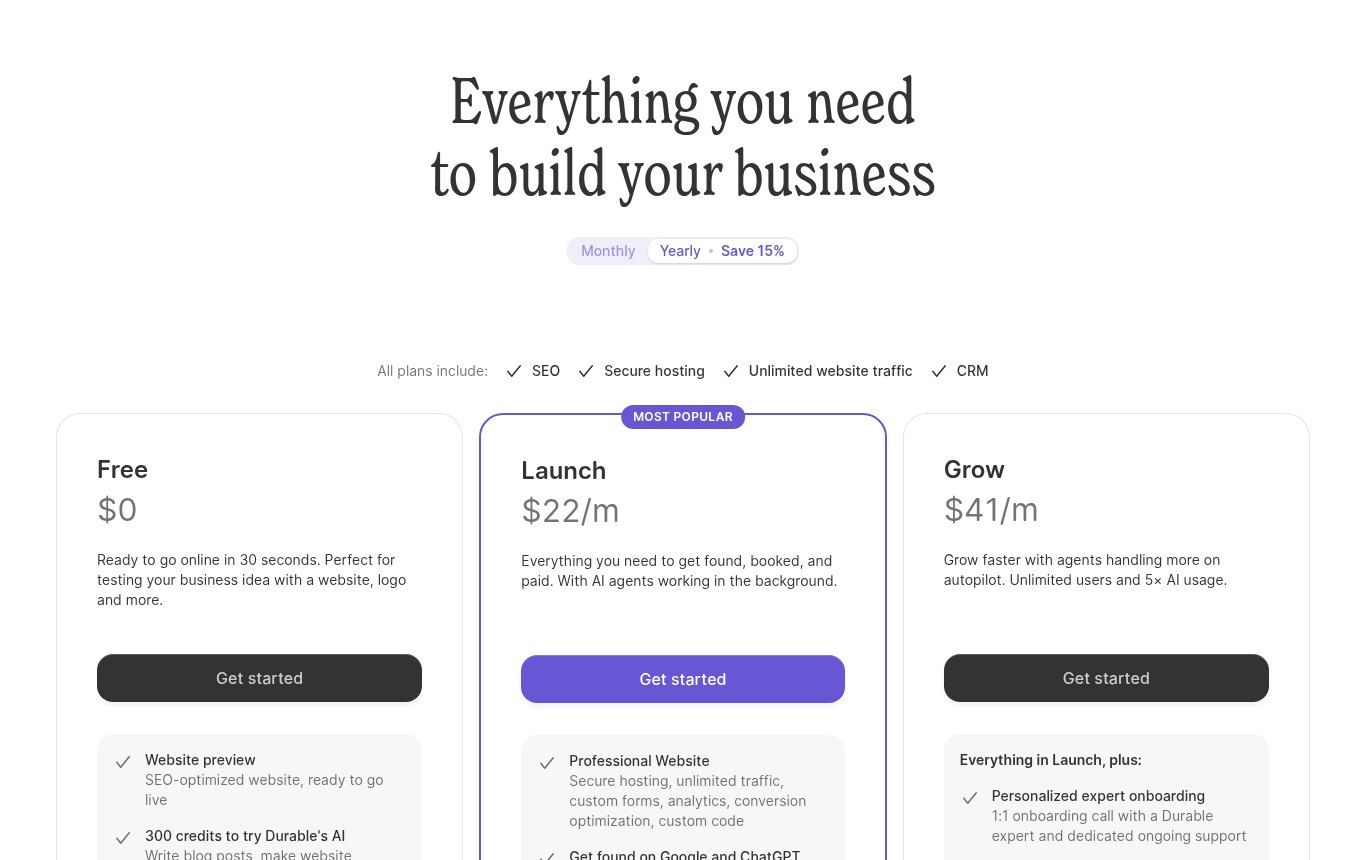
Source: durable.co/pricing, captured on 23/10/2026 (cookie banner hidden).
ChatGPT Sites: building a website by chatting
The newcomer, ChatGPT Sites, lets you describe a site, refine it in conversation and publish it. According to OpenAI's help centre, the feature is limited to paid accounts (Plus, Pro and supported Business workspaces), and every deployed URL is a production URL: whatever you publish is public immediately. Handy for a prototype or an event page, much less so for an organisation's main website.
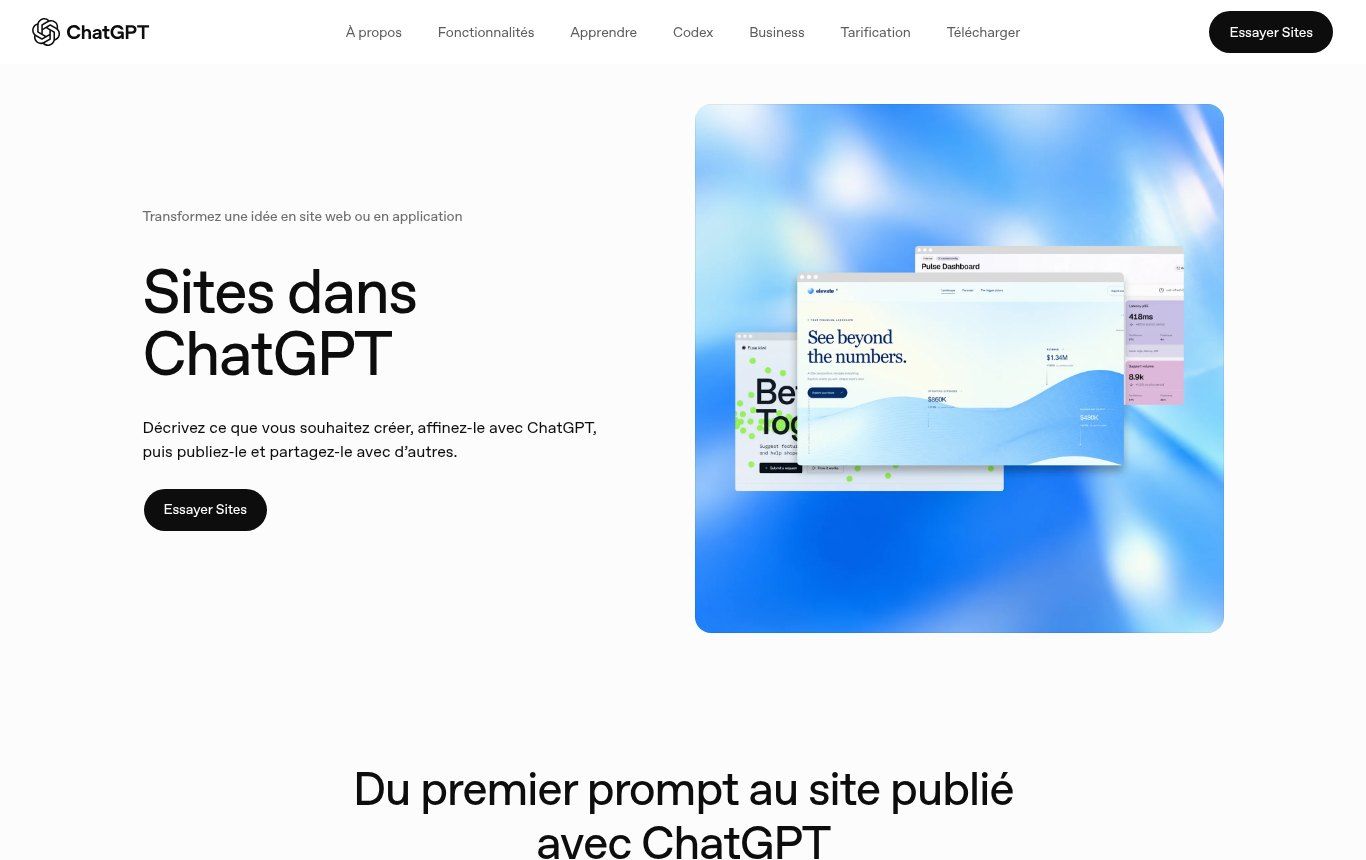
Source: chatgpt.com, ChatGPT Sites page, captured on 23/10/2026.
What AI genuinely does well
Let's be honest, because we use it ourselves. There are things AI is genuinely excellent at.
- Getting past the blank page. In minutes you see a concrete site structure. For someone who has never thought about "which pages do I need?", that's a real breakthrough.
- Testing an idea without spending. A new activity, a service to validate, a training course to launch: a generated page is enough to see whether people click.
- Producing a first draft of copy. Not final copy, but a base to correct, which many managers prefer to an empty page.
- Building temporary pages. A conference, a recruitment drive, a contest: a site that will live three months doesn't need an architecture built for ten years.
If your need fits one of these boxes, an AI builder may be the right choice. We say that with no hidden agenda.
Where it falls short, especially in French-speaking Africa
The "AI website vs professional website" comparisons on Google's first page are mostly written by European agencies. They talk about GDPR, European accessibility rules and prices in euros. They miss the problems our clients actually face in Cotonou, Abidjan or Dakar.
1. Generic copy, sometimes wrong
A generator knows nothing about your history, your clients or your numbers. So it writes sentences that could describe any firm or any NGO: "a passionate team committed to excellence". Worse, it sometimes makes things up: years of experience, certifications, testimonials. Google says so in its guidance on AI-generated content: AI can help with research and structure, but producing many pages without added value may violate its spam policies, and you should check the accuracy of everything, including titles, meta descriptions and image alt text.
So the problem isn't "AI". It's a site published without review by someone who knows the business. And that's exactly what tools promising a site "in 30 seconds" encourage.
2. You rent, you don't own
On most of these platforms, the site only exists as long as the subscription is paid. Hostinger writes it in black and white: data deleted if the plan expires. Durable warns that leaving with your domain takes time. Wix and Squarespace don't let you move a working site elsewhere. For an institution changing provider, or an NGO whose budget depends on yearly funding, that's not a detail.
Also check who owns the domain name. A "free" domain registered in the name of a platform or a third party is the classic trap we describe in .bj domain name: how to buy it and never lose it.
3. Online payments aren't designed for you
AI builders mainly integrate Stripe, PayPal and card payments. Yet Stripe's official country list (checked on 23/10/2026) includes Côte d'Ivoire, but neither Benin nor Senegal. Mobile Money, the payment method your customers actually use, usually isn't offered natively. Selling online often means an external integration, which these tools limit or reserve for their most expensive plans. We cover local options in How to create an online store in Benin.
4. A real cost in foreign currency that rises at renewal
The advertised price is almost always a promotional price, paid upfront, in euros or dollars, by international card. At renewal it can be three to five times higher (visible on the Hostinger grid above). Add bank fees and exchange rates, and the "€2 website" becomes a yearly expense you have to plan for, with no way to pay it in CFA francs.
5. Bilingual, fast on mobile, connected: that's where AI runs out of steam
Many of our clients need a site in French and English, fast on an average phone over 3G or 4G, connected to WhatsApp, a CRM or a form that reaches the right team. Generators can produce a pretty page. They're much weaker at handling two languages cleanly for Google, slimming a site down for slow connections, or connecting your tools. Test any site's speed with PageSpeed Insights: the mobile results are often revealing.
6. Your visitors' data
A contact form collects personal data. In Benin, its protection falls under the Digital Code and the APDP, the personal data protection authority. With a mass-market tool, your data is stored by the vendor, abroad, under its terms. That isn't necessarily forbidden, but an institution or NGO handling sensitive data needs to know it and be able to explain it.
AI-built website or professional website: a point-by-point comparison
This is how we sum up the difference when a client asks. By "professional website" we mean a site designed from your goals, delivered with its access and its domain in your name, whether it's built on WordPress, custom code or another tool.
- Lead time: minutes for an AI site; a few weeks for a professional site, mostly because of content and approvals.
- Copy: generic and in need of checking on the AI side; written from your trade and your clients on the professional side.
- Ownership: a platform subscription on one side; files, access and domain in your name on the other.
- Payments: mostly cards and Stripe/PayPal; the option to integrate Mobile Money and local aggregators.
- Languages: often one language handled well; French/English structured for Google when planned from day one.
- Search visibility: decent technical basics but weak content; a page and keyword strategy built around your customers.
- Cost: low upfront, recurring in foreign currency; a higher initial investment, predictable maintenance costs.
- Growth: limited to the platform's features; open to automation, CRM, chatbots and business tools.
A professional website isn't automatically better: a badly designed agency site is still a bad site. We see plenty, and we explain why in Why your website isn't bringing in customers. The difference lies in the thinking before the build, not in the tool.
Who an AI website is enough for, and who it isn't
An AI website may be enough if…
- you're a freelancer or a very small business and just want an online business card;
- you're testing an offer before investing in it;
- you need a temporary page for an event;
- you accept paying in foreign currency, staying on the platform and rewriting the copy yourself.
A professional website is the right call if…
- you're a small or medium business that wants its site to bring in quote requests, sales or applicants, and needs to be found on Google locally;
- you're an NGO whose credibility with donors depends on a serious, up-to-date, often bilingual website with reports and evidence of impact;
- you're a public institution that must keep control of its domain, data and access, and justify its technical choices;
- you need Mobile Money, several languages, automation or integration with your tools.
To understand the steps of a real project, our guide How to create a professional website in 2026 walks through them one by one.
Before you choose: our one-hour test
If you're unsure, run this test with the AI tool you're tempted by. One hour is enough, and it will save you some nasty surprises.
- Generate your site with a precise description of your business, then read every sentence: how many are true, specific to you, and verifiable?
- Find the renewal price, not the promotional one, and convert it into CFA francs over three years, bank fees included.
- Read what happens if you stop paying: does the site stay online, is the data deleted, can you export it?
- Check the domain: can you use your own .bj or .com, and will it be registered in your name?
- Test payments: are your country and Mobile Money supported, and on which plan?
- Run the home page through PageSpeed Insights and look at the mobile score.
- Send yourself a message through the form: where does it arrive, and who can read it?
If the tool passes these seven points without bothering you, it probably fits your need. If not, you know exactly what to ask a provider, and you can compare quotes with confidence using our article Website cost in Benin: what a quote should include.
The right way to use AI, even with an agency
Our position isn't "AI, no thanks". Quite the opposite: AI is very useful, as long as you put it in the right place.
- To prepare your brief: ask an AI assistant to help list your goals, audiences and pages. You'll save time, and your website requirements document will be clearer.
- To generate an inspiration mock-up: a site produced by an AI builder is a good starting point to say "I like this, not that".
- For a first draft of copy, which you then correct with your real figures and real examples.
- After launch, to automate: answers to frequent questions, sorting requests, follow-ups. That's the territory of AI agents and WhatsApp chatbots, where AI delivers real, measurable gains.
What AI won't do for you: decide what your website should achieve for your organisation, choose who it speaks to, and take responsibility for what it says.
A website generated in 30 seconds is a draft. A website that brings in business is a decision.
Our take, plainly
Building a website with AI is real progress for very small budgets and temporary projects. It has made the web more accessible, and that's good news. But for an organisation that relies on its website to look credible, be found and receive enquiries, the time saved by the generator is paid for elsewhere: copy to rewrite, dependence on a foreign platform, missing local payments, foreign-currency costs that climb at renewal.
Our advice: use AI to think and move fast, not to decide for you. And if your website is a working tool, have it built on foundations you own.
Related reading: What is WordPress, Website maintenance and Landing page.
Frequently asked questions
Can you build a website for free with AI?
Yes for creating it, rarely for publishing it professionally. Wix lets you generate a free site on its own address; Squarespace and ChatGPT Sites require a paid plan to publish; Durable offers a free preview without a custom domain. For your own domain and online payments, you have to pay.
What is the best AI website builder?
There's no single best one. Wix and Squarespace are the most complete, Hostinger the cheapest to start, Durable the fastest for a small business, ChatGPT Sites the most flexible for a prototype. The right choice comes from the one-hour test above.
Can you create a website with ChatGPT?
Yes. ChatGPT Sites lets eligible paid accounts create and publish a site through conversation. ChatGPT can also write copy or code that you put online elsewhere. Either way, review everything: what you publish is public immediately.
Does Google penalise websites built with AI?
No, not because they're made with AI. Google judges the quality and usefulness of content. However, mass-publishing generated pages with no added value can be treated as spam. An AI site with generic copy will simply struggle to rank.
Is an AI website suitable for an NGO or an institution?
Rarely as the main website. These organisations need to keep control of their domain, data and access, often need two languages, and need reliable content. An AI tool can work for an event or campaign page, not for the reference site.
Can I take my AI website with me if I change provider?
It depends on the tool. Hostinger lets you export the code; Wix and Squarespace don't let you move a working site elsewhere; Durable warns that transferring the domain takes time. Check this before you start, not when you leave.
How much does a professional website cost compared with an AI website?
An AI website costs little upfront but comes back every year, in foreign currency. A professional website needs a larger initial investment that varies with the pages, languages and integrations. At Guelichweb, we quote after a diagnosis of your needs, as explained on our Offers page.
Torn between an AI tool and a custom website?
We can look with you at what your website needs to deliver, test the AI option if it makes sense, and tell you frankly whether it's enough. If a professional website is needed, we deliver it with the domain and access in your name, and we use AI where it brings a real gain. Our services are listed on the Services page, and the way we work is described on Website design in Cotonou.
Planning a website, or an AI site that isn't delivering? [Contact us](https://guelichweb.online/en/contact) for an initial diagnosis.