Sales funnel: what it is, examples and how to build one for free (WhatsApp and Mobile Money edition)
G. CHRIST
Published on November 8, 2026
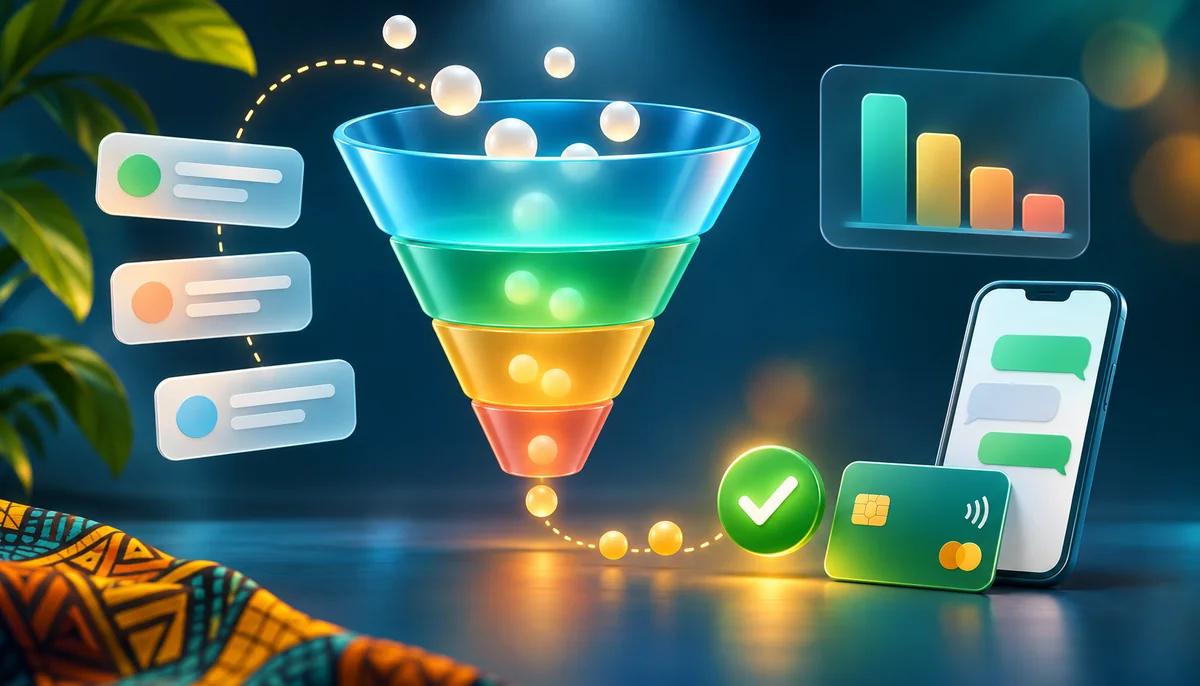
A sales funnel is not a piece of software. It isn’t a page with a red countdown timer and a “Grab it now” button either. It is simply the path you lead a stranger along until they become a customer — ideally a customer who comes back.
Search for “sales funnel” and most guides you find assume a European or American buyer: Facebook ads, an email address, a five-email sequence, card payment. That works, but it isn’t how most SMEs, NGOs and institutions in Benin and French-speaking Africa actually sell. Here, prospects would rather send a WhatsApp message, often pay with Mobile Money, and want to talk to a human before spending 150,000 CFA francs.
In this guide we explain what a sales funnel is, what it looks like in practice, how to build one for free, and above all how to adapt it to an audience that lives on WhatsApp. We also have a fairly strong opinion about “all-in-one” funnel builders — we’ll get to that.
Sales funnel: a plain-language definition
A sales funnel (also called a conversion funnel or marketing funnel) is a sequence of steps designed to take someone from a first contact to one specific action: buying, booking, requesting a quote, registering, donating.
We call it a funnel because the number of people shrinks at every step. A thousand people see your post, a hundred click, thirty leave their number, five buy. That isn’t failure; it’s the normal shape. The real job is to find where people drop off and fix that step, not to rebuild everything.
Marketers usually split the funnel into three zones:
- Top of funnel (TOFU): people discover you. They don’t know you yet and aren’t ready to buy.
- Middle of funnel (MOFU): they compare, ask questions, look for proof.
- Bottom of funnel (BOFU): they’re ready to decide. Buying must now be easy.
The key idea: you don’t talk the same way to someone who just found you and to someone already holding your quote. A funnel is first of all a way to deliver the right message at the right moment.
The 5 stages of a sales funnel that works
1. Attract: bring in the right people
WhatsApp statuses and posts, Facebook, TikTok, Google (Business Profile and SEO), word of mouth, trade fairs, radio, partners. The classic mistake is chasing “lots” of people. A hundred relevant people beat ten thousand casual viewers. If you sell Excel training to accountants in Cotonou, a viral dance video won’t help.
2. Capture: get a way to follow up
This is the most underrated step. Without a contact, you rely on luck: the person may come back — or not. So you offer something useful in exchange for their WhatsApp number or email: a guide, an indicative price list, a free diagnosis, a webinar seat, a sample. Marketers call this a lead magnet.
The page that does the capturing is the opt-in page or landing page. We have a dedicated article on landing pages and how they differ from a showcase website if you want to dig deeper.
3. Reassure: follow up and build trust
Someone who leaves their number is almost never ready to buy the same day. They need proof: testimonials, photos of past work, answers to their objections, a demo. This is where follow-up comes in, by email or — far more effective in our region — by WhatsApp. Three well-thought-out messages over a week beat ten generic ones.
4. Convert: make the decision easy
A clear sales page, an understandable quote, booking in two taps, Mobile Money or card payment, a phone number that actually answers. Every bit of friction costs customers: a twelve-field form, a payment link that breaks on mobile, a price nobody can find, a “contact us” that goes unanswered for three days.
5. Retain: bring them back and get referrals
The funnel doesn’t end at payment. A thank-you message, a check-in after delivery, a Google review request (here’s how to do it without fake reviews), a complementary offer, a referral scheme. For many SMEs, an existing customer is the cheapest prospect to convince.
5 sales funnel examples adapted to French-speaking Africa
The examples below are typical patterns, not client case studies. They show how the same logic changes shape depending on what you sell.
Example 1 — Fashion or cosmetics shop (physical products)
- Short TikTok video or WhatsApp status showing the product being worn or used.
- Link to your WhatsApp Business catalog or a simple product page.
- WhatsApp conversation: size, colour, delivery area.
- Mobile Money or cash-on-delivery payment, automatic confirmation.
- Day-3 message: “Is everything fine with your order?”, then a review request and a referral code.
Example 2 — Service provider (agency, consultancy, construction, IT)
- A blog article or LinkedIn post that answers a real customer question.
- Opt-in page: “Get the checklist / book a 20-minute diagnosis”.
- Short qualification form (budget, timeline, need) to avoid pointless meetings.
- Call or site visit, then a quote sent by email AND flagged on WhatsApp.
- Follow-ups on day 2 and day 7 if there’s no answer, with a use case or a reply to the price objection.
Example 3 — Training or webinar
- Ad or status announcing a free webinar on a specific topic.
- Registration (name + WhatsApp), automatically added to a list or group.
- Reminders the day before and one hour before (this is what lifts attendance).
- A webinar that delivers real value, then the paid course is presented.
- A payment link valid for a few days; absent registrants get the replay.
Example 4 — NGO or association (donations, volunteer recruitment)
An NGO doesn’t “sell”, but it has exactly the same problem: turning goodwill into action. Field content (a photo, a verifiable figure, an authorised testimonial) → a campaign page with one clear goal → a donation or pledge form → receipt and thank-you → an impact report three months later. That last message is what brings donors back.
Example 5 — Institution, clinic or school (registrations and appointments)
Google search or Business Profile → a “2026-2027 Admissions” or “Book an appointment” page → a short form → WhatsApp confirmation listing the documents to bring → a reminder the day before. Here the goal isn’t to persuade at all costs but to cut repetitive phone calls and incomplete files.
The “WhatsApp-first” funnel: what most guides leave out
Most sales funnel templates are built on email. In West Africa, email remains essential for official documents (quotes, invoices, donor reports), but WhatsApp open rates are in another league. Our view: for most local SMEs, WhatsApp should be the main follow-up channel, and email the channel of record.
In practice, a WhatsApp-first funnel looks like this:
- The main button on the page isn’t “Submit” but “Chat on WhatsApp”, with a pre-filled message saying where the prospect came from (“Hello, I’m coming from the Excel Training page”).
- Every contact is logged in a spreadsheet or a CRM with its source and stage, so conversations stop getting lost in someone’s phone.
- Follow-ups are scheduled: welcome message, social proof, answer to the main objection, final reminder.
- Payment goes through a Mobile Money or card link, not “send it to my personal number”.
One important limit: the free WhatsApp Business app can’t properly automate follow-ups at scale. For reliable automated messages you need the WhatsApp Business API, with message templates approved by Meta and consent rules. A WhatsApp chatbot can then handle simple questions, but it won’t replace a human for closing a significant sale.
A good funnel doesn’t harass. If someone says “no” or “stop”, you stop. That’s basic courtesy, and it’s also a data protection issue.
In Benin, collecting and using phone numbers and email addresses falls under the Digital Code and the data protection authority (APDP); other countries have their own equivalents, such as GDPR in Europe. State clearly why you collect the contact, keep a record of consent and always offer an easy way to opt out. Your legal notice and privacy policy must match.
Payment: the step nobody tests enough
Plenty of well-designed funnels die at the very last step. The visitor is convinced, clicks “Pay”… and is asked for a Visa card they don’t have. Before you sketch a single funnel, ask yourself: how do my customers actually pay?
- Mobile Money: in Benin, aggregators such as FedaPay or KKiaPay let you accept MTN, Moov or Celtiis wallets and cards from a website or a payment link. Check fees and terms directly with them.
- Cards and PayPal: useful for the diaspora and international customers.
- Cash on delivery: still essential for many physical products, as long as you confirm the order by phone or WhatsApp to limit cancellations.
- Bank transfer against invoice: the norm for institutions and NGOs, with a clean quote and invoice.
Test the whole journey yourself on a cheap Android phone over a 3G connection. If you lose patience, so will your customers.
How to build a free sales funnel: your options
Good news: you can launch a first funnel without spending anything on software. Here are the three approaches we recommend, from simplest to most complete.
Option 1 — The “DIY” funnel (free, enough to get started)
A simple page (Google Sites, Canva Sites, or a page on your existing website), a Google Form or a contact form, a WhatsApp button with a pre-filled message, a Google Sheets file to track prospects, and manual follow-ups using messages written in advance. It isn’t pretty, but it lets you prove that someone actually wants your offer before you invest.
Option 2 — An all-in-one tool such as Systeme.io
Official logo: systeme.io
Systeme.io is the tool that comes up most in French-language searches (“tunnel de vente systeme io”, “systeme io gratuit”). It bundles opt-in pages, sales pages, email, automations, online courses and payments.
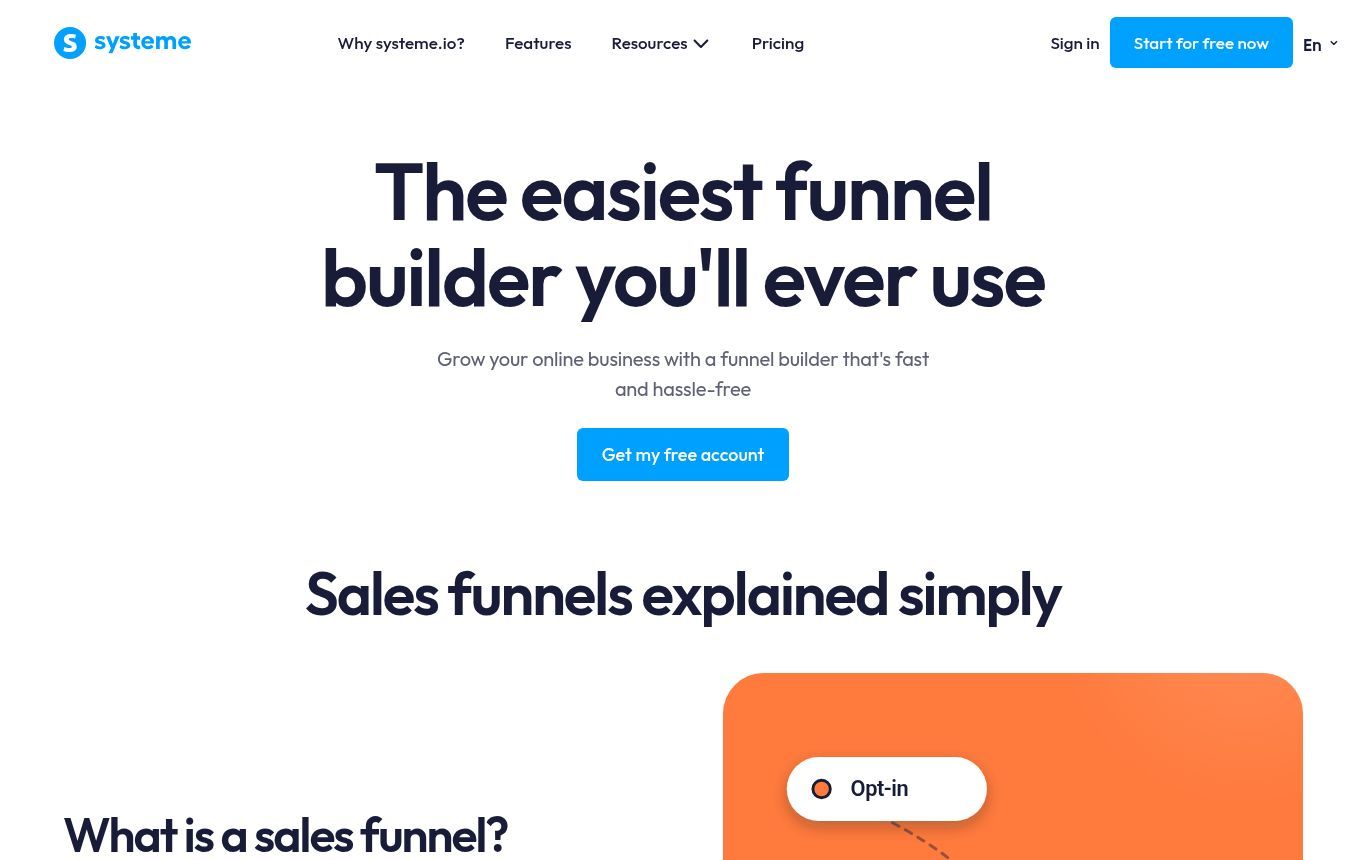
Source: systeme.io/sales-funnels, screenshot taken on 8 November 2026
According to its pricing page, checked on 8 November 2026, the Free plan includes 3 sales funnels (15 steps in total), 2,000 contacts, unlimited emails, 1 automation rule, 1 custom domain and 0% transaction fees. Paid plans shown with monthly billing are Startup ($17), Webinar ($47) and Unlimited ($97). Prices change, so always check their site.
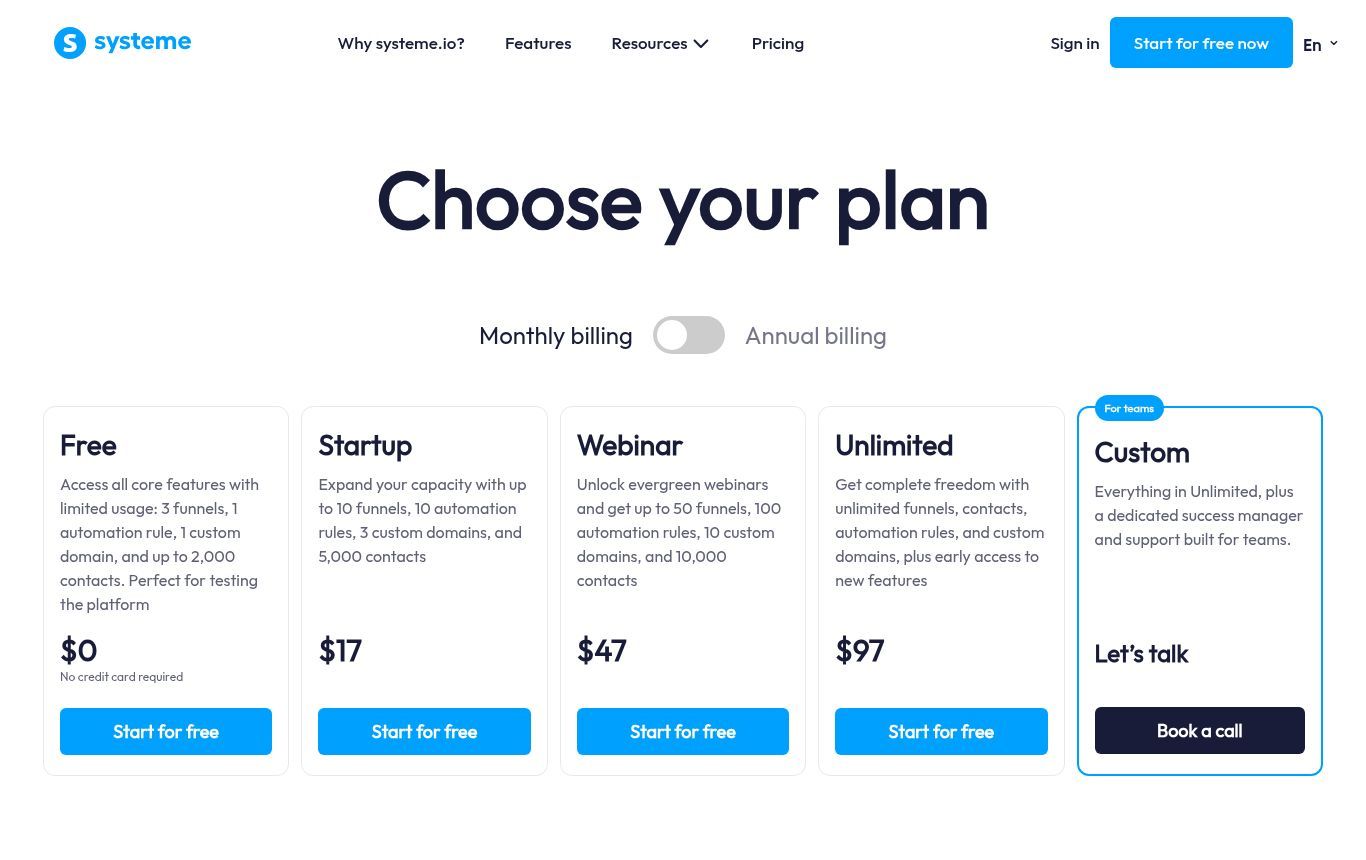
Source: systeme.io/pricing, screenshot taken on 8 November 2026
Our take: it’s a very good tool for trainers, coaches and sellers of digital products. For an SME that sells mainly through WhatsApp and Mobile Money, it’s less obvious. The payment options listed include Stripe, PayPal, Flutterwave and cash on delivery, but no native integration with Beninese aggregators. Before committing, make sure your intended payment method really works in your country and for your customers. Also, its follow-ups are designed around email, not WhatsApp.
Option 3 — Your website + automations (n8n or Make)
This is the approach we prefer for businesses that already have a website or want to stay in control. A landing page on your own domain, a form connected to a CRM, Mobile Money payment, and n8n or Make scenarios that chain the actions: save the contact, notify the salesperson, send the WhatsApp confirmation through the API, schedule follow-ups, update the stage.
The upside: you’re not locked into any tool, every building block can be swapped, and the funnel speaks your customers’ language (WhatsApp, CFA francs, Mobile Money). The downside: someone has to design and maintain the scenarios. We describe this kind of setup in our article on website + WhatsApp + CRM for an SME.
What about WordPress?
“WordPress sales funnel” is another common search. Yes, it’s doable with WooCommerce and dedicated plugins, but it’s often the heaviest option for a small team to maintain. If you already have a solid WordPress site, add an opt-in page and proper tracking; don’t build a plugin factory.
The metrics to track (and only those)
A funnel without measurement is a hunch. You don’t need thirty numbers; these five are enough to start:
- Opt-in page visitors (with Google Analytics 4 or your tool’s statistics).
- Capture rate: contacts collected ÷ visitors.
- Follow-up reply rate: how many reply to the first or second message.
- Conversion rate: customers ÷ contacts.
- Cost per customer if you run ads: ad spend ÷ number of customers.
Also note the average time between first contact and purchase. If it’s three weeks, a single day-1 follow-up will never be enough.
The most common mistakes
- Starting with the tool. You subscribe to software, spend three weeks on design, and nobody shows up. Start with the offer and the message.
- Asking too early. Pitching a 300,000 CFA purchase to someone who discovered you ten seconds ago.
- No follow-up at all. The prospect wrote, you replied once, then silence. That is the most expensive leak.
- Too many follow-ups. Six messages in three days is a guaranteed block.
- Fake urgency. A countdown that resets on every visit eventually gets noticed, and it damages your credibility.
- A desktop-first journey. Your customers are on mobile. Test on mobile.
- No source tracking. If you don’t know where customers come from, you don’t know where to spend your budget.
A 7-day action plan for your first funnel
- Day 1: pick ONE offer and ONE audience. Write the problem you solve in one sentence.
- Day 2: create your lead magnet (checklist, one-page guide, free diagnosis).
- Day 3: build the opt-in page with a single goal and a pre-filled WhatsApp button.
- Day 4: write three follow-up messages (welcome, proof, answer to the main objection).
- Day 5: set up payment or booking, and test it on mobile.
- Day 6: create the tracking sheet (source, date, stage, amount).
- Day 7: launch to your existing audience before paying for any ads.
After two to four weeks, look at your numbers and fix the step where you lose the most people. Only then should you automate.
Sales funnel FAQ
What’s the difference between a sales funnel and a website?
A website presents your whole business and lets visitors explore. A funnel guides someone towards one action, without distractions. They work together: the website reassures, the funnel converts.
Is a sales funnel the same as a landing page?
No. A landing page is one step (often capture or sale). The funnel is the full sequence: attract, capture, follow up, convert, retain.
Can you build a sales funnel for free?
Yes. With a free page, a form, WhatsApp and a tracking sheet, or with the free plan of tools like Systeme.io. Costs appear when you want to automate at scale, use the WhatsApp API or run ads.
Does a sales funnel work for B2B companies or institutions?
Yes, but it’s longer and almost always goes through a meeting or a quote. The funnel’s job is then to qualify requests and make sure no quote is left without follow-up.
Should I follow up by email or WhatsApp?
Both, with different roles. WhatsApp for short follow-ups and conversation, email for documents, invoices and formal exchanges. In both cases, with the person’s consent.
How much does a sales funnel built by Guelichweb cost?
It depends on your offer, your current tools, payment and the level of automation you want. We don’t publish a fixed price: we start with a diagnosis, then prepare a quote. Our packages are described on our offers page.
Conclusion
There’s nothing magical about a sales funnel. It’s a way to stop losing the people who are interested in you: attract them with a clear message, collect a contact, reassure them without harassing them, make payment easy and look after them after the purchase.
In French-speaking Africa, the difference usually comes down to two details that imported templates forget: WhatsApp as the follow-up channel and a payment method that fits. Get those two right and you’ll already have a better funnel than most “ready-made” pages.
Want us to review your current customer journey and show you where you’re losing sales? Tell us about your business through our contact page. We work from Cotonou (website design in Cotonou) with companies, NGOs and institutions across the region, and we can build the page, the CRM and the automations with you (see our services).