What is a backlink? Definition, examples and how to get free, high-quality backlinks
G. CHRIST
Published on October 31, 2026
Your website is clean, your pages are well written, your Google profile is up to date. And yet, on the searches that matter, a less polished competitor ranks above you. Very often the difference is not visible on their site at all. It sits elsewhere: on the other websites that talk about them and link to them. Those are their backlinks.
The topic has a bad reputation, and for good reason. Every week, someone receives a message promising "500 quality backlinks for 10,000 CFA francs". Most of these offers are useless at best and harmful at worst. But throwing the whole subject away with them would be a mistake: the links pointing to your website are still a signal Google uses to judge how credible you are.
At Guelichweb, we build websites and automations for SMEs, NGOs and public institutions in Benin and across French-speaking Africa. In this guide we explain, in plain language, what a backlink is, how to tell a good one from a bad one, where to get them for free when you have neither a PR budget nor a marketing team, and what you should never do. Our position is clear from the start: a backlink is earned, not bought in bulk.
What is a backlink, exactly?
A backlink (also called an inbound link or incoming link) is a link placed on another website that points to a page on your website. If a chamber of commerce publishes its member list and your name is clickable to your site, you have a backlink. For the chamber of commerce, it is an outbound link. For you, it is an inbound link.
Do not confuse it with an internal link, which connects two pages of your own site (for example, a blog post linking to your services page). Internal links are useful, but they are not backlinks: only links coming from another domain count. Wikipedia gives the same definition.
Technically, a backlink is nothing more than an HTML <a> tag on someone else's page. If "tag" does not mean much to you, our article What is HTML? covers the basics in ten minutes. The diagram below shows the parts of a link that matter for SEO.
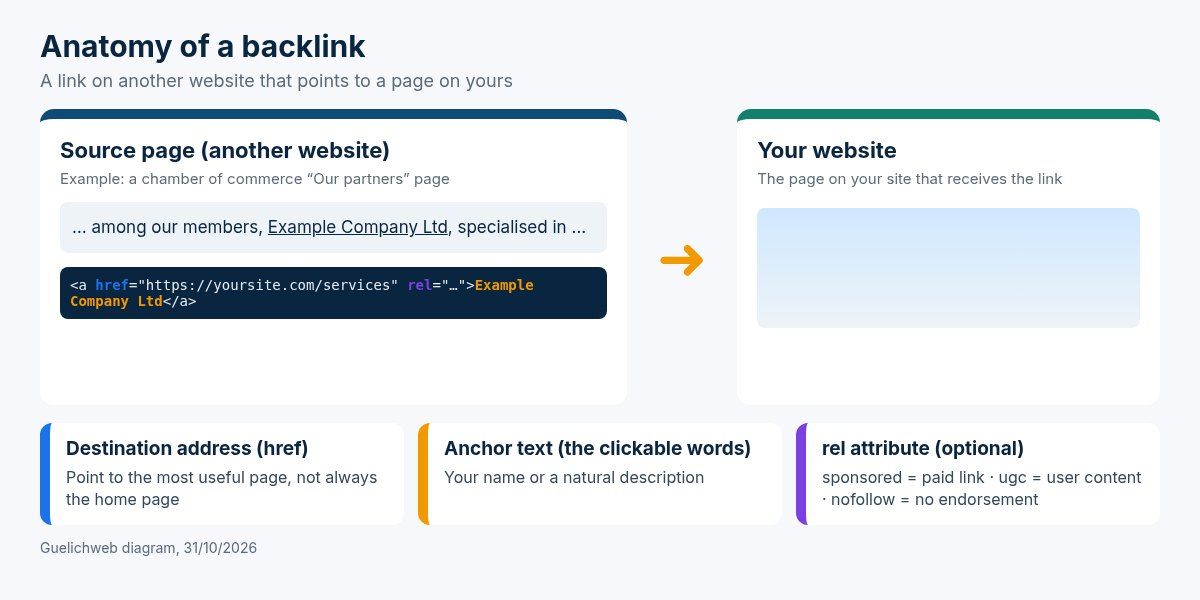
Guelichweb diagram, 31 October 2026.
- The source page: where the link lives. Its topic and trustworthiness matter more than anything else.
- The destination address: the page on your site the link points to. Ideally the most useful page for whoever clicks, not necessarily your home page.
- The anchor text: the clickable words. Your name, a natural description ("this guide to online donations"), sometimes the bare address.
- The rel attribute (optional): it tells Google what kind of link this is. We come back to it below, because that is where the line between normal advertising and spam is drawn.
Why backlinks still matter to Google
Google was originally built on a simple idea: a page cited by many other pages, especially pages that are themselves cited, is probably a good page. A link works like a recommendation. Twenty-five years later the algorithm uses hundreds of signals, but that recommendation logic has not gone away.
In practice, backlinks do three things:
- They get you discovered. Google's crawlers follow links to find new pages. A new site that nobody links to can take a long time to be crawled. If you want to understand that mechanism, read how Google crawls, indexes and ranks your site.
- They make you look credible. A link from a recognised site in your field tells Google: "someone serious trusts you".
- They send real visitors. People forget this: a good backlink also brings actual humans. A link from a donor's website to an NGO's annual report can be worth more, in useful contacts, than hundreds of visits from search.
Let us be honest about the limits. Backlinks will not rescue a slow, badly structured website or one that does not answer the question being asked. They do not replace good work on SEO keywords or on content. For a local business targeting "plumber in Cotonou" or "accounting firm in Abidjan", a Google Business Profile and customer reviews often matter more at the start. Links are an accelerator, not a starting point. If you are new to all this, start with our article What is SEO?.
Good backlink, bad backlink: how to tell them apart
Not all links are equal, and the total number of backlinks is probably the most misleading metric in SEO. Ten well-chosen links beat a thousand links from nowhere. These are the questions we ask before calling a link good.
1. Is the linking site related to you?
A link to a clinic from a health association's website makes sense. A link to the same clinic from a foreign sports-betting blog does not. Topical or geographical relevance is the first test.
2. Is the site real, and do humans read it?
Open it. Does it have recent articles, an identifiable team, an address? Or is it a stream of authorless posts about everything, with links in every paragraph? If you would not want your clients to see your name on that page, the link is not good.
3. Is the link placed inside the content?
A link in the middle of an article, surrounded by text explaining why you are being cited, is worth far more than a link buried in a footer next to fifty others.
4. Was the link earned or manufactured?
This is the decisive question. A link given because your content, your work or your partnership justifies it is a natural link. A link obtained by paying, by swapping links at scale or through automated software is an artificial link, and Google says so in writing.
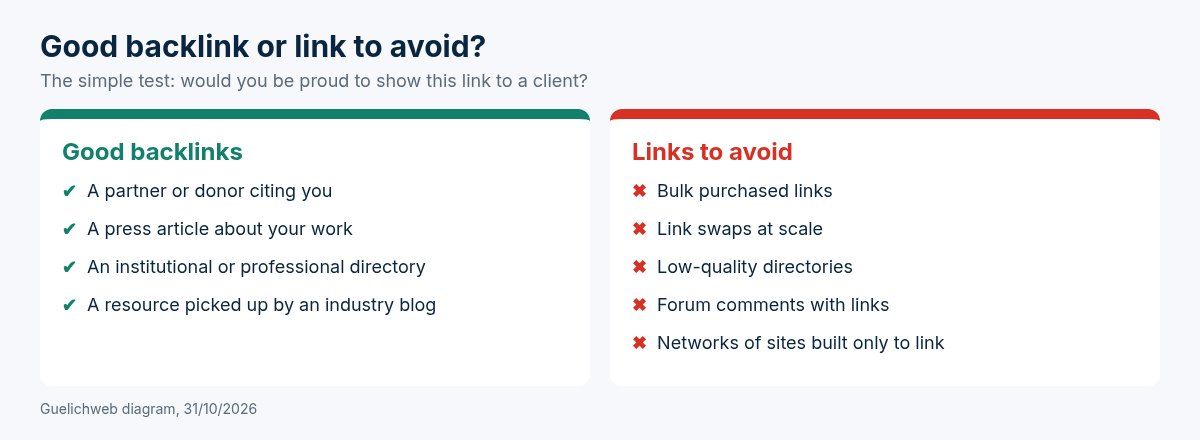
Guelichweb diagram, 31 October 2026, based on Google's spam policies.
What Google actually says about links (and why buying them is a bad bet)
There is no need to guess: Google publishes its spam policies for Google web search, with a whole section on link spam. It lists, among other things:
- buying or selling links for ranking purposes, including exchanging goods or services for links;
- excessive link exchanges ("link to me and I'll link to you");
- using automated programs or services to create links to your site;
- links from low-quality directory or bookmark sites;
- widely distributed links in the footers or templates of various sites;
- forum comments with optimised links in the post or signature.
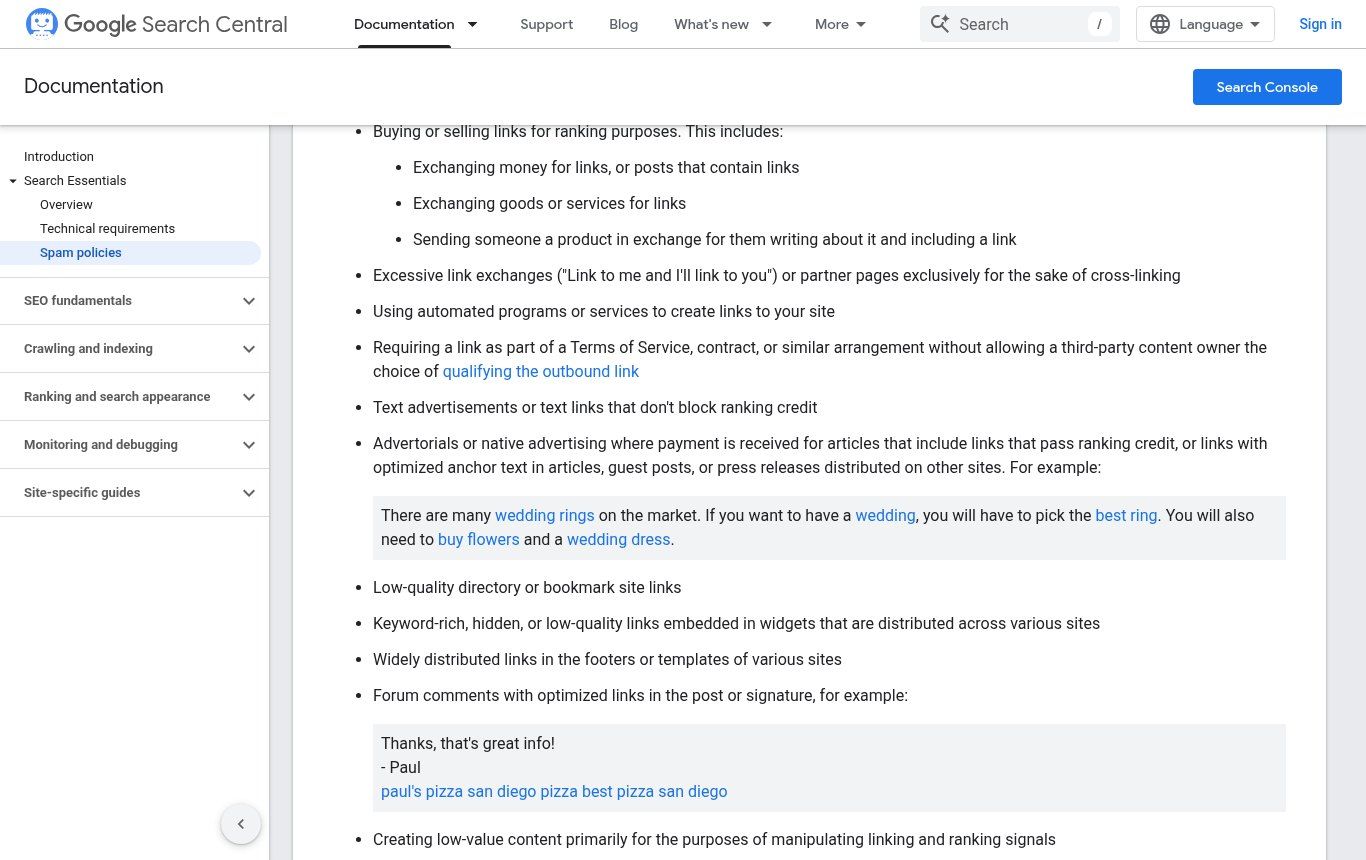
Source: Google Search Central, "Spam policies for Google web search", screenshot taken on 31 October 2026.
The same text makes a point many people miss: buying advertising that contains a link is not forbidden. It is a normal part of the web economy, as long as the link is qualified with rel="sponsored" (or rel="nofollow"). Google details these attributes on its page "Qualify your outbound links to Google": sponsored for paid links, ugc for user-generated content such as comments, nofollow when you do not want Google to associate your site with the linked page.
Our view: for an SME or an NGO, buying links is almost always a bad deal. Either the link is marked "sponsored" and does nothing for your ranking, or it is not, and you take a penalty risk for an uncertain gain. The "backlink packs" sold by direct message are, in the cases we have been able to examine, links placed on sites created only to sell links. If a provider promises a number of links per month but cannot show you where they will be published, say no.
A good backlink is one you would be proud to show a client. If you need to hide it, it is not a good link.
How to get free, high-quality backlinks as an SME, NGO or institution
The good news: organisations in French-speaking Africa often have legitimate link sources they never use, simply because nobody thought to ask. Here are the routes we recommend, from the easiest to the most demanding.
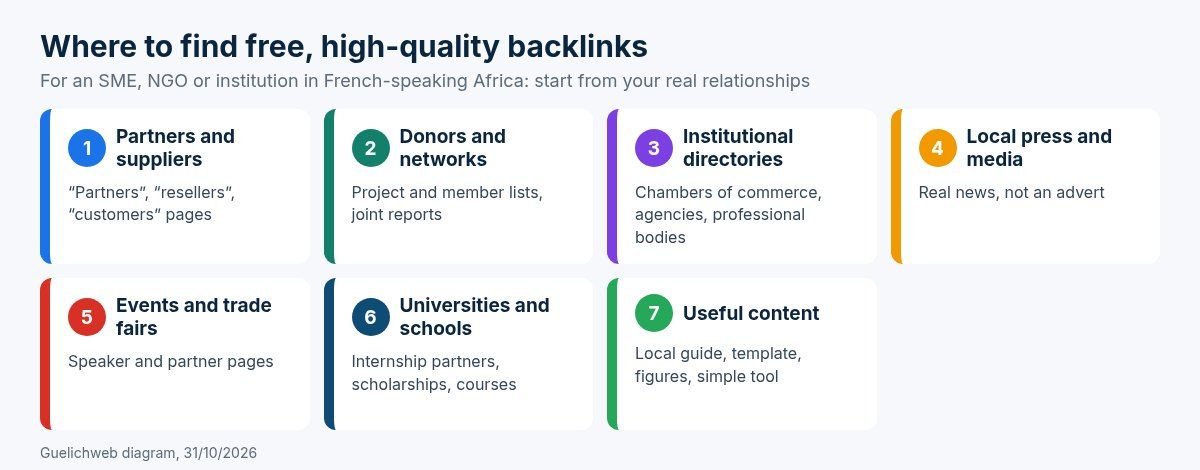
Guelichweb diagram, 31 October 2026.
1. Your partners, suppliers and business clients
This is the most underrated source. Does your distributor list its resellers? Does your software vendor have a "customers" page? Does the integrator you work with publish its partners? A polite message is often enough: "We have been working together for two years; could you add a link to our website on your partners page?" That is not a link scheme: it is the online version of a real relationship.
2. Donors, networks and consortia (for NGOs)
An NGO funded by a donor or belonging to a network often appears on that partner's website, in a list of projects or members. Check that your name is actually linked to your site, with the right address. Do the same with humanitarian coordination platforms, consortia and joint reports. If your own website is not yet ready for those demanding visitors, our guide to NGO websites lists what they expect to find.
3. Institutional directories and professional bodies
Chambers of commerce and industry, investment promotion agencies, trade associations, professional orders (doctors, pharmacists, lawyers, architects), startup directories backed by public programmes or incubators: these directories are relevant because a real institution maintains them and potential clients use them. Avoid general-purpose "SEO directories" that accept anyone: Google explicitly lists them among low-quality links.
4. Local press and online media
An opening, a new service, a partnership, a study, a new figure about your sector: these are stories for journalists. Online media in French-speaking Africa publish many business stories. Two tips. First, offer information worth reporting, not an advert. Second, simply ask whether the article can mention your website address. If the outlet charges you for publication, it is an advertorial: it must be labelled as such and the link marked "sponsored". That is visibility, not SEO.
5. Events, trade fairs, training and speaking
Speaking at a conference, sponsoring a hackathon, running a workshop? The event page usually lists speakers and partners. Ask for your name to be linked to your site, and offer a short bio. It is legitimate, useful for attendees, and rarely refused.
6. Universities, schools and internships
If you host interns, teach at a school or fund a scholarship, the institution may cite you on its corporate partners page. Such links are rare, so they are valuable.
7. Create content that deserves to be cited
This is the most durable method, and also the most demanding. People link to what helps them: a practical local guide nobody else has written, a downloadable template, an up-to-date list of administrative procedures, figures drawn from your activity (anonymised), a simple tool such as a calculator. A serious business blog is the right home for this; our article on how to create a business blog explains how to keep it going without burning out.
8. Reclaim unlinked mentions
Search Google for your organisation's name in quotation marks. You may find articles, reports or lists that mention you without a link. Write to the author to thank them and suggest adding your website address "so readers can find you more easily". The response rate is usually much better than a cold request.
9. Fix broken links pointing to you
If you have changed page addresses or rebuilt your site, old links may point to pages that no longer exist. Those links are lost until a redirect sends them to the right page. That is one reason we insist so much on the redirect plan during a website redesign.
What we advise against, even when it is "free"
- Posting comments with your link on unrelated blogs or forums: Google lists it as link spam, and such links are usually marked ugc or nofollow anyway.
- "Link exchanges" offered by strangers, especially in large numbers.
- Signing up to dozens of general directories in one afternoon.
- Software or plugins that promise to "generate backlinks" automatically.
A word on social media: links from Facebook, LinkedIn or a TikTok profile to your site are useful for bringing visitors, but they should not count as a backlink strategy. Social profiles remain essential, just for other reasons.
Concrete examples by type of organisation
To make this more concrete, here are the kind of first steps we would suggest depending on your profile. They are working directions, not promises of results: everything depends on your sector and your existing network.
- A service SME in Cotonou: check its listing with the chamber of commerce and its professional order or association, ask its three main suppliers for a mention, publish a practical guide on a question clients ask all the time.
- An NGO: review every donor, network and consortium page where it appears, publish its annual reports on a dedicated page that is easy to cite, offer journalists a figure or testimony from its projects (with consent).
- A public or semi-public institution: make sure supervising ministries, technical partners and national platforms link to the right address (they often point to an old site), publish open data or useful forms that others will naturally reference.
- An online shop: get listed on the websites of the brands it sells ("where to buy" pages), send products to content creators for review while requiring every link to be marked "sponsored", because a link obtained in exchange for a free product without that label falls under what Google calls link spam.
How to check your backlinks for free
Before chasing new links, look at the ones you already have. The most reliable free tool for this is Google Search Console. If you have not set it up yet, our guide Google Search Console: what it is and how to use it walks you through it step by step.
In Search Console, open the Links menu. The Links report shows, for external links:
- top linked pages: the pages on your site most cited by other sites;
- top linking sites: the domains that link to you the most;
- top linking text: the words used in those links.
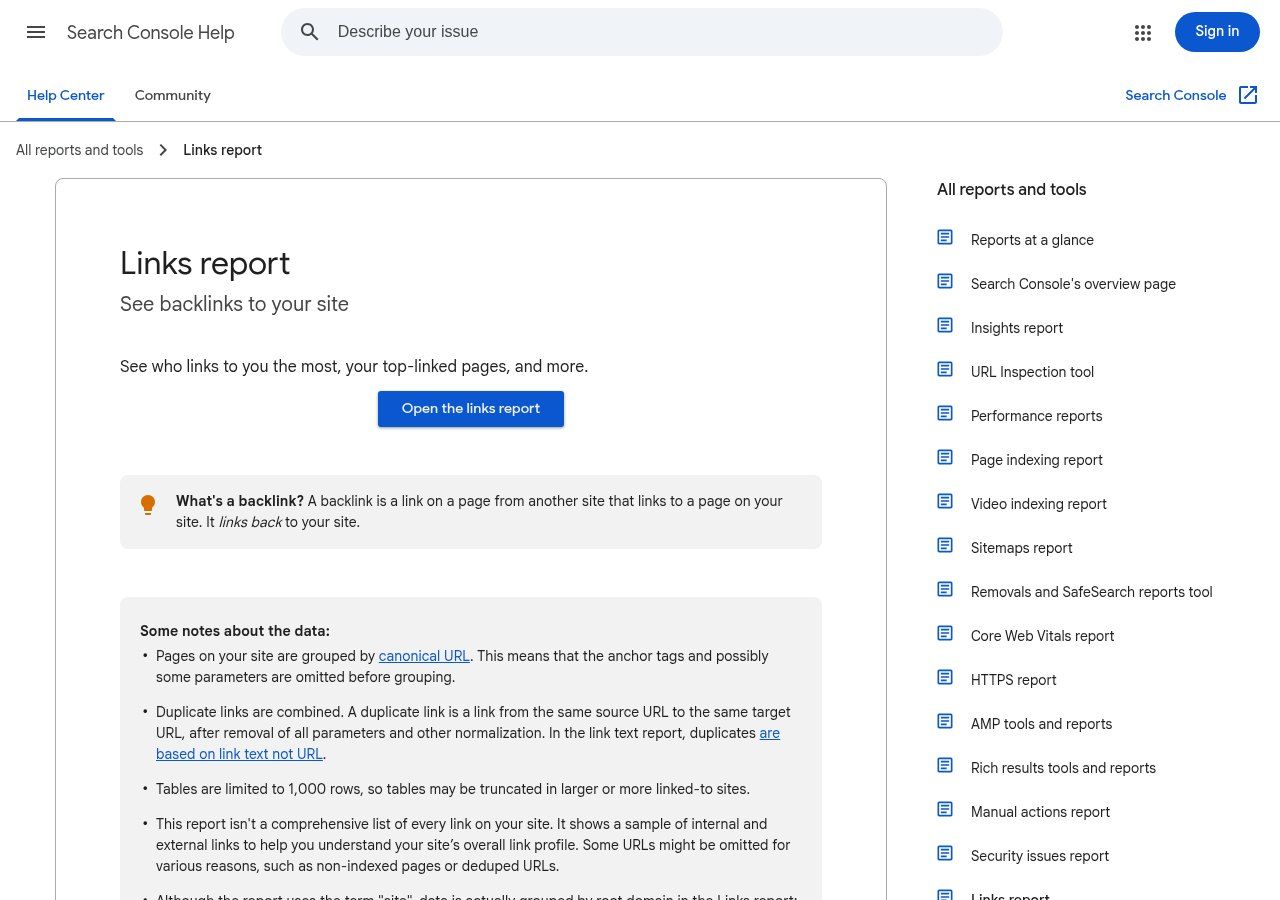
Source: Search Console Help, "Links report", screenshot taken on 31 October 2026.
Three limits to keep in mind, all stated by Google: the report shows a sample of links, not a complete list; it does not say whether a link is nofollow; and it may show links that have since disappeared. That is enough for an SME. Paid link-analysis tools (Ahrefs, Semrush, Majestic and others) go further, but their "authority scores" are proprietary metrics, not Google data. Never steer your strategy on those scores alone.
Should you disavow links?
Almost never. Google says so itself on its page "Disavow links to your site": in most cases it can assess which links to trust without extra guidance, and most sites will not need the tool. It is only recommended if you have a considerable number of artificial links pointing to you and they have caused, or are likely to cause, a manual action. Seeing a few odd links from foreign sites in the report is normal; Google generally ignores them. Be wary of providers selling a "toxic link clean-up" when there is no manual action showing in your Search Console.
A simple 90-day action plan
This is the method we would apply to an organisation starting from almost nothing. It takes a few hours a month, not a budget.
- Week 1: the inventory. Set up Search Console if needed, note the sites already citing you, and search for your name on Google to find unlinked mentions. Our website audit checklist also helps you check that the pages that will receive those links are in good shape.
- Weeks 2 to 4: existing relationships. List ten partners, suppliers, donors, associations or institutions you have a real relationship with. Check whether they cite you, and write to those who do not, or who link to the wrong address.
- Month 2: the directories that matter. Sign up, or update your listing, in the three to five institutional or professional directories genuinely related to your activity and your country. No more.
- Months 2 and 3: content that earns a link. Publish a genuinely useful resource (local guide, template, figures, tool). Then present it personally to a few websites, journalists or associations it will help.
- End of month 3: the review. Go back to the Links report. How many new sites cite you? Which pages receive the links? Did visits from those sites turn into enquiries? Adjust.
Above all, make links a communication reflex. Every time your organisation is mentioned somewhere, ask for the link. Every time you sign a partnership, plan the mention on both websites. After a year, the difference is clear.
The mistakes we see most often
- Pointing every link at the home page. If a partner talks about your training course, the link should go to the course page.
- Leaving links to an old domain or a Facebook page. Many institutions and NGOs are cited with an outdated address. A simple update recovers those links.
- Demanding keyword-stuffed anchor text. "Best cheap web agency Cotonou" repeated on ten sites is exactly what Google flags as artificial. Let people cite you in their own words, usually your name.
- Ignoring your own address. If your site is reachable in several variants (with or without www, over http and https), make sure they all redirect to a single version. Our article on what each part of a URL means explains why.
- Expecting miracles within a month. The effect of a good link is measured in weeks or months, and depends on the rest of your SEO.
Backlinks FAQ
What is a backlink in SEO?
It is a link on another website that points to a page on yours. Google uses it to discover your pages and as a trust signal, provided the link is natural and comes from a relevant site.
What is the difference between a backlink and link building?
The backlink is the link itself. Link building (called "netlinking" in French) is the set of actions taken to obtain backlinks. In this guide we argue for link building based on real relationships and real content.
Can you get high-quality backlinks for free?
Yes, and they are often the best ones: partners, donors, institutional directories, press, events, schools and useful content. They cost time, not money.
Is buying backlinks forbidden?
Buying a link to improve your ranking breaks Google's rules. Buying advertising that contains a link is allowed if the link is marked rel="sponsored" or rel="nofollow"; it will then help your visibility, not your ranking.
How many backlinks do I need to rank first on Google?
There is no number. It depends on the competition for the search you target. For many local searches in French-speaking Africa, a few relevant links, a solid website and a well-maintained Google profile are enough to make the difference.
Is a nofollow link worth anything?
It can bring visitors and awareness. Google says links marked nofollow, sponsored or ugc are generally not followed, so do not count on them for ranking.
Are links from social media backlinks?
Technically yes, they are external links. But almost all of them are qualified so that they do not pass a recommendation. They are for traffic, not ranking.
How do I find out who links to my website?
For free, with the "Links" report in Google Search Console, under "Top linking sites". It shows a representative sample of the sites that cite you.
How long does it take for a backlink to have an effect?
Google first has to crawl the page that contains the link, which can take days or weeks depending on that site. The effect on your ranking is then gradual and mixed in with every other signal, so judge your efforts over several months, not a single week.
Going further
Backlinks are the "outside" part of SEO. They only work fully if the site receiving them is fast, clear, well structured and answers your clients' searches. If you want to know where your website stands, and which realistic link sources exist in your sector, contact us. We start with an assessment, then propose a quote tailored to your situation; you can already browse our offers and services.