What is Perplexity AI? Free vs paid, pricing and how to use it in your business (2026 guide)
G. CHRIST
Published on November 26, 2026

When an NGO manager tells us “I asked AI about the eligibility rules for the call for proposals”, our first question is always the same: which AI, and did it give you the source? With ChatGPT, the answer is often vague. With Perplexity, the source is right there, numbered and clickable. That is the whole difference, and it is why this tool has earned a special place in offices that do monitoring, research or regulatory follow-up.
This guide answers the questions we actually get asked: what exactly is Perplexity? Is the free version enough? What do Pro, Max and Enterprise cost, in dollars and in CFA francs? How do you pay from Cotonou, Abidjan or Dakar? What happens to your searches? And the question almost nobody asks yet: how do you get Perplexity to cite your own website when someone looks for what you do? All prices and rules quoted here were checked on Perplexity’s official pages on 26 November 2026.
What is Perplexity?
Perplexity is an AI-powered answer engine. Instead of showing you ten blue links like Google, it runs the searches itself, reads the pages it finds, then writes a short answer in which every claim points to a numbered source. You ask in plain English (or French, or many other languages), it answers in the same language, and you can open each source to check it.
Official Perplexity logo (wordmark), source: perplexity.ai, captured 26 Nov 2026.
The company behind it is American. Perplexity does not rely only on its own model: depending on the plan, it uses models from OpenAI, Anthropic, Google or xAI, and picks the most suitable one automatically if you do not choose. For you, that means one simple thing: the quality of an answer depends less on the model than on the quality of the sources it finds.
Around the search engine, Perplexity added several building blocks in 2025 and 2026: a Research mode (long reports built from dozens of sources), Create files and apps (spreadsheets, slide decks, small dashboards), Computer, an agent that chains tasks and connects to your tools, and Comet, a web browser with a built-in assistant. For a small business, the core remains sourced search. The rest is useful, but secondary.
How it works in practice
Take a real office example: “What are the eligibility conditions of the latest European Union calls for proposals for civil society organisations in West Africa?” Perplexity breaks the question into several searches, goes through the pages it finds, discards some results and returns a structured answer with the list of sources underneath or alongside.
- Standard search: a quick answer with a few sources, ideal for a definition or a fact check.
- Pro Search: several reasoning steps and more sources; this is where the tool really earns its keep.
- Research: a full report on a complex topic within minutes; very handy to prepare a briefing note or a file.
- Files: drop in a PDF, a spreadsheet or an image and ask questions about it; limits depend on the plan.
Our advice: write your questions the way you would brief a librarian. Country, period, the type of source you expect (“official sources only”, “legal texts”, “NGO reports”). Our method for writing an effective prompt applies perfectly here.
Perplexity free: what you really get
Yes, Perplexity is free, and the free version is already very usable. According to the official help center, the free (Standard) plan includes:
- “virtually unlimited” basic searches and your search history;
- 3 Pro Searches per day and 1 Research query per month;
- limited file uploads;
- a model picked automatically by Perplexity, with no access to advanced models;
- no image generation, no Comet browser assistant and no file and app creation.
For occasional use (checking a figure, understanding a concept, finding an official document), that is plenty. What runs out quickly is Pro Search: three a day is one serious morning of research, no more. You can also ask a few questions without signing in, but you need an account for Pro Search and to keep your history.
Perplexity pricing in 2026: Pro, Max, Education and Enterprise
Prices are shown in US dollars on the pricing page. To give West African readers a rough idea, we converted them at about 600 CFA francs to the dollar (late November 2026); your bank will add its own card fees and exchange rate.
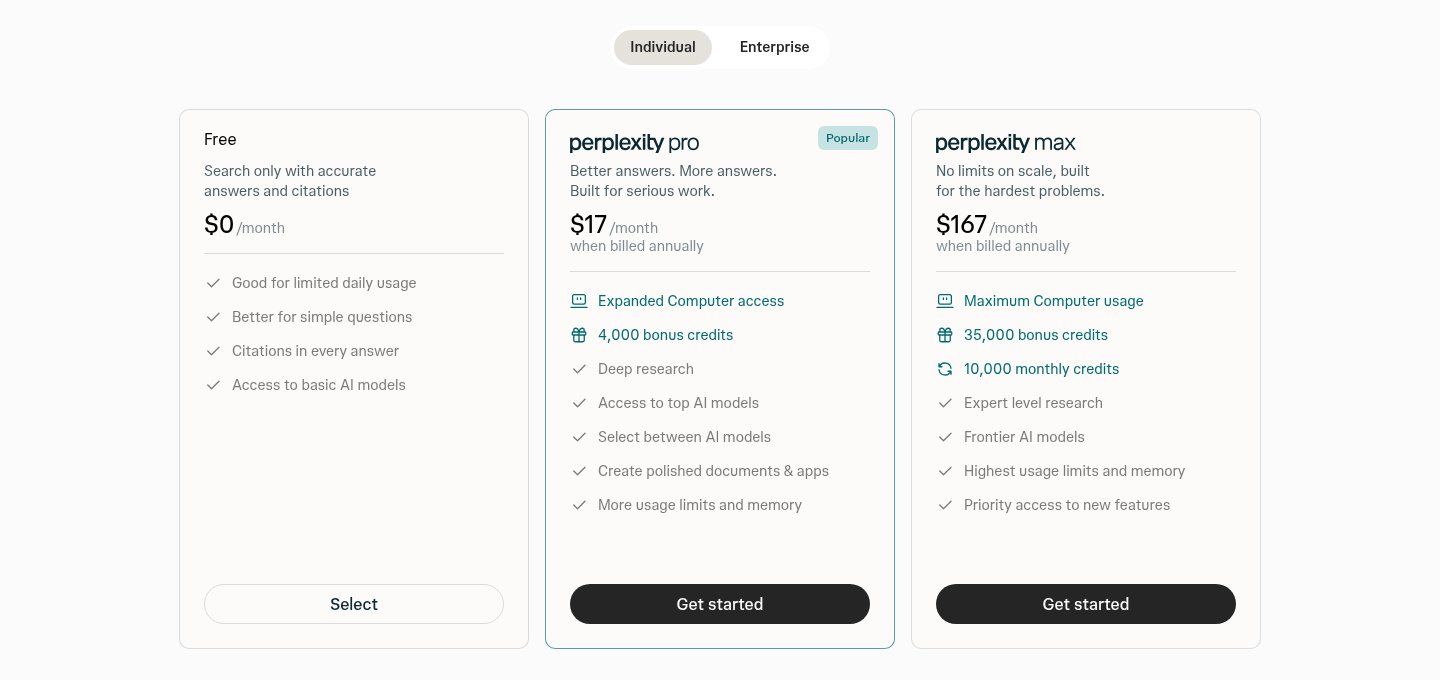
Source: perplexity.ai/hub/pricing, Individual tab, captured 26 Nov 2026.
- Free: $0.
- Pro: $17 per month billed annually (about 10,200 CFA francs a month), paid upfront for the year.
- Education Pro: $10 per month (about 6,000 CFA francs) for students and teachers verified through SheerID.
- Max: $167 per month billed annually (about 100,000 CFA francs a month). Heavy users only.
- Enterprise Pro: $40 per seat per month, or $400 per seat per year (shown as $34 a month when billed annually), about 24,000 CFA francs per person per month on monthly billing.
- Enterprise Max: $325 per seat per month, or $3,250 per year.
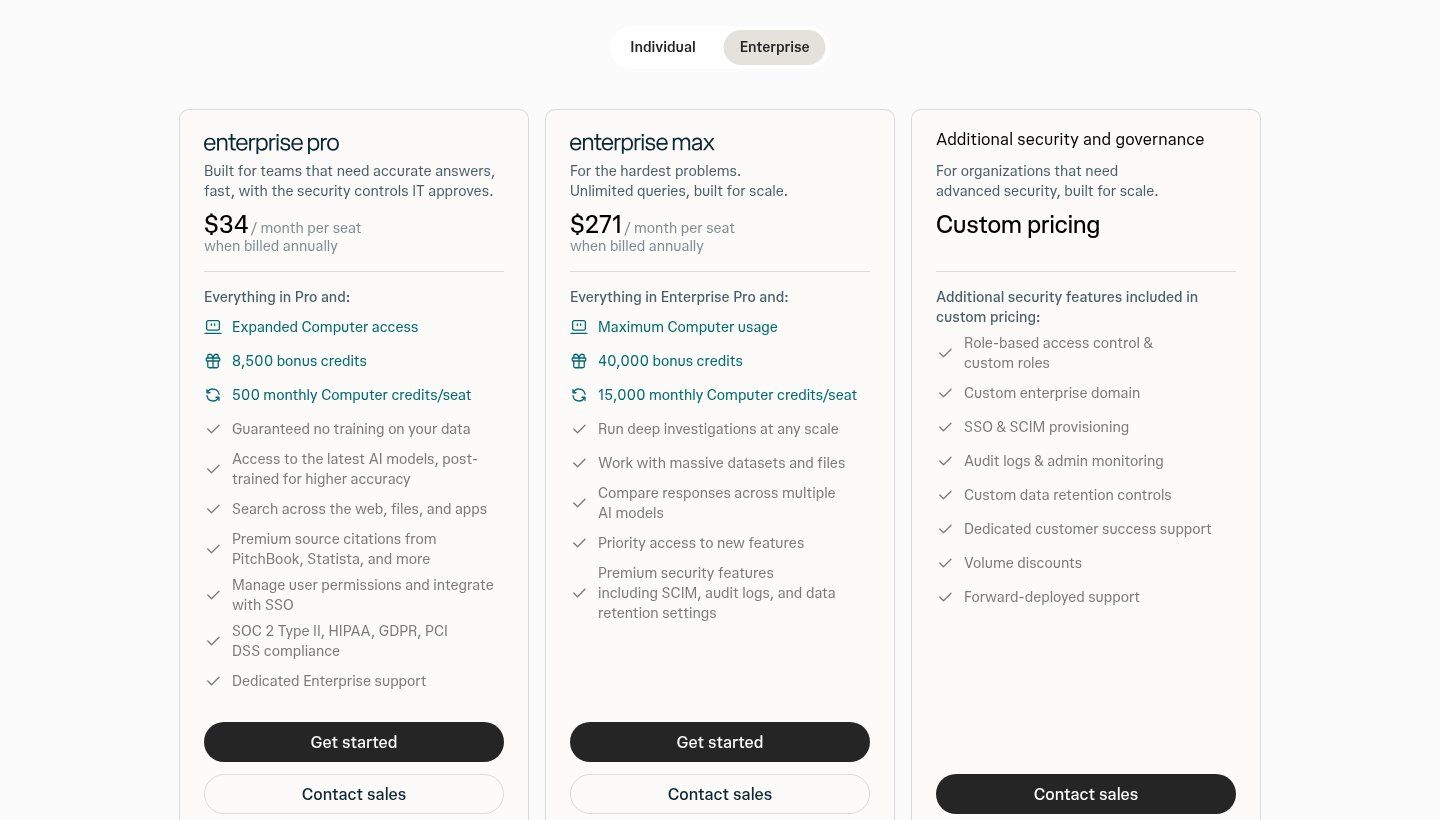
Source: perplexity.ai/hub/pricing, Enterprise tab, captured 26 Nov 2026.
Two details matter for a budget. First, paid plans include Computer credits (for the agent), used up according to the size of each task; standard searches do not use credits. Second, the Enterprise billing FAQ states that API usage is not included in Enterprise Pro or Enterprise Max: if you want to automate, that is a separate budget. The same page says discounts may be available for schools, universities, nonprofits and government agencies, so an NGO should ask the sales team before paying full price.
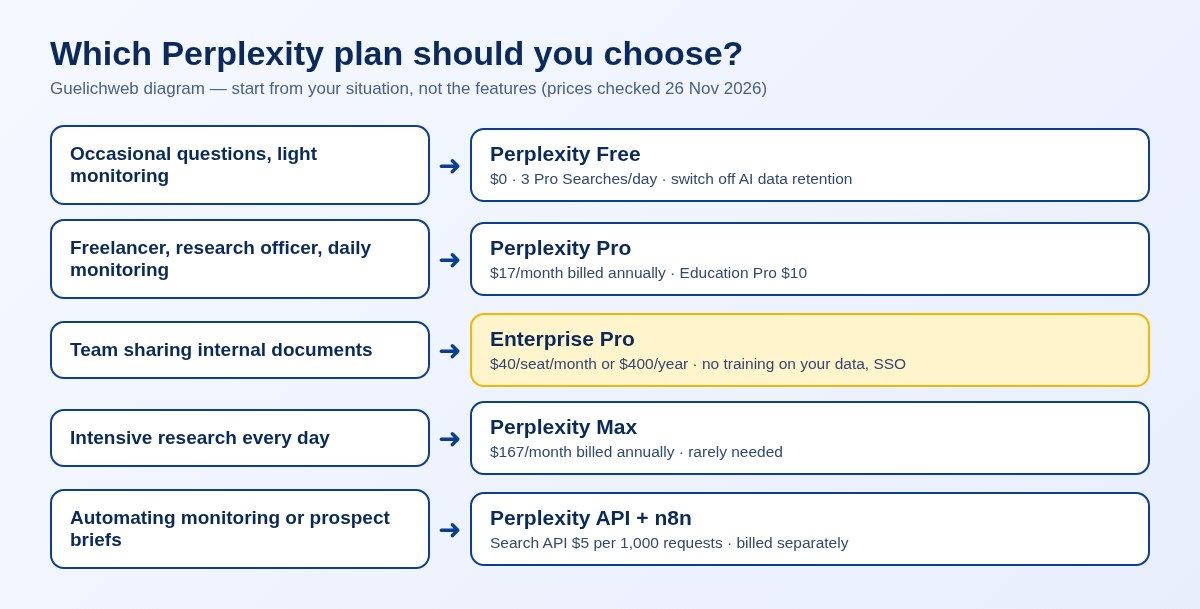
Guelichweb diagram: start from your situation, not from the feature list (prices checked 26 Nov 2026).
Paying for Perplexity from Benin or West Africa
Perplexity works in Benin, Côte d’Ivoire, Senegal or Cameroon just as it does elsewhere: the interface is available in French and English, and the free plan requires no payment. The sticking point is the subscription. Payment is by bank card, in dollars; we found no Mobile Money or CFA franc option on the official pages we checked. The help center even says a valid credit or debit card is required to activate a trial or promotional subscription.
In practice, an international Visa or Mastercard (including some virtual cards issued by banks or fintechs in the region) does the job. Start with one month, check the amount actually charged on your statement, then switch to annual billing if the tool earns its place.
A word about resellers offering “Perplexity Pro” payable by Mobile Money: some are really selling access to a shared account. You do not know who else can read the searches, the account can be closed overnight and nothing guarantees confidentiality. For an organisation, the answer is no. Likewise, the “free Perplexity Pro for a year” offers going around sometimes come from genuine partners (mobile operators, phone makers, PayPal), but always make sure you are on an official site before entering your details.
Privacy: what Perplexity does with your searches
This is the point most articles skim over, so let us be precise. According to the official page “Data Collection at Perplexity”, for Free, Pro and Max users, AI data retention is enabled by default. In other words, your questions may be used to improve Perplexity’s models unless you switch that setting off.
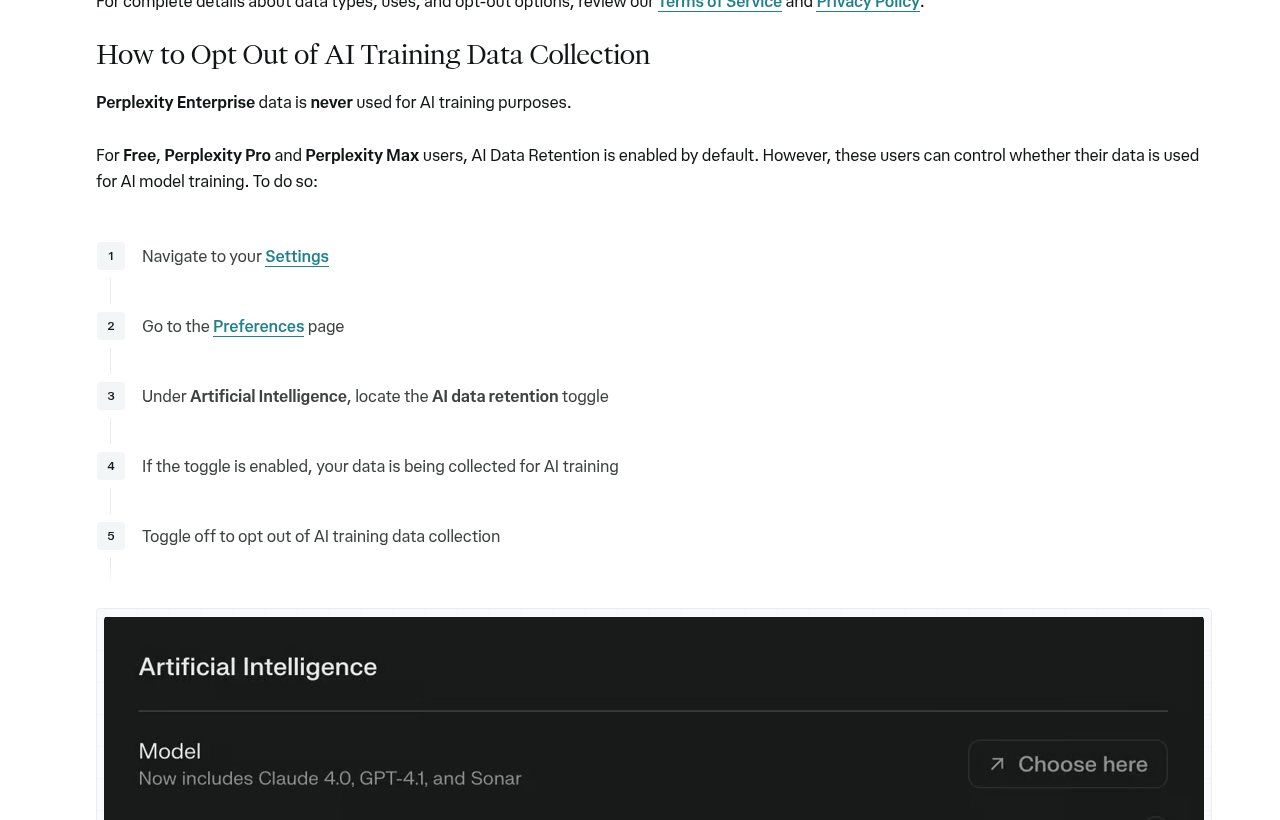
Source: Perplexity help center, “Data Collection at Perplexity”, captured 26 Nov 2026.
- Open your Settings, then the Preferences page.
- Under Artificial Intelligence, find the AI data retention toggle.
- Switch it off.
Three limits to keep in mind: the opt-out only applies to data collected after you switch it off (data already collected is not removed), it is set account by account, and your data is still processed for running the service, legal compliance and product improvement. With Enterprise Pro or Enterprise Max, Perplexity commits to never using your data for training and lists SOC 2 Type II, GDPR and HIPAA compliance, with single sign-on (SSO).
Our rule, whatever the plan: no personal data about beneficiaries, no customer lists, no medical or HR files in a consumer plan. In Benin, such data is covered by the personal data protection rules of the Digital Code, overseen by the APDP; in the UK, the ICO publishes clear guidance on AI and data protection. If you do not have internal rules yet, start with our AI usage policy template.
Is Perplexity reliable?
More reliable than the average assistant for recent facts, because it shows its sources. But a cited source is not a verified source. We regularly see three problems:
- The source exists but does not say what the answer claims. Always open it for any figure you are going to reuse.
- The source is weak: a comparison blog, an aggregator, a sales page. Ask explicitly for “official sources” or “government websites”.
- The topic is poorly documented online. For a Beninese regulation, a local price list or a niche market in Parakou or Bouaké, there are sometimes very few reliable pages, and the AI fills the gaps. In that case, Perplexity helps you find where to start, not what to conclude.
Our position is clear: Perplexity is an excellent starting point for research, never a validation tool. The decision, the published figure, the quote in a donor report remain the job of a human who has read the source.
Perplexity, ChatGPT, Gemini or Claude: which one for what?
We are often asked to name “the best one”. There isn’t one. There is the right tool for the right task:
- Perplexity: searching, checking facts, monitoring, building a sourced file. That is its home ground, and it beats the others there.
- ChatGPT: drafting, rewording, analysing a document, all-round versatility. See our guide ChatGPT for business.
- Gemini: the most convenient if your organisation lives in Gmail, Docs and Drive. See Google Gemini for business.
- Claude: long, nuanced writing and analysis of large documents. See Claude AI.
- Copilot if you run on Microsoft 365 (our Copilot guide); Mistral if European data hosting matters to you (our Mistral guide).
Our recommendation for a small team: one writing assistant (the one that fits your tools) plus the free version of Perplexity for research. Paying for two subscriptions in the first month is rarely justified.
10 practical uses for a small business, an NGO or a public body
- Tender and call-for-proposals monitoring: “open calls for proposals this month for agriculture in Benin, official sources”.
- Regulatory watch: spot a new law, decree or regulator decision, then go and read the official text.
- Meeting preparation: understand a partner’s, donor’s or supplier’s activity in ten minutes.
- Quick market research: who is active, public price ranges, trends, with links to dig deeper.
- Checking before publishing: a figure in a LinkedIn post, a date in a press release, a statistic in a report.
- Briefing notes: Research mode produces a first sourced draft of a background or advocacy note, which you then rework.
- Solution benchmarks: compare three software tools, three hosting providers or three contractors on precise criteria.
- Querying a long PDF: annual report, specifications, terms of reference; ask questions instead of rereading everything.
- Preparing a training session: gather definitions, examples and sources for an internal workshop.
- Funding research: foundations and programmes active in your country and sector, with their official pages.
The topic nobody covers: getting cited by Perplexity
Your future customers already ask Perplexity things like “which agency for an e-commerce website in Cotonou?” or “which audit firm in Abidjan for an NGO?”. And Perplexity answers by citing websites. If yours is badly built, slow, thin on content or blocks bots, you simply do not exist in that answer.
The official Perplexity crawler documentation describes two agents: PerplexityBot, which crawls and indexes sites so they can appear in results (and, according to Perplexity, is not used to train foundation models), and Perplexity-User, which visits a page when a user asks a question. Perplexity recommends allowing PerplexityBot in your robots.txt file and, if you use a web application firewall such as Cloudflare, letting its published IP ranges through.
Concretely, this is what we check on our clients’ websites:
- robots.txt does not exclude PerplexityBot by mistake (it happens with copy-pasted rules or overzealous security plugins);
- the firewall or hosting provider does not block legitimate bots;
- service pages clearly answer specific questions: what, for whom, where, how a project runs;
- factual details (address, service area, approved references) are consistent everywhere: website, Google Business Profile, social media;
- the site is properly indexed by Google, because answer engines also lean on the classic web (Google Search Console is the first tool to open).
The good news: none of this is a secret technique. It is well-executed SEO, applied to a new kind of search engine.
Automating research with the Perplexity API and n8n
To go beyond the interface, Perplexity offers a pay-as-you-go API, billed separately from subscriptions. According to the official rate card, the Search API costs $5 per 1,000 requests (about 3,000 CFA francs), or $1 per 1,000 requests in Fast Search mode; the Agent API bills the chosen model’s tokens plus the tools used (for example $2.50 per 1,000 web searches). For a weekly monitoring workflow, we are talking about a few cents to a dollar or two a month.
n8n has an official Perplexity node (the “Message a Model” operation). Here are three workflows we set up:
- Tender monitoring: every Monday, n8n queries Perplexity with your keywords, filters the results and sends a summary with links by email or to an internal WhatsApp group.
- Prospect brief: when a form comes in on your website (through a webhook), n8n prepares a short public profile of the organisation, with sources, before the sales call.
- Sector news digest: a weekly summary of news in your sector, archived in Google Sheets.
In all three cases, a human reviews before any decision or publication. When a workflow chains several decisions, it becomes an AI agent, and the level of care must go up a notch.
Getting started with Perplexity in 6 steps
- Create an account with a work email address, not an employee’s personal mailbox.
- Switch off AI data retention in Preferences.
- List the three searches that take you the most time each week.
- Test them for a month on the free plan, noting the time saved and the errors you find.
- Write three simple usage rules: which data is off-limits, who checks, where sources are archived.
- Only then decide: stay on Free, buy one Pro seat for the person who does the monitoring, or move the team to Enterprise Pro.
The 7 mistakes we see most often
- Copying an answer without opening the sources. It always shows eventually, usually at the worst moment.
- Leaving the training setting on for accounts used for work.
- Pasting personal data about customers or beneficiaries into a consumer plan.
- Buying a shared account from a reseller to save a few dollars.
- Paying for Max when Pro, or even Free, more than covers the need.
- Using Perplexity to write long texts: it searches well, it writes less well than dedicated assistants.
- Blocking PerplexityBot on your own website without knowing it, then wondering why you are never cited.
How much does Guelichweb support cost?
We do not resell Perplexity subscriptions. We help small businesses, NGOs and public bodies choose the right AI tools, write their usage policy, train their teams, make their website readable by answer engines and, where it helps, automate research workflows with n8n. Every organisation is different, so we provide a quote after a diagnosis of your situation, as explained on our offers page. To understand how this kind of budget is built, also read how much AI automation costs in Benin.
Our take on Perplexity in 2026
In our view, Perplexity is the best consumer tool for sourced research. Its free plan is enough for most small organisations, provided you switch off the training setting and check the sources. Pro makes sense for someone whose job is to search: a research officer, a monitoring lead, a consultant. Enterprise Pro becomes relevant as soon as a team shares internal documents and wants a contractual guarantee on its data.
What bothers us a little: the growing number of modes, credits and agents, which makes the offer harder to read than it used to be. What excites us: a tool that finally pushes everyone to look at where a piece of information comes from. In an environment where rumours spread fast on WhatsApp, that is far from a detail.
Frequently asked questions about Perplexity
Is Perplexity free?
Yes. The free plan gives you virtually unlimited basic searches, 3 Pro Searches a day and 1 Research query a month. Advanced models, image generation and the Comet assistant require a subscription.
How much is Perplexity Pro per month?
$17 per month billed annually on the pricing page as of 26 Nov 2026, roughly 10,200 CFA francs a month at the late-November 2026 rate, before bank fees. Verified students and teachers can get Education Pro at $10 a month.
Is Perplexity available in Benin and West Africa?
Yes. The service is accessible from Benin, Côte d’Ivoire, Senegal or Cameroon, in English and French. Prices remain displayed in US dollars.
Can I pay for Perplexity with Mobile Money?
Not directly, as far as we know on 26 Nov 2026: official payment is by bank card. Avoid resellers of shared accounts.
Does Perplexity use my data?
On Free, Pro and Max, use for training is on by default and can be switched off in Preferences. On Enterprise Pro and Enterprise Max, Perplexity commits to never using your data for training.
What is the difference between Perplexity and ChatGPT?
Perplexity is first and foremost a search engine that cites its sources; ChatGPT is first and foremost a writing and analysis assistant that can also search the web. For monitoring and fact-checking, we prefer Perplexity; for writing, ChatGPT or Claude.
How do I get my website to appear in Perplexity answers?
Allow PerplexityBot in your robots.txt, do not block it at firewall level, publish clear pages that answer specific questions and look after your classic SEO. We know of no reliable paid shortcut: the groundwork remains search engine optimisation.
Want to use Perplexity seriously in your organisation?
We can start with a short diagnosis: your research needs, the data you must protect, the plan that best fits your budget, and how your website shows up (or not) in answer engines. Contact us to talk it through, or explore our services.