What is GEO (Generative Engine Optimization)? GEO vs SEO, and how to get your website cited by ChatGPT, Gemini and Perplexity
G. CHRIST
Published on November 26, 2026

Try something before you read on. Open ChatGPT, Gemini or Perplexity and type the question a customer who has never heard of you would ask: "which [your trade] company in Cotonou?", "which NGO works on [your issue] in Benin?", "where can I get [your service] in Abidjan?". Does your name come up? If it does, is the information right? If it doesn't, who gets named instead, and why?
That little exercise is where GEO, Generative Engine Optimization, starts. The term has been everywhere for a year, usually wrapped in promises that make us wince. In this guide we take it slowly: what GEO is, how it really differs from SEO, what Google has put in writing about it, what to do on your website, and what is just a gimmick. Every rule quoted here was checked against the official pages of Google, OpenAI, Anthropic and Perplexity on 26 November 2026.
What is GEO? A plain definition
GEO is the set of practices that make it more likely your content will be used, cited or recommended by an answer engine built on generative AI: Google's AI Overviews and AI Mode, ChatGPT (with search on), Perplexity, Gemini, Copilot, Claude, Mistral. In French you will also see "optimisation pour les moteurs génératifs".
The core difference from classic search optimisation fits in one sentence. SEO tries to place a page in a list of links. GEO tries to get your information (your name, your figures, your expert view) into an answer written by a machine, ideally with a link back to you as the source.
The term comes from a research paper published in late 2023 by researchers at Princeton and IIT Delhi, then presented at the KDD conference in 2024: "GEO: Generative Engine Optimization". On their test bench, some content tweaks (adding source citations, statistics, crisper wording) increased visibility in generated answers by up to 40%. Keep the context in mind: that was a lab experiment on test engines. It is not a guaranteed recipe for ChatGPT in 2026.
GEO, AEO, LLMO, "AI SEO": same thing?
Nearly. AEO (Answer Engine Optimization) targets engines that answer directly, featured snippets included. LLMO talks about optimising for large language models. "AI SEO" is the catch-all you see in Google's suggestions. In practice everyone means the same job: being present in AI answers. We use GEO because it is the most searched term, and we will never sell you three different services for three acronyms.
SEO vs GEO: the real difference (and what stays the same)
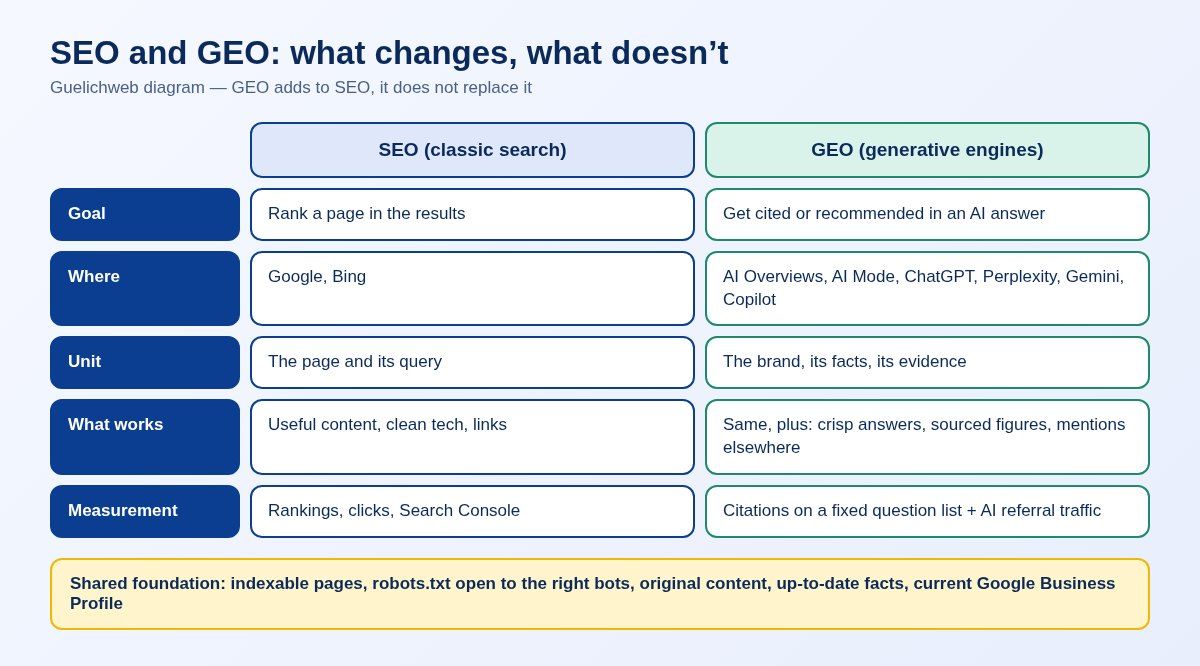
Guelichweb diagram — SEO and GEO, what changes and what stays.
Our position, after following the topic closely: 80% of GEO work is good SEO. A page Google does not index will not be cited in an AI Overview. A slow, confusing site with no author and no dates will not get better treatment from ChatGPT. If the basics are not in place (see our guides What is SEO? and How to appear on Google), starting with GEO is like painting a house that has no roof. It is often the real reason a website brings in no customers, AI or no AI.
The remaining 20% is real, and it matters:
- The unit is no longer the page, it is the entity. AI pieces together what it knows about you from several sources: your site, your Google Business Profile, press articles, directories, reviews. If those sources disagree, it hesitates or gets it wrong.
- Answers vary. Ask the same question twice and you may get two different lists. So you don't measure a "ranking", you measure how often you are cited.
- "Quotable" formats gain value. A crisp two-sentence definition, a dated figure with its source, a clear list of steps: that is what AI picks up easily.
- Mentions outside your site weigh more. Being cited by a local newspaper, a partner, a donor or a professional directory helps an AI treat you as a source that actually exists.
What Google officially says about GEO
On 13 July 2026 Google updated a whole guide on optimising for its generative AI features: Google's Guide to Optimizing for Generative AI Features on Google Search. The message is unambiguous: from Google's point of view, optimising for generative AI search is SEO. AI Overviews and AI Mode rely on the search index and the same ranking systems, with two techniques Google names: retrieval-augmented generation (the AI fetches fresh pages from the index before answering) and "query fan-out" (the AI runs several related searches in parallel to cover the topic).
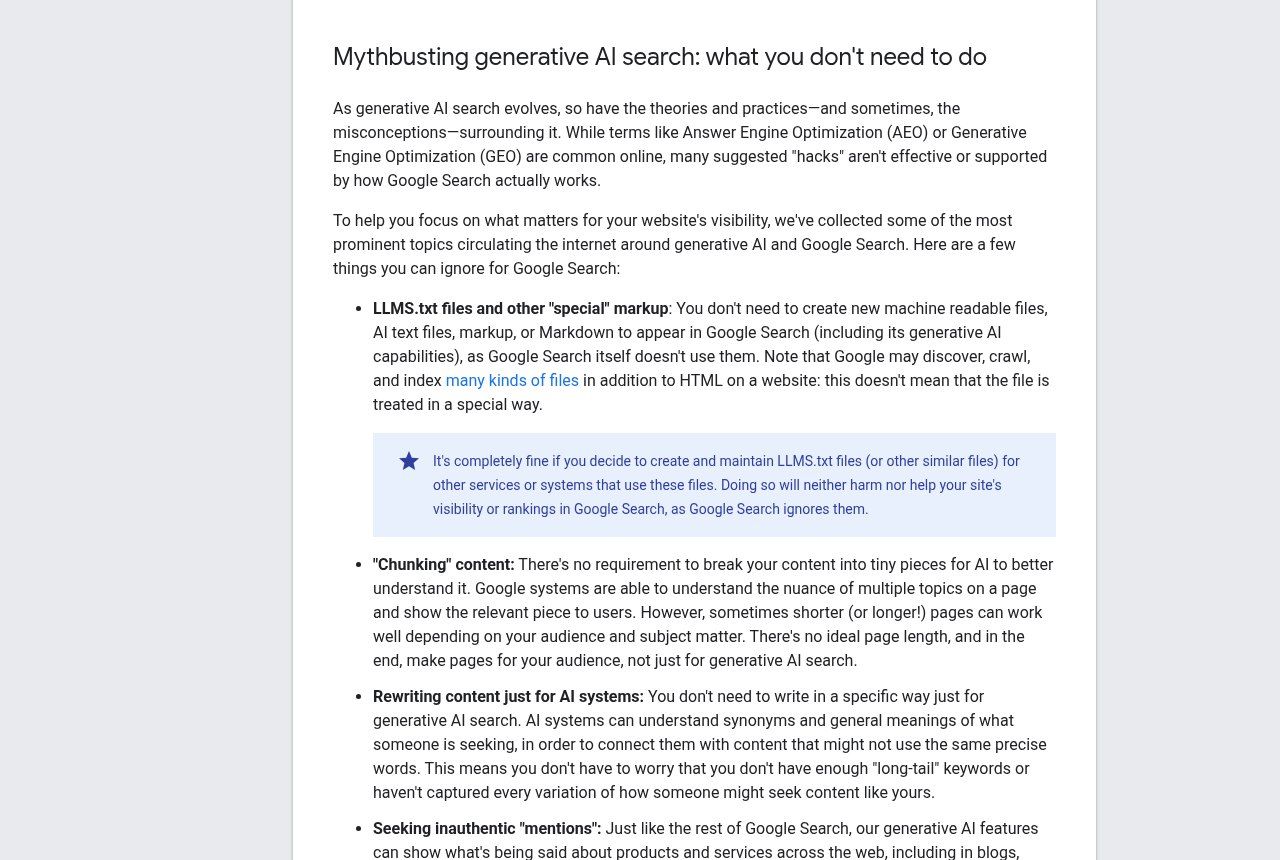
Source: developers.google.com, "Google's Guide to Optimizing for Generative AI Features on Google Search", mythbusting section (screenshot taken 26/11/2026).
The most useful part is the list of things Google tells you to ignore for its search:
- llms.txt files and other "special" AI markup, which Google Search does not use;
- "chunking" your content into small pieces supposedly easier for AI to digest;
- rewriting your copy just for machines, or chasing every long-tail keyword variant;
- seeking inauthentic mentions (fake reviews, paid articles, manufactured forum comments);
- obsessing over structured data: useful for rich results, but no special schema.org markup is required for AI.
Google adds a warning we fully share: be wary of tools and consultants who claim access to "internal" metrics. Nobody has that access. A provider who guarantees "you'll be recommended by ChatGPT within 30 days" is selling thin air.
Its page on AI features and your website states the minimum technical condition: to appear as a supporting link in AI Overviews or AI Mode, a page must be indexed and eligible to be shown in Search with a snippet. Nothing more, nothing less.
The new "Search generative AI" setting in Search Console
Since 31 August 2026, every website worldwide has a Settings > Search generative AI control in Search Console. Three options: include your site in AI Overviews, AI Mode and Discover's generative AI features (the default), exclude it, or inherit the setting from a parent property (official help). Excluding your site removes it from those answers, has no effect on classic rankings, and does not block model training (that is Google-Extended's job, more on that below).
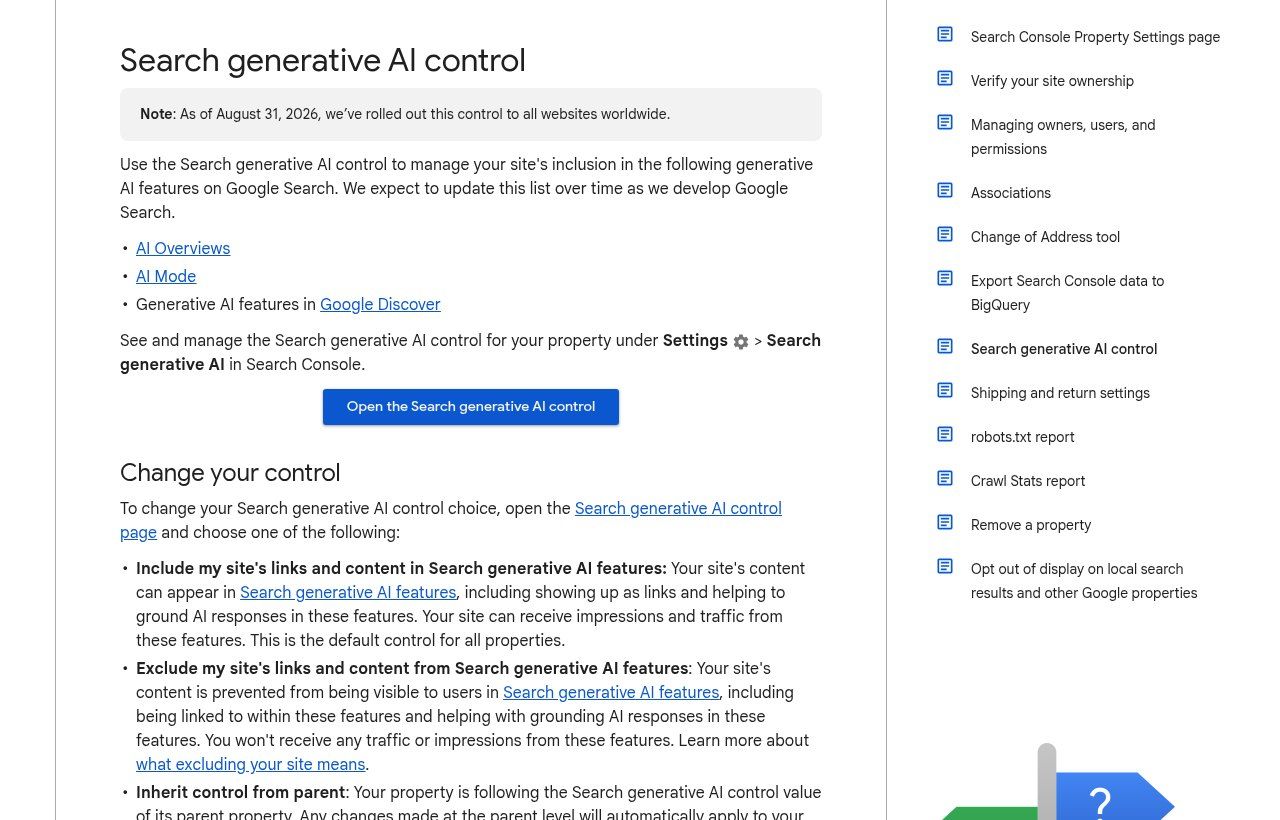
Source: support.google.com, Search Console help "Search generative AI control" (screenshot taken 26/11/2026).
The same day brought the generative AI performance report: it shows your pages' impressions in AI Overviews and AI Mode by page, country, device and date. It is, so far, the only official measure of your presence in Google's AI answers. If you don't use Search Console yet, our guide Google Search Console: what it is and how to use it walks you through it.
Why GEO already matters in Benin and French-speaking Africa
We often hear: "That's a topic for big European brands." Wrong. Google's help page on AI Overviews availability lists Benin, Côte d'Ivoire, Senegal, Cameroon and Togo among the covered countries, and French among the languages. France itself only got them on 22 July 2026. In other words, some of your prospects in Cotonou already see AI answers at the top of Google.
There is also an argument we find very encouraging for local organisations: the French-speaking African web is thinly documented. On many precise questions (local procedures, providers in a given city, an NGO's programmes, an institution's offer), AI tools lack reliable sources. They fill the gap with generalities, unrelated French pages or outdated information. A clear, dated, sourced and up-to-date page therefore has a real chance of being picked up. In Paris you have to beat a thousand competitors; in Parakou, sometimes three.
Finally, the way people search is changing. Many users now ask ChatGPT or Gemini their questions on their phone, the way they would text a friend on WhatsApp. If your website leaves no usable trace, the AI will recommend someone else, even if you are the best.
How an AI chooses the sources it cites
Without pretending to know the internal mechanics (nobody fully does), here is what we know reliably. If the way a classic search engine works is still fuzzy, read What is a search engine? first; everything below follows from it.
- It rewrites the question into several searches. "Web agency Cotonou" also becomes "website design Benin price", "digital agency Abomey-Calavi reviews", and so on.
- It queries an index. Google uses its own. Copilot relies on Bing. ChatGPT and Perplexity use their own search crawlers (OAI-SearchBot, PerplexityBot) alongside other sources. If your site blocks those crawlers, it is out of the game for those tools.
- It reads the selected pages and extracts passages. A clear, self-contained passage that answers directly is more likely to be reused than a paragraph that beats around the bush.
- It cross-checks. Information found on several consistent sources (your site, your Google profile, a press article) inspires more confidence than an isolated claim.
- It cites, sometimes. Perplexity and AI Mode almost always show their sources. ChatGPT does when web search is used. An answer drawn purely from the model's memory cites nobody.
That last point matters. There are two ways to show up: in the model's memory (what it learned during training, which you can barely influence in the short term) and in real-time search (where your site can be read today). Serious GEO works mostly on the second.
Step 1: let the right bots in (without handing your content to training if you don't want to)
This is the most neglected step, and the quickest to fix. Every AI company now separates its crawlers by role, so you can allow search while refusing training.
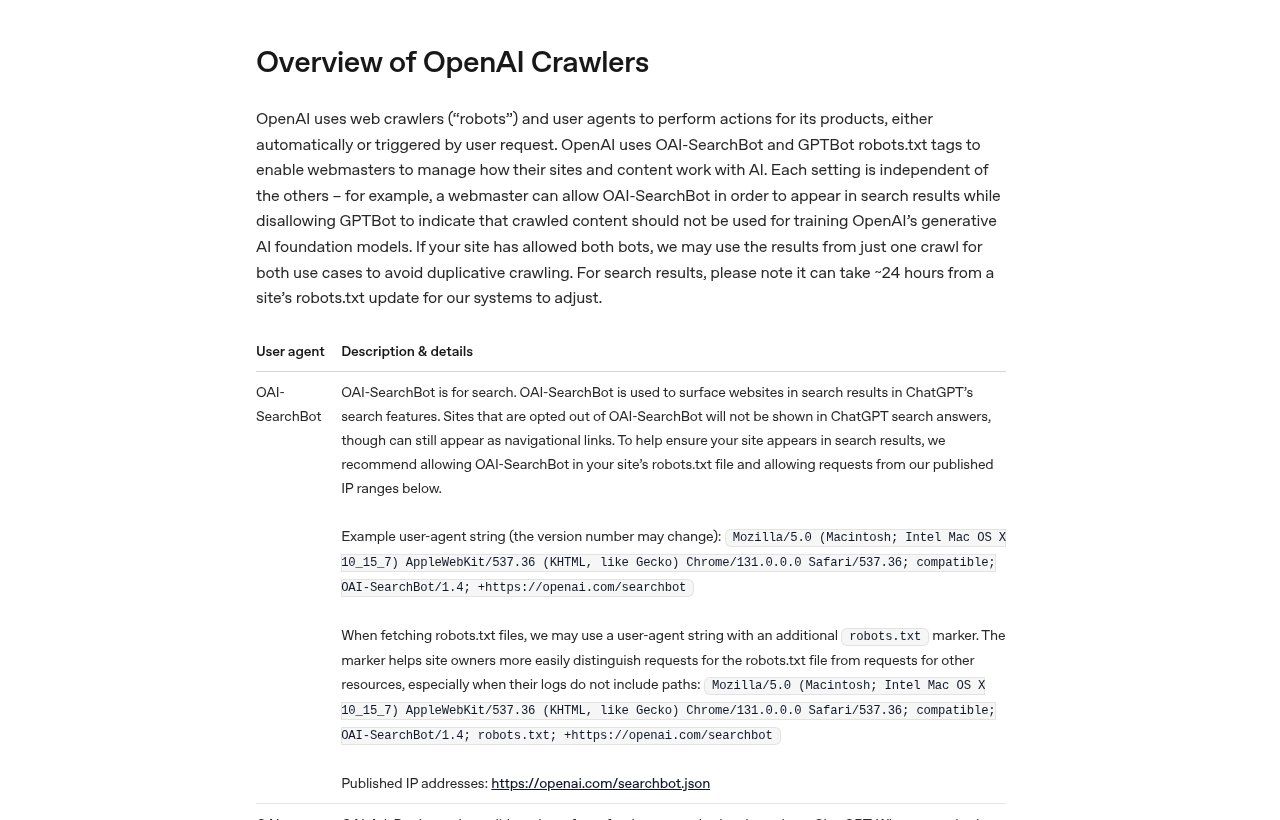
Source: developers.openai.com, "Overview of OpenAI Crawlers" (screenshot taken 26/11/2026).
- OpenAI (documentation): OAI-SearchBot surfaces websites in ChatGPT's search features; GPTBot collects for training; ChatGPT-User visits a page when a user asks. Blocking OAI-SearchBot means disappearing from ChatGPT's search answers. OpenAI mentions roughly 24 hours for a robots.txt change to take effect.
- Anthropic / Claude (official help): Claude-SearchBot for search, Claude-User for user-requested visits, ClaudeBot for training.
- Perplexity (documentation): PerplexityBot to surface sites in its results, Perplexity-User for user-requested visits.
- Google (list of crawlers): Googlebot handles Search, AI Overviews included. The Google-Extended token lets you limit the use of your content for training and grounding in some other Google systems (Gemini in particular), without affecting your Search rankings.
A sensible set-up for an SME or NGO that wants to be cited without becoming raw material for training looks like this in robots.txt (adapt it, and have it reviewed if your site has private areas):
- User-agent: OAI-SearchBot / Claude-SearchBot / PerplexityBot → Allow: /
- User-agent: GPTBot / ClaudeBot / Google-Extended → Disallow: / (if you refuse training; otherwise leave it open)
- User-agent: * → your usual rules (Disallow: /admin/, etc.) and the Sitemap line.
Two traps we see often. First, the firewall: some hosts, CDNs and security plugins block "AI bots" with one click, sometimes by default. Your robots.txt says yes, your firewall says no, and you never find out. Second, the all-JavaScript website whose text only appears once the browser runs the code: Googlebot usually copes, many other bots much less so. Check that a simple "view page source" actually shows your text.
Step 2: write pages an AI wants to quote
Here Google and common sense agree: write for humans, with a real point of view. Google's guide insists on "non-commodity" content: an expert opinion, field experience, data nobody else has. An article that rephrases what is already everywhere has no reason to be cited, because the AI can produce it on its own.
In practice, for every important page:
- Answer first, expand later. The first sentence under a heading should stand on its own. "Our average turnaround for a showcase website is X weeks" beats three lines of preamble.
- Date and source your figures. "According to the national statistics institute, in 2025…" or "checked on 26/11/2026 on the official website": an AI (and a reader) trusts a number that has an origin.
- Show who is speaking. An author or organisation name, a factual About page (year founded, city, fields, verifiable references), full contact details.
- Be precise about your area and audience. "Project management training for NGOs in the Atacora region" gets picked up for a precise question; "quality training" never will.
- Add an FAQ built on your customers' real questions, the ones you get on the phone and on WhatsApp, not ones invented for a tool.
- Keep it current. A 2022 price page, a team that has changed, an old address: the AI will repeat the mistake with total confidence.
Google's suggestions are a goldmine for finding those questions (our method: What are SEO keywords and how to find them for free). And if you don't yet have a place to publish, our guide How to create a business blog explains how to keep it going without burning out.
Our house rule: if a paragraph could sit unchanged on a competitor's website, neither Google nor ChatGPT will cite it. Rewrite it with what only you know.
Step 3: make your "entity" clear and consistent everywhere
An AI does not know you the way a loyal customer does. It rebuilds your identity from fragments. The more those fragments agree, the more willing it is to cite you.
- Same name, same address, same phone number on your site, your Google profile, Facebook, LinkedIn and directories. "Koffi & Sons Ltd", "Koffi and sons" and "KS Services" for the same business are three entities to a machine.
- An up-to-date Google Business Profile, with exact categories, opening hours, photos and services. Google names it explicitly in its guide. Not done yet? Create your Google Business Profile.
- Genuine reviews, with replies. They feed local answers. Our method, no fake reviews: How to get Google reviews.
- One page per service or programme, rather than one catch-all page. For AI as for Google, one page = one clear topic. Local SEO works on the same logic.
Step 4: exist somewhere other than your own website
This is the part agencies skip, because it can't be fixed in a dashboard. Yet when an AI answers "the recognised players in [sector] in Benin are…", it leans heavily on what others say about you.
- articles in the local or specialist press (an interview, an op-ed, a press release that gets picked up);
- pages of partners, donors, professional networks and chambers of commerce that list your projects or membership;
- serious sector directories and public platforms (tenders, registries) where your listing is complete;
- talks at events, with a recap page online;
- useful content published on LinkedIn or YouTube under your name, linking back to your site.
One firm limit: anything manufactured (fake reviews, disguised paid articles, mass-produced forum comments) is off the table. Google says so, and above all it doesn't work over time. One sincere mention in a recognised outlet is worth more than fifty dubious links.
llms.txt: useful or gimmick?
The llms.txt file is a proposal launched in September 2024 by Jeremy Howard (Answer.AI) and updated in August 2026: a small Markdown file at the root of a website that summarises what the organisation does and points to its key pages, to make life easier for AI agents.
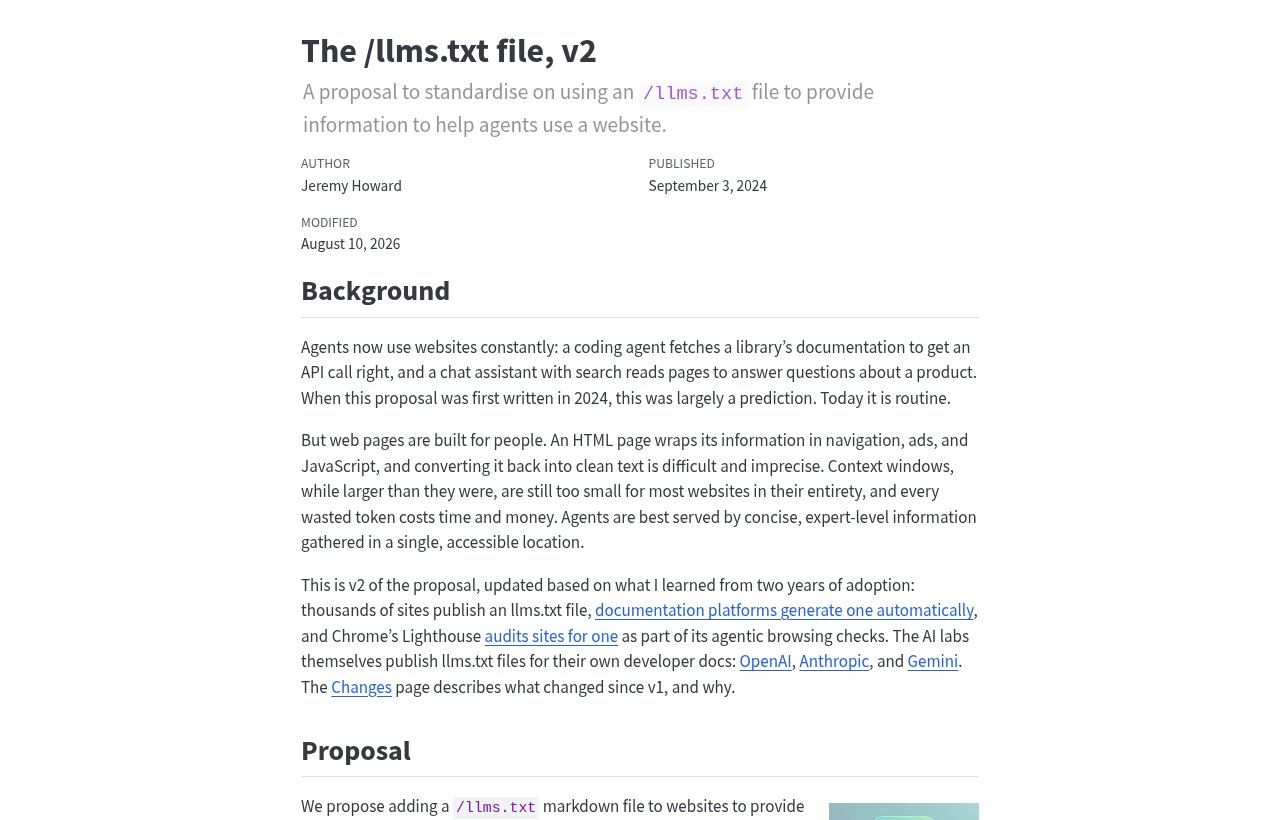
Source: llmstxt.org, "The /llms.txt file, v2" (screenshot taken 26/11/2026).
Our view is simple. For Google Search it is useless: Google says so in black and white. For coding agents and technical documentation it is handy, and WordPress plugins such as Yoast SEO or AIOSEO generate it automatically. For an SME or NGO it is twenty minutes of risk-free work, but it is not a priority: if someone bills you for a "GEO pack" whose main deliverable is an llms.txt file, find someone else.
Structured data: do it, but not for the wrong reasons
Schema.org markup (Organization, LocalBusiness, FAQPage, Article, Event…) helps search engines understand who you are and makes you eligible for some rich results. We recommend it on every professional website. But Google is clear: no special markup is needed for AI, and it must always match the visible text. Structured data announcing reviews or prices that aren't on the page is a risk, not an advantage.
Measuring your presence in AI answers
You can't steer what you don't measure. Here is the minimum dashboard we set up:
- Search Console: the "Performance > Generative AI" report for impressions in AI Overviews and AI Mode, and the classic performance report for clicks (they are included in the "Web" search type).
- Google Analytics 4: a segment or exploration filtering traffic sources chatgpt.com, perplexity.ai, gemini.google.com, copilot.microsoft.com and claude.ai. Volumes are often modest, but these visitors arrive with a precise question. Not installed yet? What is Google Analytics 4.
- A fixed list of 15 to 30 questions your customers would ask, tested once a month on ChatGPT, Gemini, Perplexity and Google (AI Mode), always the same way. Record: cited or not, linked or not, accurate or not, which competitors appear. It's hand-made, and it gives the most honest picture.
- Bing Webmaster Tools (bing.com/webmasters): free, it checks that Bing indexes your site properly, which matters for Copilot.
Worth knowing: that monthly test routine automates nicely with n8n (send the questions through APIs, store the answers in Google Sheets, get an alert if your name disappears). As for paid "AI visibility tracking" tools, they can help, as long as you remember they sample answers that change from one try to the next.
GEO by organisation type
SMEs, shops, local service providers
Local comes first: a flawless Google profile, reviews, one page per service with the city, indicative prices or at least a clear explanation of how you quote, and accurate opening hours. "Where to buy… in Cotonou" questions are exactly where AI lacks reliable sources the most.
NGOs and associations
Your assets are unique: field data, reports, impact figures. Publish them as HTML (not only as scanned PDFs), with dates, areas of intervention and methodology. One page per programme, naming its donors and partners, helps an AI associate you with a theme enormously.
Public institutions, schools, training centres
Citizens and students ask procedural questions: documents required, deadlines, fees, admission criteria. One up-to-date page per procedure, with the last-updated date visible, stops the AI from answering with a 2019 circular. It is also a matter of public service.
B2B firms and consultancies
Buyers compare. Verifiable case studies, "how we work" pages and honest comparisons (including when you are not the right fit) are among the content AI reuses in its "which provider should I choose for…" answers.
The 7 GEO mistakes we see most
- Blocking every AI bot by reflex, search bots included, then complaining you are never cited.
- Buying a "GEO audit" that doesn't look at Google indexing. No indexing, no AI Overview.
- Churning out dozens of generic AI-generated articles. Google treats that as scaled content abuse, and no AI needs to cite what it could write itself.
- Putting key information in a scanned PDF, an image or a carousel. Machines read poorly what isn't text.
- Leaving contradictory information around: old address on Facebook, old number in a directory, old name on the Google profile.
- Chasing fake mentions: bought reviews, undisclosed sponsored articles.
- Measuring once. Answers change; a single screenshot proves nothing either way.
A 30-day GEO action plan
- Week 1 — Foundations. Check indexing in Search Console, check the "Search generative AI" setting, review robots.txt and firewall rules, set up Bing Webmaster Tools. Run the 20-question test to get a baseline.
- Week 2 — Your entity. Align name, address and phone everywhere; update the Google profile; rewrite the About page with verifiable facts.
- Week 3 — Content. Rework your 5 most important pages: answer up front, dated and sourced figures, a real FAQ, a last-updated date. Fix loading speed if it hurts mobile.
- Week 4 — Outside and measurement. List 10 websites that should mention you (partners, press, directories) and contact the three most credible; create the "AI traffic" segment in GA4; schedule the monthly test.
Nothing spectacular. But it is exactly what makes the difference six months from now, when your competitors have bought an llms.txt file and are still waiting.
What Guelichweb can do for you
We support SMEs, NGOs and institutions with websites, search optimisation and automation (our services). On GEO, our approach always starts with a diagnosis: indexing, bots and firewall, consistency of your online presence, quality of key pages, and a real test of your business questions on the main AI tools. Only then do we decide together what is worth doing. If your website needs deep rework we say so plainly (and we make sure you don't lose your rankings along the way).
As for budget, we don't publish a standard GEO package: it depends on the state of your site and the number of pages to rework. You'll find our plans on the offers page, and a precise quote after diagnosis.
GEO FAQ
GEO and SEO: does one replace the other?
No. GEO extends SEO. Google says so itself: for AI Overviews and AI Mode, optimising for AI is SEO. Other AI tools also rely on search indexes. Without solid SEO foundations, GEO has nothing to stand on.
How long does it take to be cited by ChatGPT or Gemini?
Nobody can guarantee it. For real-time search, OpenAI says a robots.txt change takes about 24 hours to be picked up, and a well-indexed page can appear quickly. For the models' memory, you have to wait for future training runs, which you don't control.
Should I create an llms.txt file?
It isn't required. Google ignores it for Search. It can help some AI agents, mostly for technical documentation. Do it if your CMS makes it easy; never pay for it as a miracle service.
Does blocking GPTBot remove me from ChatGPT?
No. GPTBot is about training. OAI-SearchBot is what lets you appear in ChatGPT search. You can block the first and allow the second: OpenAI states that each setting is independent.
Are AI Overviews shown in Benin?
Yes. As of 26 November 2026, Google's help page lists Benin, Côte d'Ivoire, Senegal, Cameroon and Togo among the countries where AI Overviews are available, including in French. They only appear when Google judges they add something to the query.
Are GEO tracking tools reliable?
They show a trend, not the truth. AI answers vary from one query to the next and from one user to another. No third-party tool has access to Google's or OpenAI's internal systems. Combine them with Search Console, GA4 and your own question list.
Can a small organisation really get cited?
Yes, and that is where GEO is most interesting in French-speaking Africa: on local, precise questions, competition from reliable content is thin. A clear, current page that matches your Google profile stands a good chance.
Want to know what AI tools say about you?
Send us three questions a customer would ask to find you. We'll look at how your website, your profile and your online presence perform, and tell you honestly where to start. Write to us through the contact page.